How to Write a Cheque Correctly: Field-by-Field Guide and RBI’s No-Correction Rule Under CTS
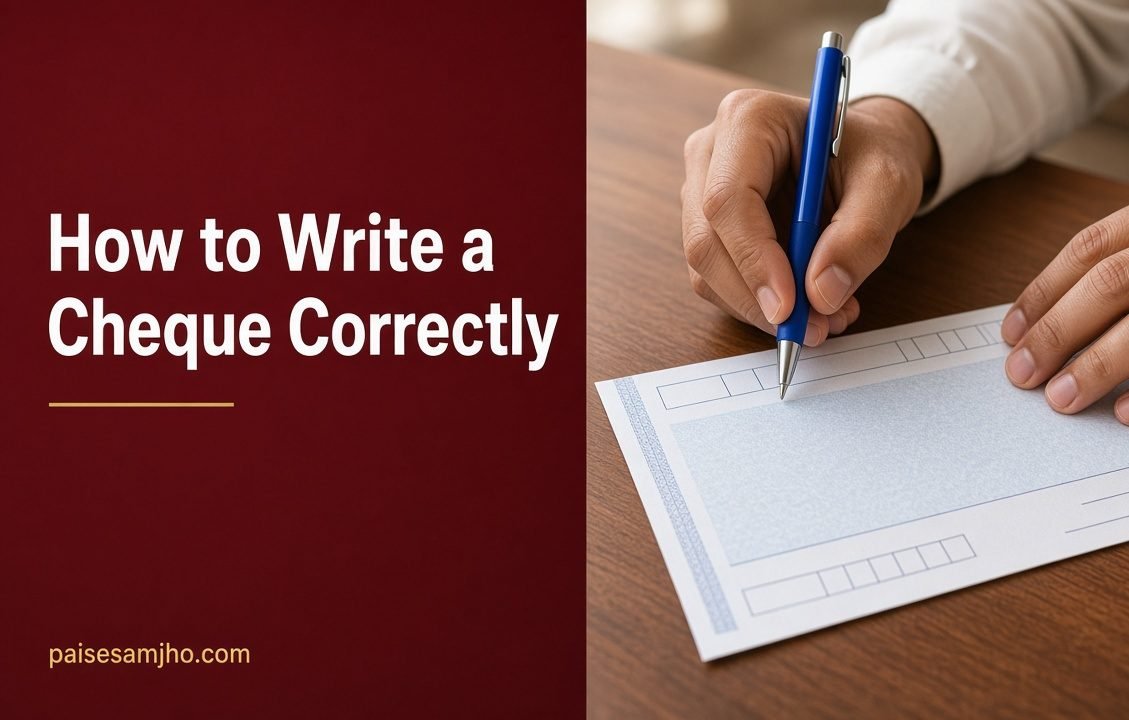
Date, name, amount in words, amount in figures, signature. Five fields, and a mistake in any one of them can send a cheque back unpaid. If you only occasionally write a cheque for rent, school fees or a deposit, it is easy to forget the rules that matter under the Cheque Truncation System (CTS), which clears cheques as images. This guide walks through each field and the one rule many people miss: on a CTS cheque, you cannot correct a mistake.
How to write a cheque: field by field
| Field | What to write | Common mistake |
|---|---|---|
| Date (top right) | Today’s date in the boxes, DD MM YYYY | Leaving it blank, or a date more than three months old when deposited |
| Pay (payee line) | Full name of the person or company, as on their bank account | Nicknames, short forms, or writing “Self” by mistake |
| Rupees (amount in words) | Amount in words followed by “only” | Leaving space before or after the words |
| ₹ box (amount in figures) | Amount in figures, starting close to the ₹ sign, ending with “/-“ | Figures and words not matching |
| Signature | Your signature as in the bank’s records | A signature that differs from the specimen |
Draw a line through unused space after the payee name and after the amount in words, so nothing can be added later. Write clearly; CTS clears cheques from scanned images, so smudged or faint writing can lead to rejection.
The no-correction rule under CTS
RBI’s CTS-2010 standard says: “No changes / corrections should be carried out on the cheques (other than for date validation purposes, if required). For any change in the payee’s name, courtesy amount (amount in figures) or legal amount (amount in words), etc., fresh cheque forms should be used by customers.”
RBI’s June 2010 circular clarified that the rule applies to cheques cleared through image-based CTS, and that collecting banks should not accept altered cheques for presentment in CTS. It was introduced “to curtail cheque frauds on account of alterations.” With CTS now the main clearing system, the practical advice is simple: if you make a mistake in the name or amount, cancel that leaf and use a new one. Do not overwrite, cut and initial, or use correction fluid.
The one exception is the date, which may be changed for date validation if needed. Even then, many banks prefer a fresh cheque, and you will usually need to sign next to the change.
Ink and handwriting
RBI’s FAQs on CTS say customers should use “image friendly coloured ink” and “permanent ink to prevent fraudulent alteration.” RBI has not prescribed a specific colour. Blue or black ballpoint ink works well. Avoid gel pens that smudge, and never use erasable ink. Before you write a cheque for a large amount, check that the leaf is clean, unfolded and not torn near the code line at the bottom, which the clearing system reads.
Account payee and bearer cheques
- Account payee crossing. Two parallel lines across the top-left corner with “A/C Payee” written between them mean the cheque can only be credited to the payee’s account, not encashed over the counter. Use this for almost all payments.
- Bearer cheques. If “or bearer” is not struck off, anyone holding the cheque can encash it at the branch. Strike it off unless you specifically want a bearer cheque.
- Self cheques. Write “Self” in the payee line only when you withdraw cash yourself at your own branch.
How long is a cheque valid?
A cheque is valid for three months from the date written on it. After that, banks do not pay it and it is returned as “stale”. A cheque dated 21 October 2026, for example, should be deposited before about 20 January 2027. Post-dated cheques can be written for a future date and are honoured only on or after that date.
Our guide to cheque clearing time explains how quickly money reaches the payee once the cheque is deposited.
Big cheques: use Positive Pay
For cheques of ₹50,000 and above, banks offer Positive Pay: you share key details (date, payee, amount, cheque number) with your bank through the app, net banking or branch before the cheque is presented. The bank checks the presented cheque against your details. Some banks make it mandatory above ₹5 lakh. Our Positive Pay guide explains how to register.
What makes a cheque bounce
When you write a cheque, the main reasons it can come back unpaid are:
- insufficient balance in your account;
- signature mismatch;
- amount in words and figures not matching;
- alterations on a CTS cheque;
- a stale date (more than three months old);
- account closed, frozen or with a stop-payment instruction.
A cheque returned for insufficient funds can lead to bank charges and, in some cases, a criminal complaint under Section 138 of the Negotiable Instruments Act. Our cheque bounce rules guide explains the process and penalties. If you need to cancel a cheque you have already issued, see our stop payment guide.
Safety habits
- Never sign a blank cheque.
- Keep your chequebook locked away and note the number of every cheque you issue.
- When giving a cancelled cheque for KYC or a mandate, write “Cancelled” across it with two lines and do not sign it.
- Check your statement to confirm each cheque was paid to the right person for the right amount.
- If a chequebook is lost, tell your bank immediately and stop payment on unused leaves.
When not to use a cheque
For most payments, UPI, NEFT and IMPS are faster and leave a digital record. Cheques still make sense for rent with post-dated instalments, security deposits, some government fees, or when the payee asks for one. Whenever you write a cheque, treat it like cash.
FAQs
Can I correct a mistake on a cheque?
Not on CTS cheques, except the date. For any change in payee or amount, RBI says use a fresh cheque.
Which ink should I use to write a cheque?
RBI has not prescribed a colour. Use permanent, image-friendly ink such as blue or black ballpoint.
How long is a cheque valid?
Three months from the date on the cheque.
Do I need to write “only” after the amount?
It is not mandatory, but it prevents anyone adding words after the amount.
Takeaway: To write a cheque correctly, fill each field clearly in permanent ink, cross it “A/C Payee”, and draw lines through blank space. Under CTS rules you cannot correct the payee or amount, so use a fresh leaf if you make a mistake.
RBI references
- RBI: Standardisation and Enhancement of Security Features in Cheque Forms (22 Jun 2010)
- RBI: FAQs on Cheque Truncation System
Partly verified, 21 Oct 2026, 8:48 PM IST. The no-alteration rule and ink guidance are from RBI’s 22 Jun 2010 circular and RBI’s CTS FAQs. The three-month validity and Positive Pay thresholds are from long-standing RBI rules summarised in our earlier posts, not re-read today.