Stop Payment of a Cheque: Charges, How to Request It, and Why Section 138 Can Still Apply
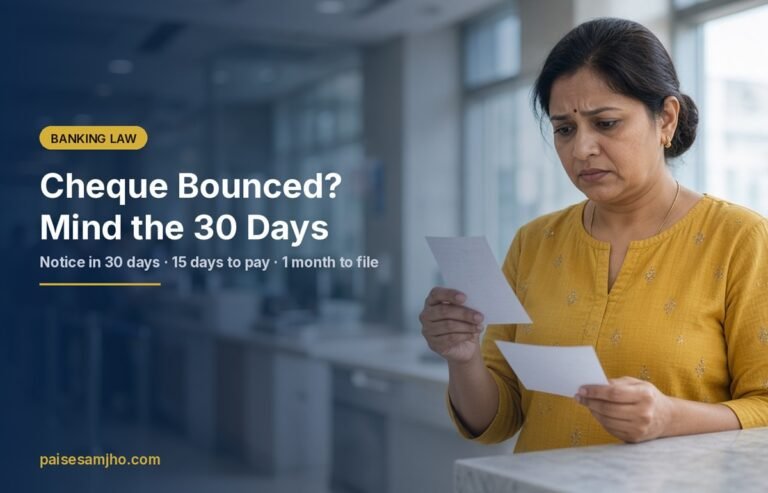
Myth: once you ask the bank for a stop payment of a cheque, you are legally safe. Fact: the bank will refuse to pay the cheque, but the person holding it may still be able to file a cheque bounce case against you. The Supreme Court has held more than once that a cheque returned because the drawer stopped payment can attract Section 138 of the Negotiable Instruments Act. Here is when a stop payment makes sense, what it costs, and how to do it.
Stop payment of a cheque: what it is
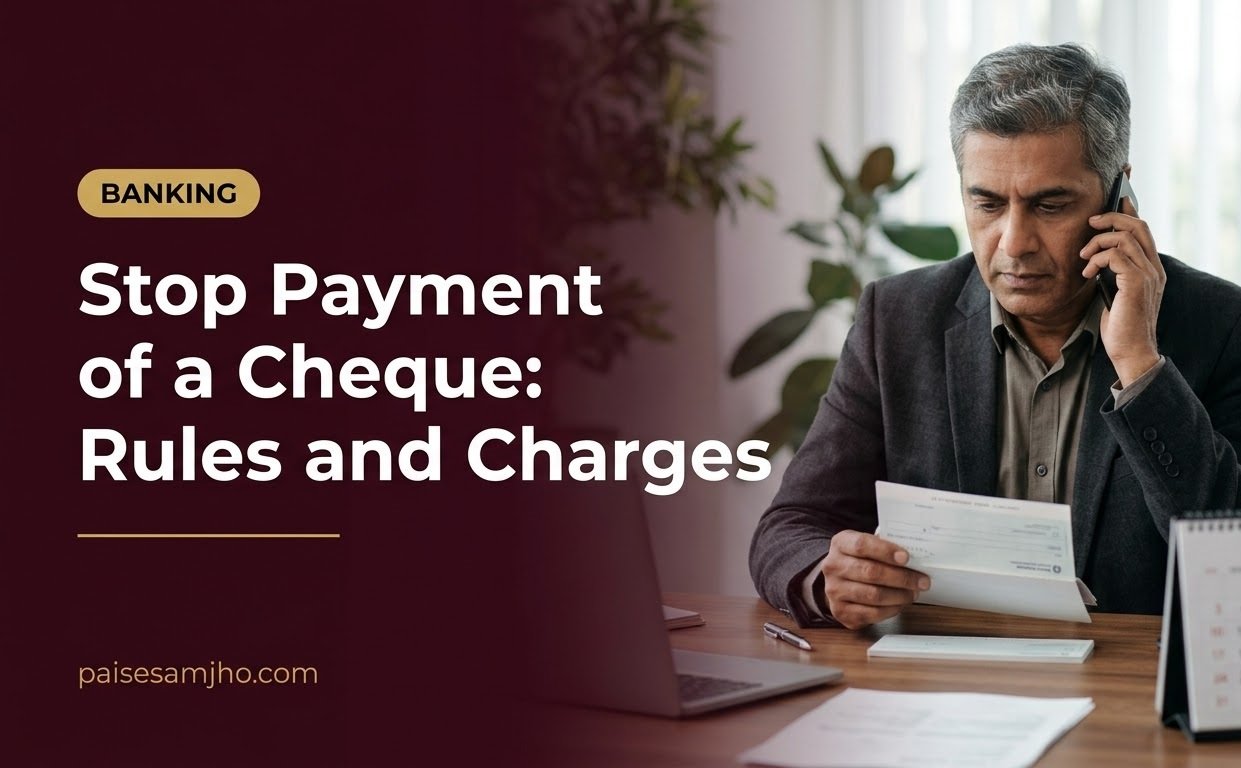
A stop payment instruction tells your bank not to pay a specific cheque you have issued. If the cheque is presented after the instruction is recorded, the bank returns it unpaid with a reason such as “payment stopped by drawer”. It works only if the cheque has not already been paid.
Common reasons people use it:
- A cheque or cheque book is lost or stolen.
- A cheque was filled in with the wrong amount, date or name.
- You suspect fraud, for example a cheque handed to someone who turned out to be a fake agent.
- A deal fell through before the cheque was presented.
The stop payment charge
Banks charge for recording the instruction. SBI’s schedule is an example.
| Number of cheques stopped in one request | SBI charge | With 18% GST |
|---|---|---|
| 1 | ₹100 + GST | ₹118 |
| 3 | ₹300 + GST | ₹354 |
| 5 | ₹500 + GST | ₹590 |
| 8 (for example, a lost cheque book’s remaining leaves) | ₹500 + GST (capped) | ₹590 |
Source: SBI service charges document, updated as on 30.09.2025: ₹100 plus GST per instrument, maximum ₹500 plus GST per instance, for savings, current and cash credit accounts. GST amounts are our calculations. The stop payment charge differs from bank to bank, and some banks may waive it for lost cheque books; check your bank’s schedule.
The cap matters if you lose a whole cheque book and need a stop payment of a cheque series. Stopping all the unused leaves in one request costs no more than ₹590 at SBI, however many leaves there are.
How to request a stop payment of a cheque
- Collect the details: cheque number (or range), date, amount and payee name. For a lost cheque book, the serial numbers of the unused leaves.
- Use the fastest channel. Most banks offer stop payment through net banking or the mobile app, often under “cheque services”. You can also call customer care or visit the branch with a signed letter.
- Act quickly. Under the CTS clearing system, a cheque can be presented and paid within a day or two; see our post on cheque clearing time. An instruction recorded after payment is too late.
- Keep the confirmation. Save the reference number or acknowledgement.
- For theft or fraud, also file a police complaint and keep a copy.
If you later want the cheque honoured after all, ask the bank in writing to revoke the instruction.
Section 138: why stopping payment is not a legal shield
Section 138 of the Negotiable Instruments Act makes the dishonour of a cheque, issued to pay a debt or liability, an offence, subject to conditions such as a legal notice and a payment window. For years, drawers argued that a cheque returned for “payment stopped” was not covered, because the section speaks of insufficient funds.
The Supreme Court rejected that argument. In Laxmi Dyechem v. State of Gujarat (27 November 2012), it recalled its 1998 ruling in Modi Cements v. Kuchil Kumar Nandi, which held that otherwise a drawer could “easily get rid of the penal consequences” by stopping payment right after issuing a cheque. It also cited MMTC v. Medchl Chemicals (2002), which said the legal presumption that the cheque was issued for a debt applies even when payment is stopped. The 2012 judgment described “payment stopped” and “account closed” as “only species” of the genus of insufficient funds.
| Situation | Section 138 risk |
|---|---|
| You owe the money and stop payment to delay paying | High: the presumption works against you |
| Cheque lost or stolen, with no debt to the person presenting it | You can contest; keep your police complaint and stop payment record |
| Deal cancelled, no legally enforceable debt | You can try to rebut the presumption at trial with evidence |
Our general summary of court rulings, not legal advice. Whether a case succeeds depends on facts and evidence. If you receive a legal notice after stopping a cheque, speak to a lawyer promptly; the payment window after a notice is short. The notice and timeline rules are in our cheque bounce rules guide.
Stop payment vs Positive Pay
These are different tools. Positive Pay lets you confirm the key details of a high-value cheque to your bank before it is presented, so a tampered cheque gets flagged. Stop payment blocks a cheque altogether. For large cheques, Positive Pay is a good habit; see our Positive Pay explainer.
Alternatives worth considering
- Talk to the payee first. If you want to cancel a payment by agreement, ask them to return the cheque, and keep it, or get it in writing.
- Use digital payments for one-off deals. A UPI or NEFT transfer after delivery avoids handing over cheques in advance.
- When the other side wants assured payment, a demand draft is issued by the bank itself, so the rules for cancelling or replacing it are different; our demand draft guide covers cancellation.
Whatever route you choose, keep a record. A stop payment of a cheque, a returned cheque, or a cancelled draft can all become evidence later, so file the acknowledgements with your bank papers.
FAQs
How much does a stop payment cost?
At SBI, ₹100 plus GST per cheque, capped at ₹500 plus GST per request. Other banks set their own charges.
Can I request a stop payment of a cheque online?
Most banks allow it through net banking or the app. You can also call customer care or write to the branch.
Can I face a cheque bounce case after stopping payment?
Yes. The Supreme Court has held that a stopped cheque can attract Section 138. You can defend yourself by showing there was no legally enforceable debt.
What if the cheque was already paid?
The instruction won’t work. If the payment was fraudulent, report it to your bank and the police at once.
Takeaway: A stop payment of a cheque blocks the bank from paying it, at a small charge (₹118 to ₹590 at SBI), but it does not cancel a debt. Use it for lost, stolen or wrongly written cheques, and get legal advice if the payee sends a notice.
Rules we used
- SBI: service charges (updated as on 30.09.2025)
- Supreme Court: M/s Laxmi Dyechem v. State of Gujarat, 27 Nov 2012 (PDF)
Partly verified, 16 Oct 2026, 9:26 PM IST. Stop payment charges are from SBI’s service charges document updated as on 30.09.2025. Court rulings are from the Supreme Court judgment in Laxmi Dyechem (27 Nov 2012), read in full; the Modi Cements and MMTC rulings are as quoted in it. General information, not legal advice; other banks’ charges were not checked.