Wrong Account Transfer: Why NEFT Credits the Number, Not the Name, and How to Start a Recall
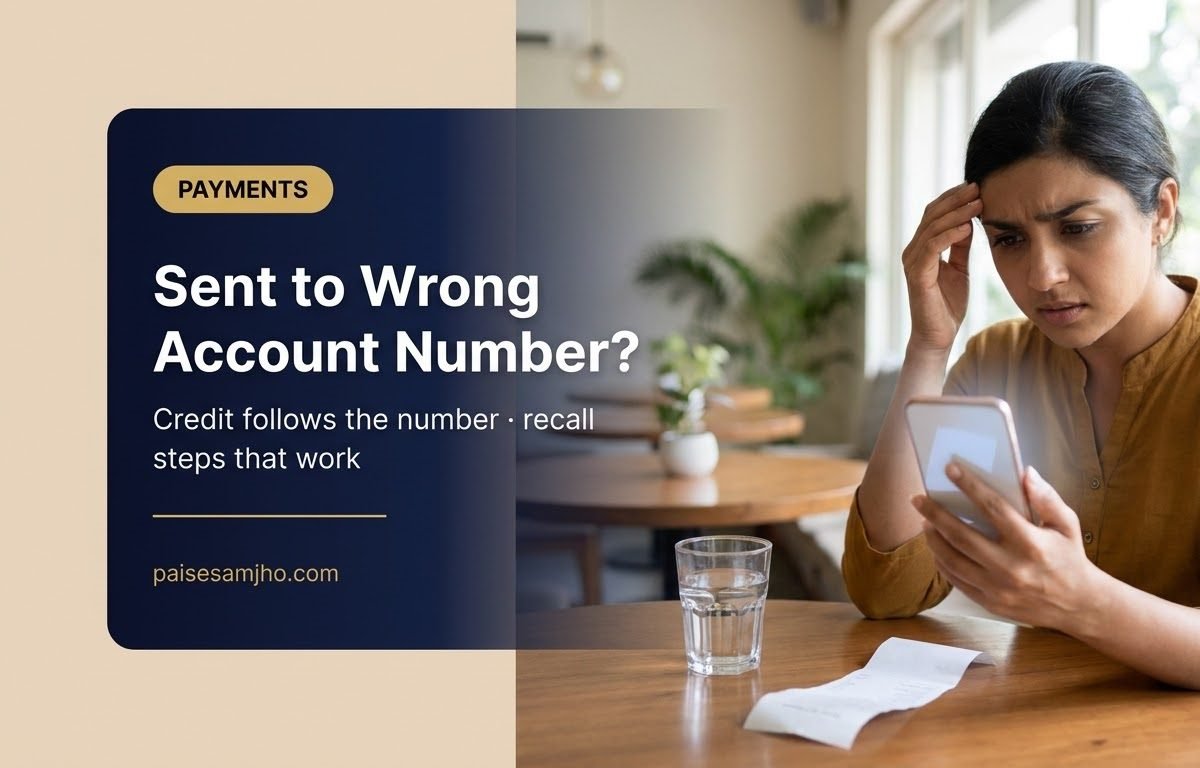
A wrong account transfer starts with a typo. RBI’s 2010 circular on electronic payments is blunt: “Being essentially credit-push in nature, responsibility for accurate input and successful credit lies with the remitting customers and the originating banks.” Destination banks credit “based solely on the beneficiary account number information.” If you type a wrong but valid account number, the money can land in a stranger’s account even when the name field looks right.
That rule still governs NEFT, RTGS and similar credit-push transfers. UPI adds its own handle and number checks, but a wrong UPI ID that belongs to someone else works the same way once the payment succeeds. This guide covers what to do next, what banks can and cannot reverse, and how to lower the chance of the mistake.
Why does the name on the screen not stop a wrong account transfer?
Indian names are written in many ways. Matching every NEFT credit to the exact name on the bank’s books would slow the system, so RBI told banks in September 2010 that credit will rely on the account number. Banks must show a warning on internet banking and forms that the name is not used for the credit decision.
| Situation | Likely result |
|---|---|
| Account number invalid / does not exist | Transfer returned; money comes back (often same day or next) |
| Account number valid but wrong person | Credit succeeds; recovery needs the beneficiary’s consent or a court/ombudsman path |
| Bank delay in crediting or returning a failed transfer | Penal interest rules in NEFT FAQs can apply (repo + 2% in the FAQ framework) |
The same circular tells destination banks to keep a “robust, transparent and quick grievance redressal mechanism to reverse such credits” when a wrong credit is found — but reversal still needs cooperation once the money is in another customer’s account.
How do you start an NEFT recall after a wrong account transfer?
- Screenshot everything. UTR / reference number, amount, time, beneficiary account or UPI ID, and the confirmation SMS.
- Call your bank’s wrong-transfer / NEFT help desk immediately. Ask them to raise an NEFT recall request with the beneficiary bank.
- File a written complaint on the app or email so you have a ticket number.
- If the beneficiary agrees, their bank can debit them and return the funds. Many people do agree when contacted.
- If they refuse or stay silent, your bank cannot simply pull the money. Options then are a civil recovery claim and, after the bank’s reply window, a complaint to the RBI Ombudsman at cms.rbi.org.in.
From the branch desk, the cases that resolve in days are the ones reported within minutes, while the balance is still untouched. Once the beneficiary has withdrawn cash or moved the money on, recovery gets harder.
UPI versus NEFT
UPI shows the payee name after you enter a mobile number or UPI ID, which catches many mistakes. It does not catch a wrong number that is still a real person’s VPA. For NEFT and RTGS, double-entry of the account number (or the app’s confirm screen) is the main safeguard RBI asked originating banks to build.
IMPS follows the same credit-push logic. Linked guides: NEFT vs IMPS vs RTGS, UPI Lite limits, and debit holds if a bank freezes an account during a dispute.
What the rules leave open
RBI does not fix a maximum number of days for a recall to succeed, does not force the beneficiary to return funds without due process, and does not make the destination bank automatically liable for a correctly processed credit to the number you typed. Those gaps are why prevention — checking the number twice — matters more than any later complaint.
Before the next large transfer, send ₹1 first, confirm with the recipient, then send the rest.
Prevention habits that actually work
Save beneficiaries only after a ₹1 test credit and a phone confirmation. For one-time NEFT to a new contractor, prefer pasting the account number from a cancelled-cheque image rather than typing it from memory. On UPI, read the name that appears after the number — and still stop if the name is unexpected, even if the app shows a green tick.
Businesses should segregate maker and checker for large vendor payments. RBI’s 2010 circular explicitly asked originating banks to build maker-checker and double-entry of account numbers; the same discipline belongs inside your firm.
If you are the accidental beneficiary of someone else’s transfer, returning it quickly through your bank is the clean path. Keeping money you know is not yours can become a civil and, in some fact patterns, a criminal issue.
Documentation for the Ombudsman
Keep the bank’s final reply, the UTR, both account numbers, and a timeline of calls. The Ombudsman looks for whether the bank followed its grievance process, not for a guarantee that every rupee comes back. Court recovery against an uncooperative beneficiary is a separate track and needs legal advice.
UPI collect requests and QR traps
Wrong-account NEFT is only one failure mode. Approving a UPI collect request you did not initiate, or scanning a QR stuck over a merchant’s real code, moves money with your consent flag set — banks treat that differently from a typed wrong beneficiary. Never approve collect requests from unknown numbers, and cover public QRs with your hand until you confirm the merchant name on screen.
If fraud rather than a typo is involved, call the bank’s unauthorised-transaction helpline, block UPI and cards, and file a cyber complaint. Limited-liability timelines under RBI rules start when you report. Keep the ticket number.
Corporate treasuries should disable “save beneficiary without cooling period” where the bank still allows instant activation for large limits. A 30-minute or next-day cooling period has stopped many fat-finger payouts.
A worked timeline
Suppose Rohan NEFTs ₹1.85 lakh to a vendor on Monday at 11:40 AM and realises at 12:10 PM that two digits were swapped. He already has a UTR. He raises a recall through net banking at 12:15 and phones both banks. If the beneficiary bank flags the credit and the beneficiary has not spent the money, a same-day or next-day reversal is possible. If the beneficiary withdrew cash at 12:05, Rohan’s bank can only escalate; recovery may take weeks or fail.
Police complaints for cheating require facts that show dishonest intent. An honest recipient who refuses to return funds is mainly a civil matter. Do not wait for a police FIR before alerting the banks — run both tracks if fraud is suspected, but start with the NEFT recall.
Keep expectations sober: RBI rules allocate responsibility to the remitter for the account number. Banks facilitate recovery; they do not insure typos.
Finally, train family members who use your UPI on shared phones. A relative approving a collect request from a fraudster is as damaging as your own typo, and the bank will still ask who authenticated the payment. Separate UPI apps with app locks reduce that household risk.
FAQs
Can the bank reverse a wrong NEFT on its own?
Not once the credit has gone to a valid third-party account, except with that customer’s consent or under a legal/ombudsman order. The 2010 circular puts primary responsibility on the remitter’s accuracy.
Does the beneficiary’s name protect me?
No. Credit is based on the account number. The name may be used for risk checks, not as the binding address.
How long do I wait before going to the Ombudsman?
Usually after the bank rejects the complaint or 30 days pass without a reply, under the RBI Integrated Ombudsman scheme rules.
Disclaimer: This explains RBI payment rules and common bank practice as of 5 October 2026. It is not legal advice for a specific dispute.
Rules this guide relies on (Last verified: 5 October 2026, 9:40 PM IST):
- RBI circular on processing inward electronic transactions based solely on account number, September 2010 (Id=6043).
- RBI NEFT FAQs (customer facilitation, positive confirmation, delay penalties).
- Bank practice on recall requests: general industry process; individual bank SLAs vary.