Cheque Clearing Time in 2026: Same-Day Credit Windows and Positive Pay
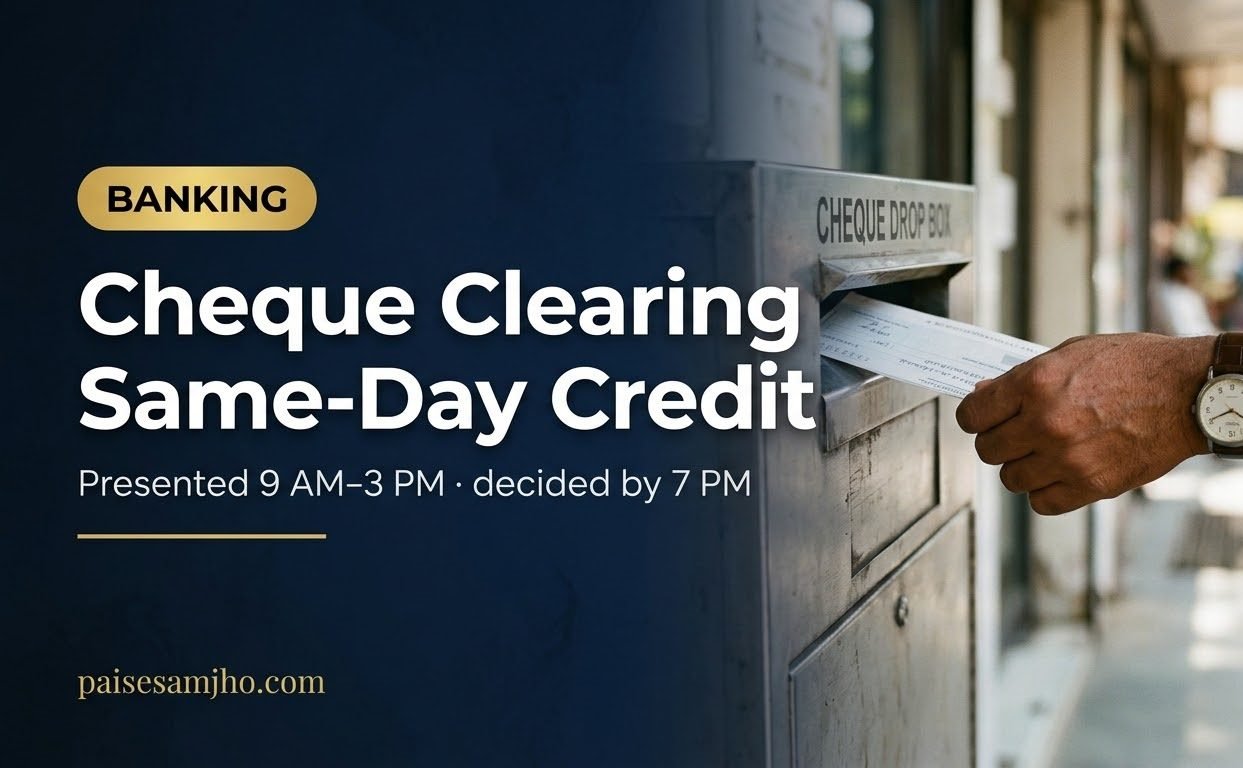
Under RBI’s continuous-clearing rules, a cheque presented in the Cheque Truncation System (CTS) between 9 AM and 3 PM must be confirmed or rejected by the paying bank by 7 PM the same day. After settlement, your bank must release the money “immediately, but not later than 1 hour from successful settlement”. That makes the cheque clearing time for most local cheques a matter of hours, not the two days customers were used to before October 2025.
Two RBI directives set this up. Circular CO.DPSS.RLPD.No.S536/04-07-001/2025-2026 (RBI/2025-26/73), dated 13 August 2025, moved CTS to “continuous clearing and settlement on realisation” from 4 October 2025. A second circular, CO.DPSS.RLPD.No.S1039/04-07-001/2025-2026 (RBI/2025-26/156), dated 24 December 2025, changed the session timings and postponed the faster Phase 2 “until further notice”.
Cheque clearing time, hour by hour
| Clock | What happens in CTS | Source |
|---|---|---|
| 9:00 AM | Presentation and confirmation sessions open | Dec 2025 circular, para 2 |
| 11:00 AM onwards, every hour | Settlement of cheques confirmed (or deemed approved) so far | Aug 2025 circular, Annex para 4 |
| 3:00 PM | Presentation session closes | Dec 2025 circular, para 2 |
| 7:00 PM | Confirmation session closes; unconfirmed cheques “will be deemed to have been approved and included for settlement” | Aug 2025 circular, Annex para 3 |
| Within 1 hour of each settlement | Presenting bank credits the customer, “subject to usual safeguards” | Aug 2025 circular, Annex para 4 |
Worked example: a ₹75,000 cheque presented at 2:30 PM
Your bank presents a ₹75,000 cheque into CTS at 2:30 PM on a working day. The paying bank has until 7 PM to say yes or no. If it confirms at 4:10 PM, the cheque goes into the 5 PM settlement and the money should reach your account by about 6 PM. If the paying bank says nothing, the cheque is deemed approved at 7 PM. On our reading of the hourly-settlement rule, that would put the credit at around 8 PM, about five and a half hours after presentation. That timing is our calculation from the circular’s rules. It is not an RBI-published example.
One caution: “presented” means presented by your bank into CTS. The time you drop the cheque at the branch isn’t the same thing. Each bank sets its own branch or drop-box cut-off, and a cheque deposited late in the afternoon may only be presented the next morning.
Phase 2 is on hold
The August 2025 circular planned a Phase 2 from 3 January 2026, with a “T+3 clear hours” expiry. A cheque received between 10 and 11 AM would have had to be confirmed by 2 PM. The December 2025 circular says: “Implementation of Phase 2 is being postponed, until further notice, to allow more time for banks to streamline their operations.” So the 7 PM end-of-day confirmation still applies, and RBI hasn’t given a new Phase 2 date.
Positive Pay on cheques of ₹50,000 and above
The ₹75,000 cheque in the example is also above the Positive Pay threshold. Under RBI circular RBI/2020-21/41 (DPSS.CO.RPPD.No.309/04.07.005/2020-21, 25 September 2020), banks “shall enable it for all account holders issuing cheques for amounts of ₹50,000 and above”. The person writing the cheque re-confirms the key details (date, payee, amount) with their bank before it is presented. Using the facility is “at the discretion of the account holder”, but banks “may consider making it mandatory” for ₹5 lakh and above.
Para 4 of that circular adds the practical point: “Only those cheques which are compliant with above instructions will be accepted under dispute resolution mechanism at the CTS grids.” If you issue a high-value cheque without Positive Pay and something goes wrong, you have fewer options for raising a dispute.
From the banker’s desk: a common reason for a same-day return now is a Positive Pay mismatch, such as the issuer entering ₹75,000 against a cheque written for ₹7,500, or the wrong date. If you are the issuer, enter the Positive Pay details on the day you hand over the cheque.
Why a faster return also matters
A shorter cheque clearing time works for bounced cheques too. Under continuous clearing, a cheque the paying bank rejects is usually reported back the same evening, along with the return reason. If you received a cheque that bounced for insufficient funds, the legal clock for a demand notice starts from when the bank informs you, so a same-day return memo gives you a dated record sooner. Our cheque bounce guide covers the 30-day notice and the steps after it.
If the credit is late
RBI’s Responsible Business Conduct Directions for commercial banks require each bank to have a cheque collection policy. Para 10 says it must cover “Immediate credit for local / outstation cheques”, the “Time frame for collection” and “Interest payment for delayed collection”. Para 133 adds: “Compensation by way of interest payment, where necessary, shall be made without any claim from the customer.” The interest rate and the number of days come from your bank’s own policy, so ask the branch for it. As an illustration only, interest at 2.70% a year for three days on ₹75,000 would be about ₹16.64.
- Ask the bank for the presentation time and the paying bank’s response time for your cheque.
- If it was returned, ask for the return memo and the reason code.
- If credit came after the time in the bank’s own policy, ask for the delay interest in writing.
- If there is no reply in 30 days, the RBI Ombudsman route at cms.rbi.org.in opens.
Not confirmed: whether RBI will set a new date for Phase 2; how individual banks have revised their cheque collection policies since October 2025; and the exact wording of RBC Directions paras 10 and 131–135. We read those paras from a third-party copy, because RBI’s PDF host didn’t load from our system.
For moving money without a cheque, see NEFT, IMPS and RTGS compared. For depositing cash, see the bank cash deposit rules. The working answer, before the FAQ: present by 3 PM and expect a decision by 7 PM, with credit within an hour of settlement.
FAQ
What is the cheque clearing time in 2026?
For a cheque presented in CTS between 9 AM and 3 PM, the paying bank must respond by 7 PM. Credit follows within one hour of settlement, usually on the same day.
Is Positive Pay mandatory?
RBI requires banks to offer it for cheques of ₹50,000 and above. Using it is the account holder’s choice, but banks may make it mandatory at ₹5 lakh and above.
What if the paying bank doesn’t respond by 7 PM?
The circular says such cheques “will be deemed to have been approved and included for settlement”.
Does this apply on Sundays?
No. CTS sessions run on clearing days, so bank holidays and weekends aren’t counted.
Takeaway: under continuous clearing, a cheque presented by 3 PM is usually decided by 7 PM. If your credit is late, ask for your bank’s collection-policy timeline and the delay interest.
References (Sources checked 6 Oct 2026, 11:17 PM IST; not stamped verified, because the RBC Directions PDF on rbidocs.rbi.org.in could not be fetched (paras 10 and 131–135 read from a third-party copy). The three RBI CTS/Positive Pay circulars were read on rbi.org.in.)
- RBI/2025-26/73, CO.DPSS.RLPD.No.S536/04-07-001/2025-2026, 13 Aug 2025: para 2; Annex paras 2–4
- RBI/2025-26/156, CO.DPSS.RLPD.No.S1039/04-07-001/2025-2026, 24 Dec 2025: para 2 (Phase 2 postponed; 9 AM–3 PM / 9 AM–7 PM)
- RBI/2020-21/41, DPSS.CO.RPPD.No.309/04.07.005/2020-21, 25 Sep 2020: paras 2, 3, 4, 6 (Positive Pay)
- RBI (Commercial Banks – Responsible Business Conduct) Directions, 2025, RBI/DOR/2025-26/170, 28 Nov 2025, updated as on 1 Oct 2026: paras 10, 131–135. Read from a third-party copy (caalley.com); the rbidocs.rbi.org.in PDF fetch failed.