Positive Pay System for Cheques: How to Register Cheques of ₹50,000 and Above, Step by Step
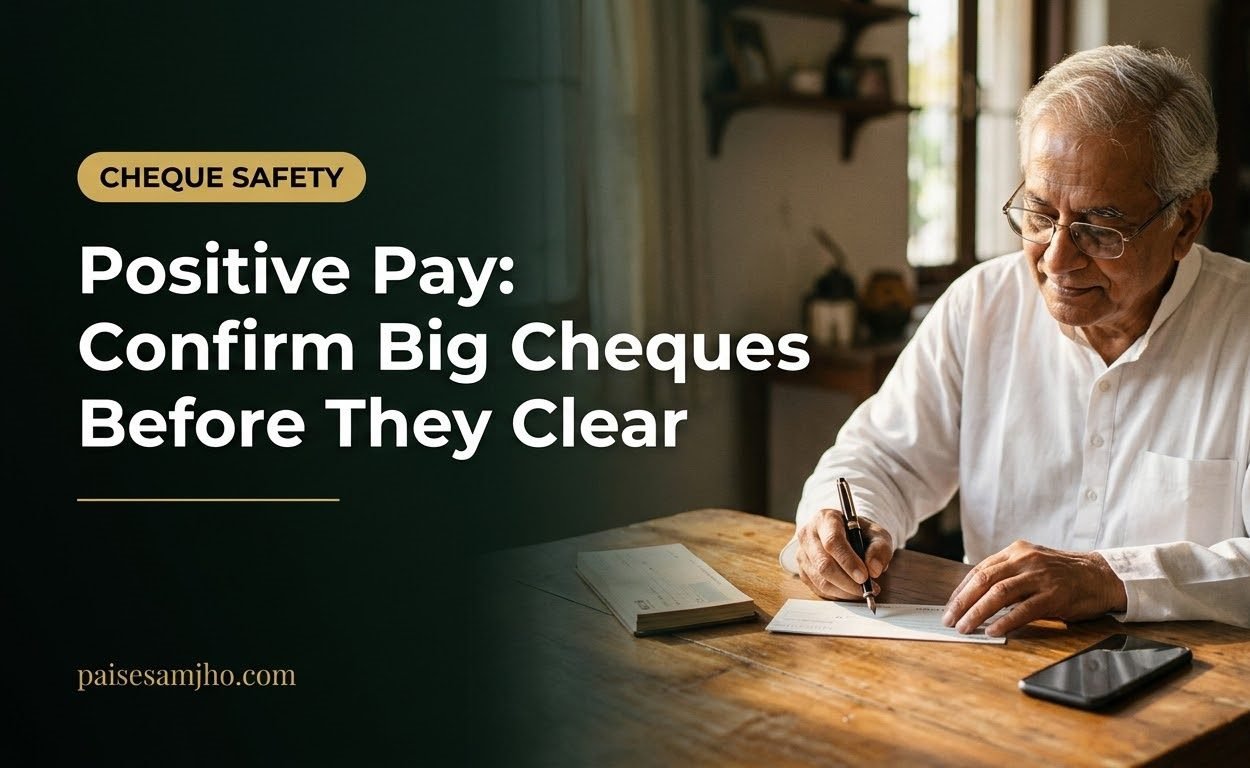
Rule in one line: for cheques of ₹50,000 and above, your bank must let you confirm the cheque details in advance, and for ₹5 lakh and above it may insist on it. That is the Positive Pay System, which RBI introduced for cheque clearing from 1 January 2021. It takes a minute in your banking app and protects you if a cheque is stolen, altered or forged. Here is how Positive Pay works, when to use it, and what happens if the details do not match.
What is the Positive Pay System?
Under this system, the person who writes a cheque sends its key details to their own bank electronically before the cheque is presented. When the cheque comes for clearing through the Cheque Truncation System (CTS), the details are matched. Any mismatch is flagged to both banks, which then take action. RBI calls it a way of “reconfirming key details of large value cheques”.
| Point | Rule |
|---|---|
| Introduced by | RBI circular of 25 Sep 2020; built by NPCI into CTS |
| In force from | 1 January 2021 |
| Banks must offer it for | Cheques of ₹50,000 and above |
| Is it compulsory for you? | Optional, but banks may make it mandatory for cheques of ₹5 lakh and above |
| Details you submit | Minimum details like date, payee name and amount; banks also ask for the cheque number and account |
| Channels | SMS, mobile app, internet banking, ATM, etc. |
| Dispute protection | Only cheques compliant with Positive Pay are accepted under the dispute resolution mechanism at CTS grids |
Source: RBI circular RBI/2020-21/41 dated 25 Sep 2020; RBI FAQ on cheque clearing.
Why the Positive Pay System matters
Cheque fraud usually happens in one of three ways: a cheque leaf is stolen and forged, a genuine cheque is altered (amount or payee changed), or a cloned cheque is presented. With advance confirmation, the bank already knows what you actually wrote. A cheque for ₹5,00,000 presented as ₹50,00,000, or payable to a different name, gets flagged before money leaves your account.
The second reason is the dispute rule. If something goes wrong with a large cheque that you did not register in advance, the CTS dispute resolution mechanism may not accept it. Registering keeps that option open.
With continuous cheque clearing now in place, cheques are processed through the day and can clear within hours, RBI’s FAQ explains (see how long cheque clearing takes). Faster clearing leaves less time to catch a fraud manually, which makes advance confirmation more useful.
How to register a cheque: step by step
- Write the cheque and note the cheque number, date, amount and payee name exactly as written.
- Open your bank’s app or internet banking. Look under “Cheque services” or “Positive Pay”. Some also accept SMS in a set format, or a branch form.
- Enter the details: account number, cheque number, cheque date, amount and payee name. Some banks also ask for the transaction code or MICR details.
- Submit and save the reference number.
- Do it before handing over the cheque, or at least well before it is presented. Banks set their own cut-off times.
Check your bank’s schedule of charges for any fee before you start.
What happens if details do not match
| Situation | Likely result |
|---|---|
| All details match | Cheque is processed normally |
| Amount, date or payee mismatch | CTS flags it; the bank may return the cheque or contact you |
| You made a typing mistake while registering | A genuine cheque may be held or returned; correct or re-register quickly if your bank allows |
| No advance confirmation for a cheque of ₹5 lakh or more, where your bank has made it mandatory | The bank may return the cheque unpaid |
Bank practices differ; this table is a general guide. Ask your bank how it handles mismatches and corrections.
A cheque returned for a mismatch is different from a cheque bounced for insufficient funds. But if you are the payer and a genuine cheque is returned because of your own error, the payee will be inconvenienced, and repeated returns may cause friction. Our cheque bounce rules guide explains when a return becomes a legal issue.
Good cheque habits to pair with it
- Write “A/c Payee” on cheques meant for a specific account.
- Do not leave space before or after the amount in words and figures.
- Avoid signing blank or undated cheques.
- Keep your chequebook locked away; report a lost leaf or book to your bank at once and ask it to stop payment.
- Check your account statement and SMS alerts after a cheque clears.
- For cheques of ₹50,000 and above, make advance confirmation a habit even when it is optional.
If a forged cheque is cleared from your account despite these steps, report it immediately. RBI’s liability rules and the Ombudsman route are explained in our RBI Ombudsman complaint guide.
For businesses and frequent cheque users
Many banks let companies issuing many cheques upload cheque details in bulk through corporate internet banking. Post-dated cheques, such as rent or EMI cheques, can often be registered at the time of issue with the future date. Check with your bank for its file format and limits.
Common questions, briefly answered.
FAQs
Is Positive Pay mandatory?
RBI made it optional for account holders. Banks must offer it for cheques of ₹50,000 and above, and may make it mandatory for ₹5 lakh and above.
Can I use it for cheques below ₹50,000?
Banks are required to offer it from ₹50,000; some may accept smaller amounts. Check with your bank.
Does Positive Pay apply to the person receiving the cheque?
No. The issuer (drawer) of the cheque registers the details with their own bank.
What details are needed?
At least the cheque date, payee name and amount, along with the cheque number and account number.
Takeaway: The Positive Pay System lets you confirm a cheque’s date, payee and amount to your bank before it is presented. Use it for every cheque of ₹50,000 and above; it blocks altered cheques and protects your right to dispute.
From RBI
- RBI circular: Positive Pay System for Cheque Truncation System (RBI/2020-21/41, 25 Sep 2020)
- RBI FAQs on cheque clearing and Positive Pay
Last verified: 13 Oct 2026, 6:25 AM IST against RBI circular RBI/2020-21/41 (25 Sep 2020) and RBI’s FAQ on cheque clearing. Bank-level steps, cut-off times, charges and mismatch handling vary and were not checked for any specific bank.