Co-operative Bank Withdrawal Limit: RBI Extends Curbs on 6 Banks to January 2027
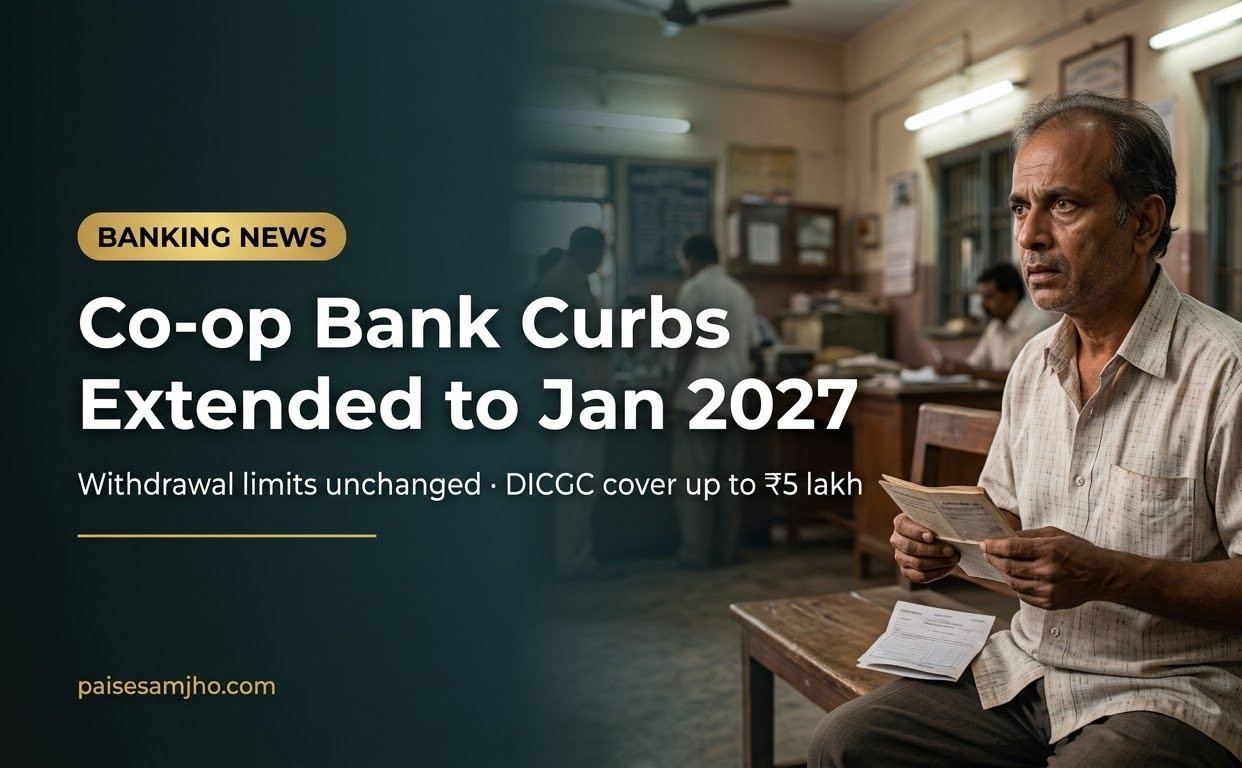
The Reserve Bank of India on 5 and 6 October 2026 extended its directions on six co-operative banks by three more months, keeping their withdrawal limits in place until early January 2027. Each extension order states that “Other terms and conditions of the Directive under reference, shall remain unchanged.” For depositors, that means the co-operative bank withdrawal limit set when the curbs began, which is nil in three of the six banks, still applies.
The six banks are Ramgarhia Co-operative Bank (New Delhi), The Baghat Urban Co-operative Bank (Solan), Samarth Sahakari Bank (Solapur), Sadbhav Nagrik Sahakari Bank Maryadit (Chhatarpur), Motiram Agrawal Jalna Merchants Co-operative Bank (Jalna) and Samarth Urban Co-operative Bank (Osmanabad). RBI issued all six under Section 35A read with Section 56 of the Banking Regulation Act, 1949.
Co-operative bank withdrawal limit at each of the six banks
The extension orders don’t repeat the co-operative bank withdrawal limit for each bank. They point back to the original directions, so we matched each bank to its first press release. The table below shows the cap as worded in that original release, along with the new expiry date.
| Bank | Withdrawal allowed (original order) | Original press release | Curbs now run to (close of business) | Extension release |
|---|---|---|---|---|
| Ramgarhia Co-op Bank, New Delhi | Up to ₹50,000 across all accounts | 8 Jul 2022, PR 2022-2023/505 | 8 Jan 2027 | 5 Oct 2026, PR 2026-2027/1249 |
| Baghat Urban Co-op Bank, Solan | Up to ₹10,000 | 8 Oct 2025, PR 2025-2026/1275 | 8 Jan 2027 | 5 Oct 2026, PR 2026-2027/1250 |
| Samarth Sahakari Bank, Solapur | No withdrawal | 7 Oct 2025, PR 2025-2026/1266 | 7 Jan 2027 | 5 Oct 2026, PR 2026-2027/1251 |
| Sadbhav Nagrik Sahakari Bank, Chhatarpur | Up to ₹5,000 | 7 Oct 2025, PR 2025-2026/1268 | 7 Jan 2027 | 5 Oct 2026, PR 2026-2027/1253 |
| Motiram Agrawal Jalna Merchants Co-op Bank | No withdrawal | 10 Apr 2026, PR 2026-2027/71 | 10 Jan 2027 | 5 Oct 2026, PR 2026-2027/1254 |
| Samarth Urban Co-op Bank, Osmanabad | No withdrawal | 7 Oct 2025, PR 2025-2026/1267 | 7 Jan 2027 | 6 Oct 2026, PR 2026-2027/1257 |
The wording matters. Take Baghat’s original release: the bank “has been directed to permit withdrawal of a sum not exceeding ₹10,000/- … of the total balance held in savings bank or current accounts or any other account of a depositor”. So the cap applies to the depositor’s combined balance across all accounts, not to each account separately. The same release adds that the bank “is allowed to set off loans against deposits subject to the conditions stated in the above RBI Directions.”
RBI also repeats a standard caution in every extension. The extension “should not per se be construed to imply that the Reserve Bank of India is satisfied with the financial position of the bank.” It is not a sign of recovery, and it is not a licence cancellation either.
What the ₹5 lakh deposit insurance covers here
Every original order issued from October 2025 onward includes the same deposit-insurance clause: “The eligible depositors would be entitled to receive deposit insurance claim amount of their deposits up to a monetary ceiling of ₹5,00,000/- … in the same capacity and in the same right, from the Deposit Insurance and Credit Guarantee Corporation (DICGC) … based on submission of willingness by the depositors concerned and after due verification.” That covers five of the six banks. Ramgarhia’s July 2022 release has no such paragraph.
The DICGC guide sets out three rules that decide what a depositor actually gets:
- The cap: each depositor is insured up to ₹5 lakh for “both principal and interest” held “in the same right and same capacity”.
- Set-off: “Banks have the right to set off their dues from the amount of deposits as on cut off date. The deposit insurance is available after netting of such dues.”
- The clock: under Section 18A of the DICGC Act (in force from 1 September 2021), the bank must send the depositor list within 45 days of the directions. DICGC verifies it within 30 days and pays within 15 days, within 90 days in all.
Worked example: ₹6.5 lakh in deposits and a ₹1 lakh loan
Take a depositor with ₹1.5 lakh in savings and a ₹5 lakh fixed deposit (interest included) at one of the nil-withdrawal banks, who also owes the bank ₹1 lakh on a personal loan.
| Step | Amount |
|---|---|
| Total deposits (savings + FD) | ₹6,50,000 |
| Less: loan set off by the bank | ₹1,00,000 |
| Net deposit | ₹5,50,000 |
| Covered by DICGC (cap ₹5 lakh) | ₹5,00,000 |
| Not insured, left to the bank’s own recovery | ₹50,000 |
If the same depositor banked with Baghat and withdrew the full ₹10,000, the net balance would fall to ₹5,40,000. The insured amount would stay at ₹5 lakh and the uninsured part would shrink to ₹40,000. At Sadbhav, a ₹5,000 withdrawal leaves ₹45,000 uninsured. These figures come from our calculation sheet. Your actual claim depends on the balance DICGC verifies.
The 90-day clock has already run for five banks
The directions for Samarth Sahakari, Samarth Urban and Sadbhav are dated 6 October 2025. On the Section 18A timeline, the 45-day list was due by 20 November 2025, and the 90-day outer limit for payment fell on 4 January 2026. Baghat’s directions, released a day later, ran on almost the same schedule. For Motiram Agrawal (released 10 April 2026), the outer limit was around 9 July 2026. That is our arithmetic from the DICGC timeline, not a payout date published by DICGC.
So depositors in these banks may already have been paid, or may be part-way through verification. DICGC’s guide also says there is no deadline for the willingness form while the bank stays under directions: depositors “can submit the willingness forms to the bank at any time … provided the bank is under AID at the time of submission”.
From the banker’s desk: the most common delay we see is a mismatch between the KYC on the deposit account and the ID attached to the willingness form. If your passbook still carries an old address or a spelling difference, fix that first.
Steps for depositors before 7 January 2027
- Find out whether your claim has been paid. Ask the bank’s administrator or CEO in writing whether your name was on the depositor list sent to DICGC, and on what date.
- If you haven’t filed a willingness form, file one now. Under DICGC’s process, you give the signed form to the bank’s CEO or administrator with attested copies of officially valid documents.
- Check the set-off. If you have a loan with the bank, ask for a statement that shows the deposit-loan netting. The insured amount is calculated after that netting.
- Keep paying EMIs. The curbs restrict withdrawals, not repayments. A missed EMI still goes to the credit bureaus.
- Don’t open new deposits with these banks while the directions stay in force.
If the bank doesn’t answer within 30 days, you can escalate. RBI’s complaint portal is cms.rbi.org.in, and our guide to tracing unclaimed deposits through UDGAM explains how to find older balances you may have forgotten.
Not confirmed as of tonight
Ramgarhia’s current cap. The ₹50,000 figure comes from the July 2022 order. The 2023, October 2025, July 2026 and October 2026 releases we read don’t change it, but we haven’t read every quarterly extension since 2022.
Payment status. DICGC hasn’t published a bank-wise payment status for these six banks on any page we could reach.
What comes next. RBI’s orders say the directions are “subject to review”. No order says what happens after January 2027.
If your money sits in one of these six banks, the next useful step is a written request to the bank. These links cover related questions on nominee claims, breaking an FD early and how joint accounts are treated. Joint accounts held in a different order of names count as a different capacity under DICGC’s rules.
FAQ
Can I withdraw money from Samarth Sahakari Bank, Samarth Urban Bank or Motiram Agrawal Bank?
The co-operative bank withdrawal limit at these three banks is nil under the original orders, which allow no withdrawal from any account. A loan can still be set off against your deposits, subject to the conditions in RBI’s directions.
Is my FD in Baghat Urban Co-operative Bank insured?
The October 2025 order says eligible depositors are entitled to DICGC cover of up to ₹5 lakh, including interest, in the same capacity and right, once they submit a willingness form and it is verified.
Does the extension mean the bank’s licence is cancelled?
No. RBI says the extension shouldn’t be read as approval of the bank’s finances. The banks continue to operate under restrictions.
Is there a last date for the DICGC willingness form?
DICGC says there is no cut-off date, provided the bank is still under directions when you submit it.
Takeaway: under these curbs, the ₹5 lakh DICGC cover, after any loan set-off, matters more than the small withdrawal allowance. Make sure your willingness form and KYC are in order.
Primary documents read for this report
| Document | Number / date | Used for |
|---|---|---|
| RBI extension releases (six) | PR 2026-2027/1249, 1250, 1251, 1253, 1254 (5 Oct 2026); 1257 (6 Oct 2026) | New end dates; “remain unchanged”; “not per se” caution |
| RBI original directions releases | PR 2022-2023/505 (8 Jul 2022); 2025-2026/1266, 1267, 1268 (7 Oct 2025); 1275 (8 Oct 2025); 2026-2027/71 (10 Apr 2026) | Withdrawal caps, set-off, DICGC clause |
| DICGC “A Guide to Deposit Insurance” | dicgc.org.in, Section 18A FAQs | ₹5 lakh cap, set-off, 45/30/15/90-day timeline, no cut-off for willingness |
Last verified: 6 Oct 2026, 11:17 PM IST. Checked: six RBI extension releases (PR 2026-2027/1249–1257), the six original directions releases, DICGC deposit-insurance guide.