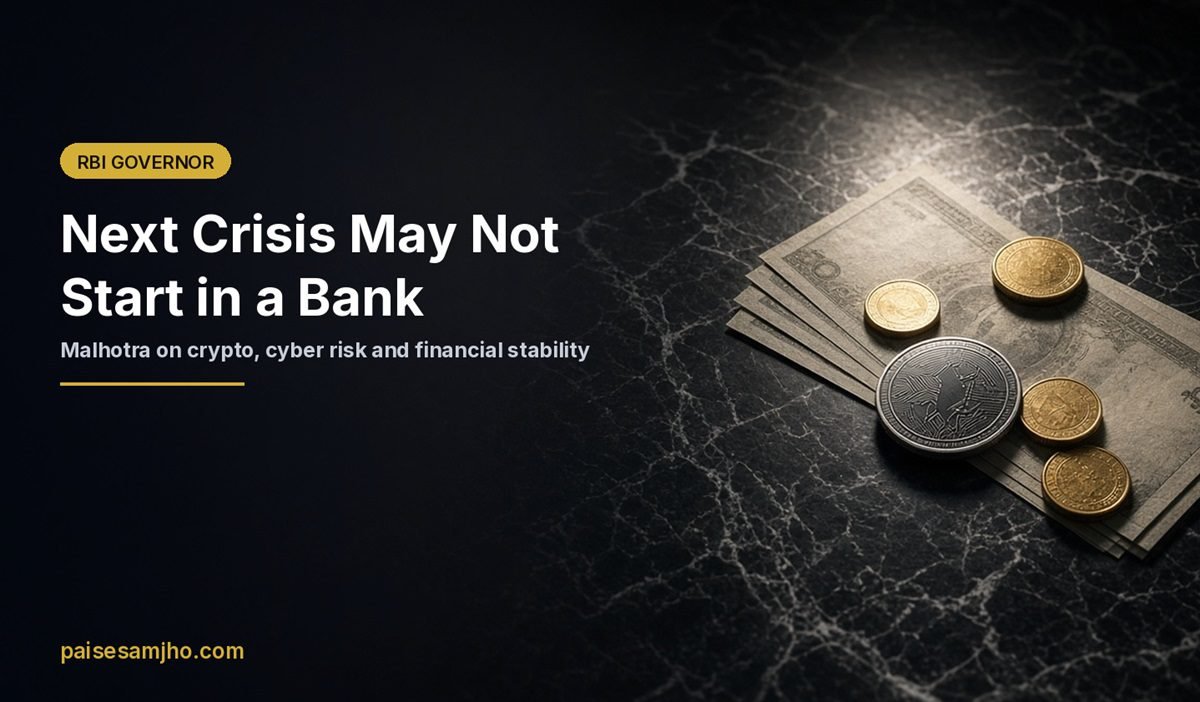
RBI Governor Malhotra: Next Crisis “May Not Originate in a Bank”; RBI Stays Cautious on Crypto
RBI Governor Sanjay Malhotra said on 3 October 2026 that the next financial crisis “may not originate in a bank, or even in finance” and could begin with “a geopolitical event, a cyberattack, or a technological failure”. He was speaking at the fifth Kautilya Economic Conclave in New Delhi, four days before the RBI’s monetary policy decision on 7 October.
The prepared speech, titled “Preserving Financial Stability in an Evolving World”, is published on the RBI website. In remarks at the conclave reported by PTI, RBI Governor Malhotra also restated the central bank’s cautious position on cryptocurrencies. This report covers both: what the official text says, and what news agencies reported him saying.
Crypto: “it has been a cautious approach”
The crypto comments do not appear in the speech text on rbi.org.in; they were reported from the conclave by PTI and carried by The Hindu and The Economic Times. According to PTI, he said: “So, our approach has been to promote the underlying technologies, and we are using some of these in the central bank and outside, in PPP mode. But insofar as crypto is concerned, it has been a cautious approach.”
PTI reported that he linked the caution to the “singleness of money” and its implications for monetary policy, especially in emerging economies with capital-flow restrictions. He also said domestic payments in India are already fast and cheap, and that the bigger gap is cross-border payments, where central bank digital currencies could be one answer.
The written speech makes a related point in its closing priorities. It says innovation will be sustainable only if the financial system preserves “sound institutions, settlement finality, singleness of money, and financial integrity.”
Five global risks RBI Governor Malhotra listed
The speech names five emerging risks to global financial stability. The table summarises each in the speech’s own terms.
| Risk named in the speech | What the RBI Governor said |
|---|---|
| Elevated global debt | Debt-to-GDP has risen and bond yields “hardened sharply”; emerging markets may face capital outflows “as the carry trade unwinds”. |
| Stretched asset valuations, especially AI-related | A slowdown in AI investment or earnings “could trigger a sharp repricing of financial assets”. |
| Elevated leverage | Hedge funds, option sellers, ETFs and other non-bank intermediaries have expanded leverage in equity and bond markets. |
| Private credit | High-profile defaults suggest “weak lending standards” in this sector globally. |
| Cyber risks compounded by AI | Described as “the most immediate concern”, because the financial system “does not have national borders”. |
He added that each risk on its own “may not be a matter of concern as of now”, but several occurring together could put “significant pressure on the global financial architecture.”
What the speech says about India’s financial stability
On India, the speech is reassuring in tone and specific in its numbers. Malhotra said the financial system has “absorbed the supply shock due to the West Asia conflict well”, and that India is “navigating this phase from a position of strength”.
- Bond yields: Indian government bond yields have risen “only partially” in response to higher energy prices and global yields.
- Equities: Markets “have corrected in recent months, albeit from high valuations, but the movement has been orderly.”
- Banks: The June 2026 Financial Stability Report stress tests show banks’ capital (CET1) ratio “remaining comfortable under all adverse scenarios”.
- NBFCs: Average capital adequacy of 24.6% as on 31 March 2026, against a requirement of 15%.
- Private credit: “still small and not assessed to be a risk” in India.
He also listed recent RBI steps on technology risk: 2026 directions for commercial banks on cyber-risk governance, covering board oversight, the chief information security officer’s role, third-party arrangements and incident response, plus draft guidance on how banks and NBFCs manage the risk of the models they use. Readers who have faced a sudden freeze after a reported fraud can see our explainer on debit holds on bank accounts.
One line from the speech sums up the caution: “today’s resilience may not necessarily imply tomorrow’s immunity.”
Five priorities for policymakers
The speech closes with five priorities:
- Accept that some shocks are inevitable; the aim is resilience, not prevention.
- Recognise a “new generation of systemic risks” that are cross-border and interconnected.
- Improve monitoring with “better and more granular data”, including on non-bank lenders.
- Build resilience across the whole system, beyond banks: markets, payment systems and technology providers too.
- Make sure innovation such as AI and tokenisation strengthens trust rather than fragmenting it.
His final line: “in central banking, invisibility is perhaps the most meaningful measure of success.”
Does the speech hint at the 7 October policy?
No. The speech text does not discuss the repo rate or the coming decision. It refers to “credible monetary policy” and “declining structural pressures on inflation” when explaining why Indian bond yields have risen less than global ones, but it gives no signal on rates. Our RBI policy preview sets out the dates and what the committee is weighing, and our report on the fall in forex reserves covers the pressure on the rupee that the speech alludes to.
Whether the RBI will say anything more about crypto or stablecoins in the policy statement on 7 October is not known.
The Governor’s next scheduled statement is the policy announcement on Wednesday, 7 October.
FAQs
Is the RBI Governor’s full speech available?
Yes. The prepared text of the 3 October address is on the RBI website under Speeches. The remarks on crypto were made at the conclave and reported by PTI; they are not part of that text.
Did RBI Governor Malhotra say crypto will be banned?
No. According to PTI, he described the RBI’s approach to crypto as “cautious” while supporting the underlying technologies such as distributed ledgers and tokenisation. He did not announce any new rule.
What does “singleness of money” mean?
It is the idea that every form of money in an economy, whether cash, bank deposits or digital, exchanges at par for the same rupee. Central banks worry that private tokens could break that link and weaken monetary policy.
Disclaimer: This is a news report based on the RBI Governor’s published speech and agency reports of his remarks, as of 4 October 2026. It does not predict RBI policy and is not investment advice.
Sources
- RBI: “Preserving Financial Stability in an Evolving World”, special address by Governor Sanjay Malhotra, 3 October 2026 (official text; all quotes in the risks, India and priorities sections).
- Last verified on 4 October 2026 at 1:16 PM IST.
- The Hindu (PTI), 3 October 2026, and The Economic Times (PTI), 3 October 2026, for the crypto remarks, which are not in the official text; CNBC-TV18 for conclave coverage.
- The RBI has not issued a separate press release or transcript of the conclave Q&A.