Failed UPI Transaction Refund: T+1 Deadline and ₹100-a-Day Compensation Explained
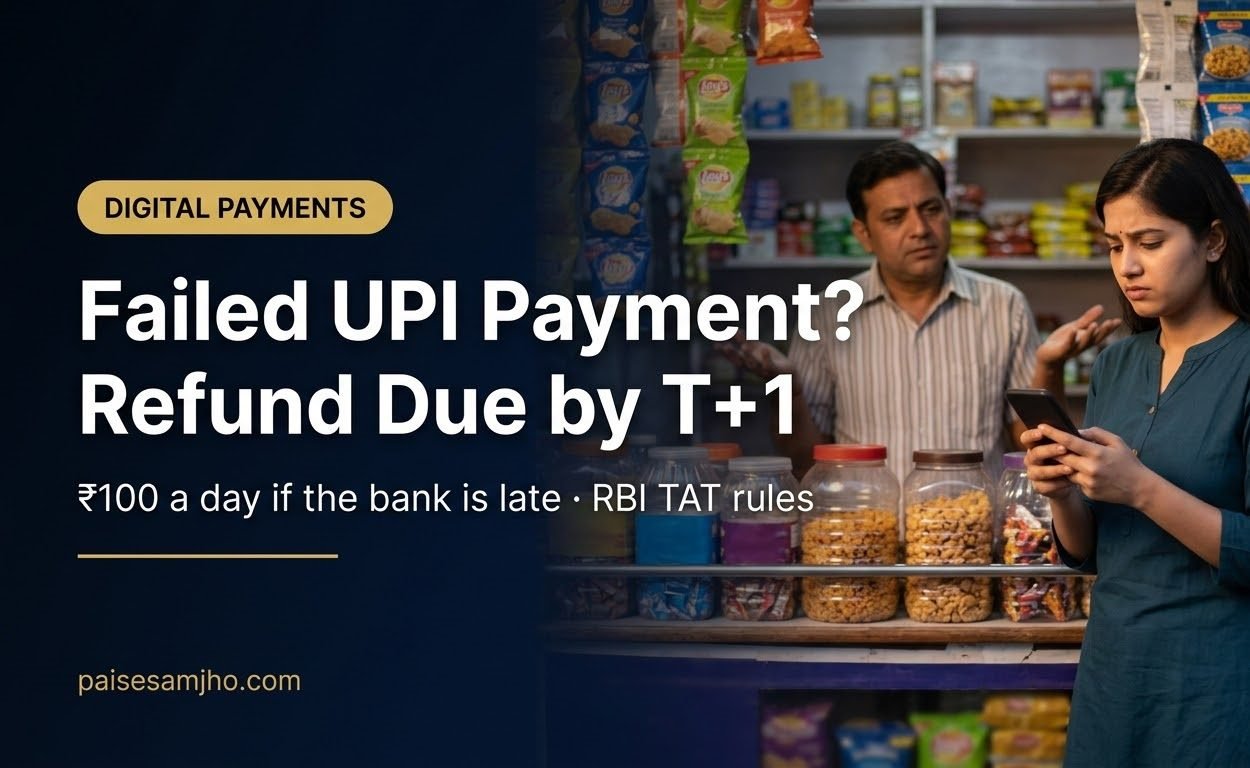
₹100 for every day of delay. That is the compensation an RBI circular sets for a bank that misses its deadline to reverse a failed digital payment. The bank is supposed to pay it without the customer asking. For a failed UPI transaction refund on a person-to-person transfer, the deadline is the day after the payment, and many customers don’t check whether the ₹100-a-day amount was credited.
The rule comes from RBI circular RBI/2019-20/67 (DPSS.CO.PD No.629/02.01.014/2019-20), dated 20 September 2019, on harmonising turnaround time (TAT) and customer compensation for failed transactions. It took effect on 15 October 2019 and still governs UPI, IMPS, ATM, card, AePS and NACH failures.
Last verified 6 Oct 2026, 11:17 PM IST against RBI circular RBI/2019-20/67 (TAT annex) and RBI’s RB-IOS 2026 FAQs.
Failed UPI transaction refund: the deadline and the penalty
The circular defines a failed transaction as one “which has not been fully completed due to any reason not attributable to the customer such as failure in communication links, non-availability of cash in an ATM, time-out of sessions, etc.” It also defines how days are counted: “T is the day of transaction and refers to the calendar date.” R is the day the reversal is concluded.
| Channel and what went wrong | Reversal deadline | Compensation if late |
|---|---|---|
| UPI transfer: account debited, beneficiary not credited | T + 1 day | ₹100 per day beyond T + 1 |
| UPI merchant payment: debited, merchant got no confirmation | T + 5 days | ₹100 per day beyond T + 5 |
| IMPS: debited, beneficiary not credited | T + 1 day | ₹100 per day beyond T + 1 |
| ATM / micro-ATM: debited, cash not dispensed | T + 5 days | ₹100 per day beyond T + 5 |
| Card at a shop or online: debited, no charge-slip or confirmation | T + 5 days | ₹100 per day beyond T + 5 |
| Card-to-card transfer: debited, not credited | T + 1 day | ₹100 per day beyond T + 1 |
| NACH: delay in crediting the beneficiary or in reversal | T + 1 day | ₹100 per day beyond T + 1 |
Two lines in the circular do most of the work for customers. Paragraph 5 says: “Wherever financial compensation is involved, the same shall be effected to the customer’s account suo moto, without waiting for a complaint or claim from the customer.” Paragraph 6 lets customers who don’t get redress within the TAT complain under RBI’s Integrated Ombudsman Scheme.
Two failures, worked through
We used the same counting method for both examples. The figures come from scripts/calc.py.
UPI transfer of ₹4,500. The money left your account on Friday, 2 October 2026, and didn’t reach your relative. The reversal deadline (T + 1) was 3 October. If the money came back on 8 October, the bank was 5 days late, which works out to ₹500 in compensation, about 11% of the payment.
ATM withdrawal of ₹10,000. The machine debited you on 1 October but gave no cash. The deadline (T + 5) was 6 October. A reversal on 9 October means 3 days of delay, or ₹300.
Counting the days of delay from the deadline to the day the money is back is our reading of “per day of delay beyond T + 1/T + 5”. The circular doesn’t include a worked example, so your bank may count a day differently at the edges.
If the ₹4,500 had been a merchant payment instead of a transfer, the deadline would have been T + 5, which is 7 October. A reversal on 8 October would then earn ₹100, not ₹500. Check which kind of payment it was before you work out what you are owed.
What to do in the first 48 hours
- Screenshot the transaction. Note the UPI reference (RRN), date, time and amount. In the UPI app, the payment usually shows as “pending” or “failed” with a reference number.
- Raise it inside the UPI app. Most apps have a “raise dispute” or “report issue” option on the transaction, which creates a complaint number.
- Write to your own bank, not just the app. The account debited is with your bank, and the TAT obligations sit with the banks involved.
- For ATM failures, complain to the bank that issued your card, even if you used another bank’s machine.
From the banker’s desk: when a customer asks for the compensation, it usually turns out to be due, but nobody had worked it out. Ask in writing for the reversal date (R) along with the compensation figure. Once R is on record, the count is simple.
When the bank doesn’t pay
If a failed UPI transaction refund arrives late and no compensation follows, send the bank a written reminder that quotes paragraph 5 of the circular and gives your count of delay days. Under the Reserve Bank – Integrated Ombudsman Scheme, 2026, which replaced the 2021 scheme from 1 July 2026, a complaint to the ombudsman is maintainable after 30 days “or the time specified by RBI, NPCI or Card Network guidelines, if applicable, whichever is higher”. For a failed transfer, the TAT is shorter than 30 days, so the 30 days apply. You then have 90 days to file. Complaints go through RBI’s portal at cms.rbi.org.in, by email to crpc@rbi.org.in, or by post to the Centralised Receipt and Processing Centre in Chandigarh.
A failed payment is different from a transfer to the wrong account. If the money reached the wrong beneficiary because of a typing error, the TAT circular doesn’t apply. See how wrong-account transfers are recovered. If money is blocked rather than debited, our explainer on debit holds may be the closer match.
Gaps we could not close
- NEFT and RTGS failures aren’t in the circular’s annex. We found no RBI document tonight that sets a ₹100-a-day rate for them, so that question stays open.
- We found no later RBI notice withdrawing or changing the 2019 circular. Its own text now refers to the Ombudsman Scheme “as amended from time to time”, but RBI hasn’t published a consolidated version of the TAT rules.
- Whether a weekend or bank holiday counts as a day of delay isn’t spelled out beyond “calendar date” for T.
For a failed UPI transaction refund that involves UPI Lite, the same UPI rows of the table apply on our reading, because the circular groups by channel, not by app. For more on how UPI limits and UPI Lite differ, see our UPI limits explainer. Before the FAQ, here is the short version. The deadline is fixed by RBI, the compensation should be paid automatically, and the bank’s written reversal date is the number to ask for.
FAQ
How long does a failed UPI refund take?
For a person-to-person UPI transfer, RBI’s circular requires auto-reversal by the day after the payment (T + 1). For a UPI merchant payment, it is T + 5.
Do I have to apply for the ₹100-a-day compensation?
The circular says it “shall be effected to the customer’s account suo moto”. In practice, a written request with the transaction reference helps if it hasn’t appeared.
Money left my account at an ATM but no cash came out. Whose responsibility is it?
Your card-issuing bank’s. The deadline is T + 5 days, with ₹100 a day after that.
Can I complain to RBI straight away?
Not straight away. Complain to your bank first. The ombudsman route opens after 30 days, or earlier if the bank rejects your complaint or you are unhappy with its reply.
Takeaway: a failed transfer has a one-day reversal deadline. Every day beyond it is worth ₹100 to you, and you can ask the bank for that in writing.
Where these rules come from
- RBI circular RBI/2019-20/67, DPSS.CO.PD No.629/02.01.014/2019-20, 20 Sep 2019: paras 5–6; Annex definitions 2, 4, 5; TAT table rows 1(a), 2(a)-(c), 3(a), 4(a)-(b), 7(a)
- RBI FAQs on RB-IOS 2026 (updated 1 Jul 2026): maintainability timelines (30 days / TAT; 90 days)