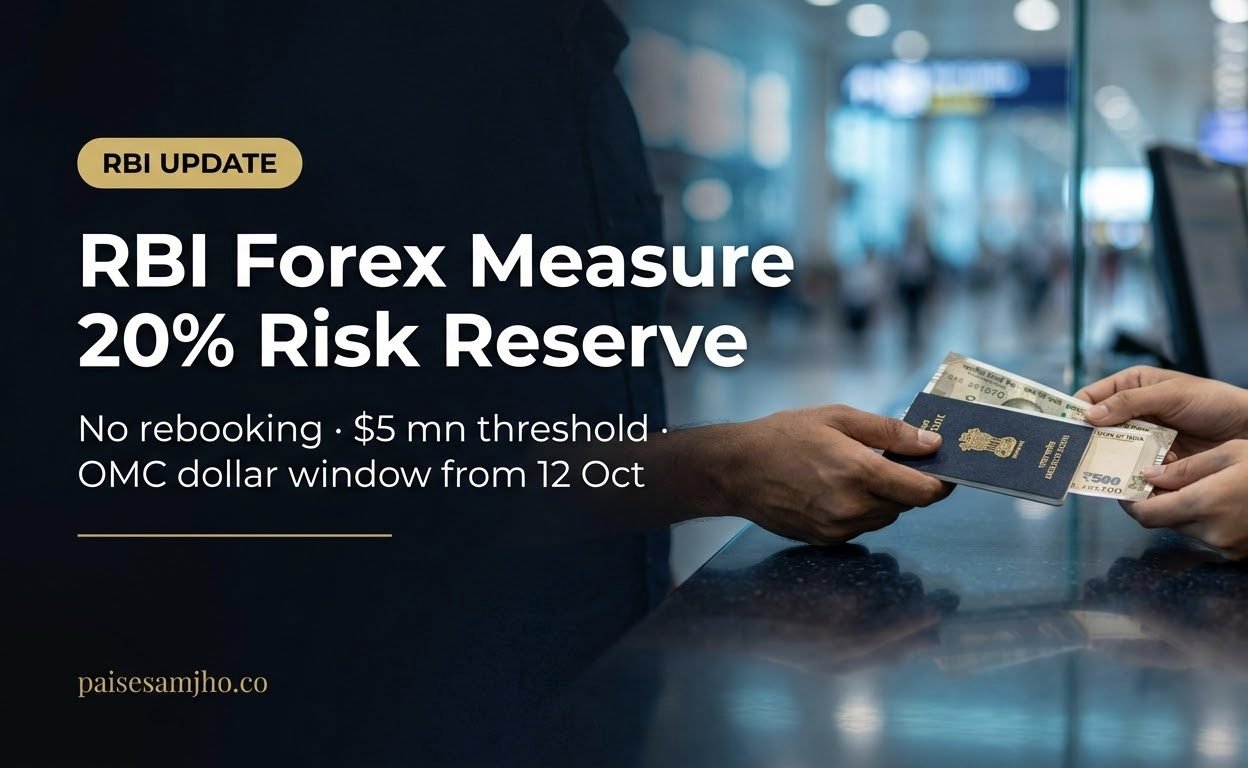
RBI Forex Measures: 20% Risk Reserve, Hedging Curbs, OMC Dollar Window and a Tighter CRR Floor
RBI moved on three fronts this week to steady the rupee and drain surplus cash. The RBI forex measures came on Saturday 10 October: two foreign-exchange circulars, one of which brings in a new 20% cash reserve on some hedging contracts. It also opened a dollar window for the three public-sector oil companies from Monday 12 October. A day earlier, on 9 October, it raised the minimum share of the cash reserve ratio that banks must hold every day from 90% to 99%. The FBIL reference rate shown on RBI’s website was ₹96.6149 per US dollar at 1 PM on Friday.
These measures apply to banks, companies and oil marketers. Below is what each one does, and where an ordinary saver or borrower might feel it.
RBI forex measures announced on 10 October
| Measure | What changes | Source |
|---|---|---|
| No rebooking of cancelled contracts | Banks “shall not permit users to rebook any foreign exchange derivative contract involving the INR … which has been cancelled”. Rollovers on maturity are still allowed. | A.P. (DIR Series) Circular No. 25, para 2(a)–(b) |
| Lower no-documents threshold | The limit for hedging without proving an underlying exposure falls from USD 100 million to USD 5 million, for both bank (OTC) and exchange-traded positions | Circular No. 25, para 2(c) |
| Undertaking against double hedging | Users must confirm “that the same underlying exposure has not been hedged with any other Authorised Dealer” | Circular No. 25, para 2(d) |
| Foreign Exchange Risk Reserve (FERR) | 20% of the INR notional, kept in cash with RBI, on contracts above USD 2 million that hedge current-account purchases of foreign currency | A.P. (DIR Series) Circular No. 26, paras 2–5 |
| Dollar window for OMCs | RBI will sell US dollars through designated banks to cover “the entire daily dollar requirements” of IOC, HPCL and BPCL from 12 October | RBI PR 2026-2027/1306 |
RBI’s press release says the forex measures “are intended to strengthen market discipline and ensure appropriate risk management in the foreign exchange market” (PR 2026-2027/1305). The FERR circular takes effect “with immediate effect” (Circular No. 26, para 5).
How the 20% FERR works
Take an importer that books a USD 3 million forward contract to buy dollars for a current-account payment. At ₹96.6149 per dollar, the notional value is about ₹28.98 crore, so the bank must keep about ₹5.80 crore in cash with RBI until the contract ends (Circular No. 26, para 2). Contracts of USD 2 million or less are not covered. Para 3 warns that splitting a deal into several smaller transactions to avoid the reserve “shall be considered as a violation”.
The no-documents threshold for hedging falls by 95%, from USD 100 million to USD 5 million. Above USD 5 million, users now have to show the trade or payment they are hedging.
The CRR change of 9 October
The CRR is currently 3% (RBI website, Reserve Ratios). Banks may average it over a fortnight, but until now each day had to cover at least 90% of the requirement. RBI’s circular of 9 October raises that daily floor “from 90 per cent of the requirement to 99 per cent effective from the fortnight beginning October 16, 2026”, citing “current liquidity conditions” (RBI/2026-27/290). The same week RBI also announced a ₹25,000 crore OMO sale of government securities for 13 October, and a ₹2,00,000 crore 3-day VRRR auction for 12 October (PR 2026-2027/1304). Both take cash out of the banking system.
What this means for you
- Travel or study abroad. None of these measures limits what an individual can remit under the existing rules. A weak rupee still makes every dollar cost more; rates are tracked on our dollar to rupee today page.
- Fuel prices. The OMC window covers how the oil companies buy dollars, not what they charge at the pump. RBI has said nothing on retail prices.
- Loans and FDs. Tighter cash conditions add to the 7 October repo hike. In practice, banks facing costlier funds tend to keep deposit and lending rates firm. That is our reading; RBI has not said so. See our pieces on the EMI impact of the repo hike and our October policy coverage.
For most households, then, the RBI forex measures change little directly. Not yet known: how long the OMC window will run (“until further notice”), and whether RBI will publish how many dollars it sells through it.
The shorter questions come next.
FAQ
Do the RBI forex measures apply to my forex card or remittance?
Circulars 25 and 26 deal with foreign-exchange derivative contracts. A forex card load or an outward remittance is not a derivative contract.
From when does the OMC dollar window start?
Monday 12 October 2026, according to PR 2026-2027/1306.
Is the CRR rate itself changing?
No. Only the daily minimum changes, from 90% to 99% of the requirement, from the fortnight beginning 16 October.
Can a company still roll over a contract?
Yes. Circular No. 25 allows rollovers on maturity; only rebooking a cancelled contract is barred.
Takeaway: these measures act on banks and hedgers, not on your account. If you have a foreign payment coming up, the exchange rate on the day you pay is still the number that counts.
Primary documents
- RBI PR 2026-2027/1305, 10 Oct 2026, Regulatory Measures for the Foreign Exchange Market
- RBI/2026-27/291, A.P. (DIR Series) Circular No. 25, 10 Oct 2026: para 2(a)–(d)
- RBI/2026-27/292, A.P. (DIR Series) Circular No. 26, 10 Oct 2026: paras 2–5
- RBI PR 2026-2027/1306, 10 Oct 2026, special window for public-sector OMCs
- RBI/2026-27/290, DoR.RET.REC.247/12.01.001/2026-27, 9 Oct 2026: paras 1–2
- RBI PR 2026-2027/1301, OMO sale, 9 Oct 2026; RBI PR 2026-2027/1304 (VRRR, 9 Oct 2026)
Last verified: 10 Oct 2026, 8:00 AM IST. Checked on rbi.org.in: PR 2026-2027/1305 and 1306, A.P. (DIR Series) Circulars 25 and 26, RBI/2026-27/290, and PRs 1301 and 1304. Not known yet: how long the OMC window will last.