Sweep-in FD Explained: How Auto-Sweep Works, With SBI Savings Plus Rules and a ₹1.2 Lakh Example
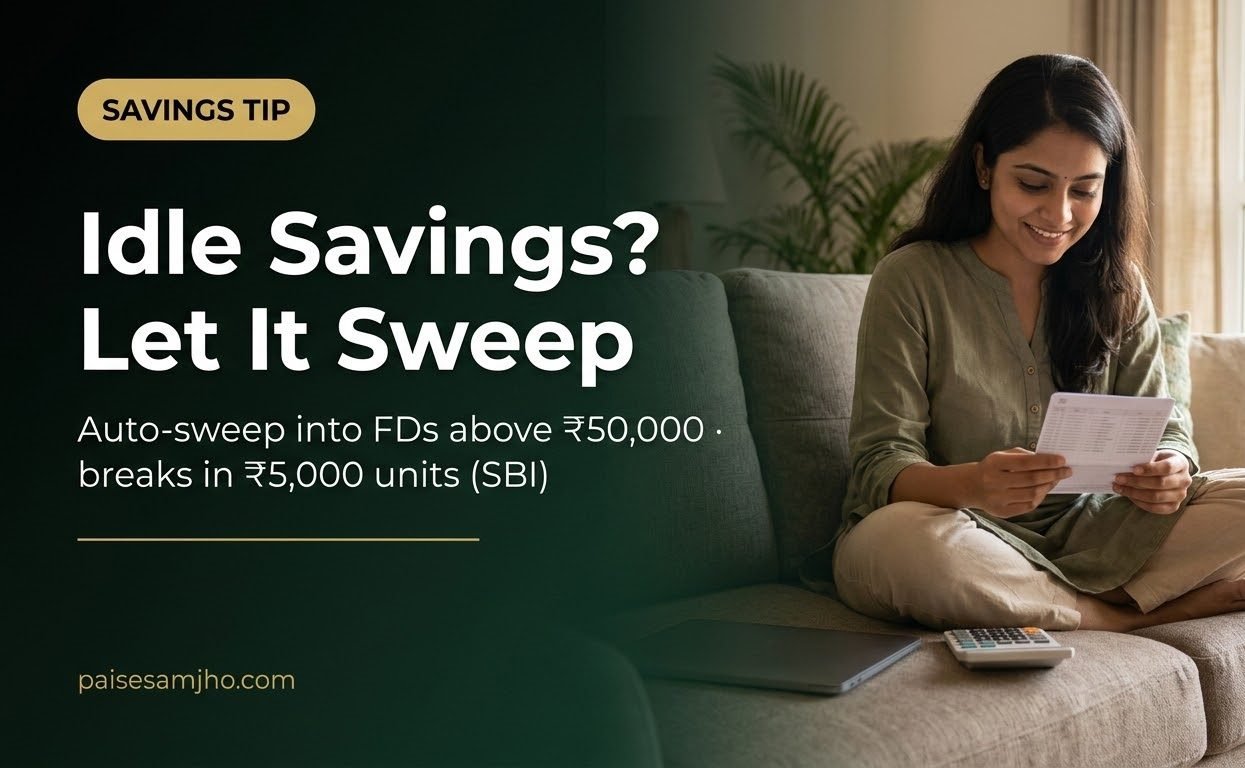
Meena keeps ₹1,20,000 in her savings account “just in case”. Most of it earns the savings rate. With an auto-sweep account, the bank would move the extra into fixed deposits by itself and pull it back when she spends. This is how a sweep-in FD works, using SBI’s Savings Plus Account as the worked example, with the rules from SBI’s own page (last updated 1 December 2025).
How a sweep-in FD works
A sweep account links your savings account to fixed deposits. When the balance crosses a set threshold, the surplus is swept out into term deposits automatically. When you need money and the savings balance falls short, the bank breaks those deposits and sweeps it back in. SBI calls the deposits MODs (Multi Option Deposits).
SBI Savings Plus Account: the sweep rules
| Rule | SBI Savings Plus |
|---|---|
| Threshold for auto sweep | ₹50,000 |
| Balance left in savings after sweep | ₹35,000 minimum |
| Minimum deposit created | ₹15,000, then multiples of ₹5,000 |
| Deposit period | 1 to 5 years |
| Reverse sweep (withdrawal) | In units of ₹5,000 |
| When a deposit falls to ₹15,000 | Whole amount returns to savings |
| Which deposit breaks first | Your choice of FIFO or LIFO; LIFO if you don’t say |
| Monthly average balance | Nil |
| Loan against the deposits | Available |
Source: SBI Savings Plus Account page. Other banks call the product auto-sweep, flexi deposit or similar, with their own thresholds.
The sweep in rupees
Back to Meena’s ₹1,20,000. SBI keeps ₹35,000 in savings and sweeps ₹85,000 (a multiple of ₹5,000) into a deposit.
If the ₹85,000 stays for a full year at SBI’s current 1-to-2-year FD card rate of 6.25%, it earns about ₹5,313. At an assumed savings rate of 2.5% (check your bank’s actual rate), it would earn about ₹2,125. The difference is about ₹3,188 a year. This is simple interest and ignores any rate the bank applies when deposits are broken early.
Now she needs ₹20,000 on top of what is in savings. The bank breaks four units of ₹5,000 from the deposit and leaves ₹65,000 still invested. Under LIFO, the most recent deposit breaks first; under FIFO, the oldest.
FIFO or LIFO: which to pick
- LIFO (last in, first out): breaks your newest deposit. Older deposits keep running towards maturity.
- FIFO (first in, first out): breaks your oldest deposit, which may be closest to completing its term.
If older deposits were booked at higher rates, LIFO protects them. SBI applies LIFO unless you give a mandate, so tell the branch if you want FIFO.
What to check before opening one
- Premature rate: a deposit broken early usually earns the rate for the period it actually ran, less any penalty. Ask the bank exactly what applies to swept deposits.
- Threshold and retained balance: SBI’s ₹50,000 trigger and ₹35,000 floor mean small surpluses won’t sweep at all.
- Tax: interest on swept deposits is FD interest, taxable at your slab and subject to TDS. If you owe no tax, note that Form 121 has replaced Forms 15G/15H from tax year 2026-27.
- Cheque and ECS debits: make sure the reverse sweep covers auto-debits, so an EMI does not bounce.
- Insurance: savings and swept FDs are added together for DICGC cover of up to ₹5 lakh per depositor per bank. See our DICGC explainer.
Sweep-in FD vs a separate FD
| Point | Sweep-in FD | Separate FD |
|---|---|---|
| Setup | Automatic, above the threshold | You book each one |
| Access | Breaks in small units when you spend | You close it (fully or as the bank allows) |
| Interest earned | FD rate while it lasts; premature terms if broken | Full FD rate if held to maturity |
| Discipline | Easy to spend | Harder to touch |
Who it may suit, who can skip it
- May suit: people who keep a large cushion in savings, such as freelancers waiting on irregular payments, or families parking a bonus before using it.
- Can skip: anyone whose balance rarely crosses the threshold, and anyone who prefers a separate FD they won’t touch. For that, compare RD vs FD.
Breaking a normal FD early has its own costs; see our FD premature withdrawal rules.
A few common questions follow.
FAQs
Is a sweep-in FD safe?
It is a bank deposit, so DICGC cover of up to ₹5 lakh per depositor per bank applies across your accounts there.
Can I withdraw swept money from an ATM?
Yes. When your savings balance runs short, the reverse sweep funds the withdrawal in ₹5,000 units at SBI.
Does SBI’s Savings Plus have a minimum balance?
Its page lists the monthly average balance as nil.
Do I get a separate FD receipt?
Ask your bank. The deposits show in your account statement or passbook.
Takeaway: a sweep-in FD earns FD interest on idle savings and returns it when you spend; check the threshold, the premature rate and FIFO/LIFO first.
Checked on
- SBI Savings Plus Account (last updated 1 Dec 2025)
- SBI retail term deposit rates
Partly verified, 12 Oct 2026, 6:00 AM IST. Read: SBI Savings Plus Account page (last updated 1 Dec 2025) and SBI retail term deposit rates. The 2.5% savings rate in the example is an assumption, not SBI’s quoted rate. SBI’s premature-withdrawal terms for MOD deposits were not read.