NEFT vs RTGS vs IMPS: Limits, Timings, Charges and Which One to Use
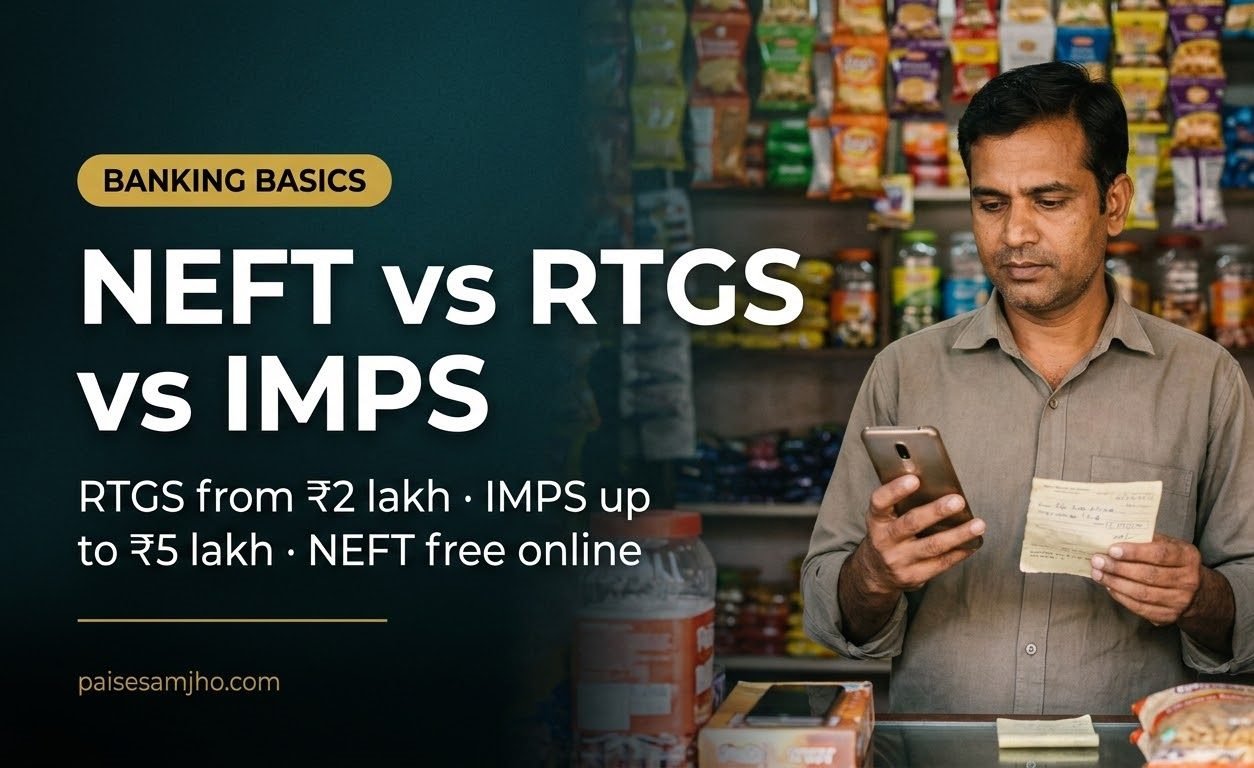
NEFT vs RTGS vs IMPS: which one should you use? All three move money between bank accounts and all three now run 24×7. The differences are in speed, minimum amount and what the bank may charge. Here is the comparison, from RBI’s own FAQs.
NEFT vs RTGS vs IMPS at a glance
| Point | NEFT | RTGS | IMPS |
|---|---|---|---|
| Run by | RBI | RBI | NPCI |
| Hours | 24x7x365 | 24x7x365 (since 14 Dec 2020) | 24×7 |
| How it settles | Half-hourly batches | Real time, one by one | Instant |
| Minimum | None | ₹2 lakh | None |
| Maximum | No RBI limit (bank may set one) | No ceiling | ₹5 lakh per transaction (₹5,000 by SMS/IVRS) |
| Charge for online SB transfer | Free | Bank may charge, capped by RBI | Set by your bank |
Sources: RBI FAQs on NEFT (updated 2 Sep 2024) and RTGS (updated 31 Oct 2022); RBI policy statement of 8 Oct 2021 for the IMPS limit.
NEFT: free online, credited in hours
NEFT works in half-hourly batches. RBI says you can expect the money within two hours of the batch settling. Banks cannot charge savings account holders for NEFT done online, a rule in force since 1 January 2020. At a branch, the bank may charge, but no more than:
| Amount | Maximum NEFT charge (plus GST) |
|---|---|
| Up to ₹10,000 | ₹2.50 |
| ₹10,000 to ₹1 lakh | ₹5 |
| ₹1 lakh to ₹2 lakh | ₹15 |
| Above ₹2 lakh | ₹25 |
If the money is late: a bank that does not credit or return the NEFT within two hours of the batch must pay penal interest at the RBI repo rate plus 2%. With repo at 5.50%, that is 7.50% a year. On ₹1,00,000 held up for two days, it comes to about ₹41. Small, but it is your right.
RTGS: for ₹2 lakh and above
RTGS settles each payment in real time and has a minimum of ₹2 lakh and no upper limit. Incoming RTGS is free. For outgoing payments the bank may charge up to ₹25 for ₹2 lakh to ₹5 lakh, and up to ₹50 above ₹5 lakh, plus tax. At 18% GST that is ₹29.50 and ₹59 at most. If a payment cannot be credited, the beneficiary bank must return it within one hour or by the end of the RTGS business day, whichever is earlier.
IMPS: instant, up to ₹5 lakh
IMPS is NPCI’s instant transfer service. In its policy statement of 8 October 2021, the RBI proposed raising the per-transaction limit from ₹2 lakh to ₹5 lakh for all channels other than SMS and IVRS, which stay at ₹5,000. NPCI’s IMPS page did not load for us today, so confirm the limit in your bank app. Your bank can set a lower daily IMPS limit, and some charge a small fee; check its schedule of charges.
Check the name before you send
Since 1 April 2025, every bank in RTGS and NEFT must let you see the beneficiary’s account name before you send money, using the account number and IFSC. RBI ordered this on 30 December 2024. It is free, and works in internet banking, mobile banking and at branches. UPI and IMPS already showed the name. If the name on screen doesn’t match the person you expect, stop. Our guide to recovering money sent to the wrong account explains why prevention beats recovery.
Which one to pick
- Rent, fees, bills under ₹5 lakh, and you want it now: IMPS or UPI. For UPI’s own caps, see UPI limits explained.
- Not urgent, any amount, and you want zero charge: NEFT online.
- Property payment, car, or anything above ₹5 lakh in one go: RTGS.
- A cheque is the only option: see how long cheque clearing takes.
Other things NEFT can do
RBI’s FAQ notes NEFT can also be used to pay credit card dues to the card-issuing bank, pay loan EMIs and receive inward foreign remittances. It also works to and from NRE and NRO accounts, subject to FEMA rules. Outward NEFT abroad is allowed only to Nepal, under the Indo-Nepal Remittance Facility. When a NEFT fails, your statement should show “NEFT-Return” against the reversed debit.
Common mistakes
- Typing the IFSC of the wrong branch. The name check helps catch this.
- Using RTGS for ₹1.5 lakh. It will be rejected; the minimum is ₹2 lakh.
- Assuming a “pending” NEFT is lost. Wait for the next batch; if it is beyond two hours of settlement, ask your bank about penal interest.
- Adding a new payee and sending a large amount at once. Some banks limit transfers to a newly added payee for a while; check your bank’s rule first.
Short answers below.
FAQs
Is NEFT available on Sundays?
Yes. NEFT runs 24×7, all year.
Can I send less than ₹2 lakh by RTGS?
No. ₹2 lakh is the RTGS minimum.
Which is fastest?
IMPS and RTGS are near-instant. NEFT credits in batches, usually within two hours.
Can I send NEFT without a bank account?
Yes, by depositing cash at a NEFT-enabled branch, up to ₹50,000 per transaction, RBI’s FAQ says.
Takeaway: NEFT vs RTGS vs IMPS in one line: use NEFT online when free and unhurried, IMPS for instant payments up to ₹5 lakh, RTGS for ₹2 lakh and above, and check the beneficiary name every time.
From the RBI
- RBI FAQs on NEFT (updated 2 Sep 2024)
- RBI FAQs on RTGS (updated 31 Oct 2022)
- RBI circular on beneficiary name look-up, 30 Dec 2024
- RBI Statement on Developmental and Regulatory Policies, 8 Oct 2021 (IMPS limit)
Partly verified, 12 Oct 2026, 6:00 AM IST. Read: RBI FAQs on NEFT (updated 2 Sep 2024) and RTGS (updated 31 Oct 2022), RBI circular of 30 Dec 2024 on name look-up, RBI statement of 8 Oct 2021 on IMPS. Not read: NPCI’s IMPS pages (403 from npci.org.in), so NPCI’s implementation of the ₹5 lakh limit and any bank-level limits are not confirmed here.