
Matured FD Not Renewed? RBI Rules on Overdue Interest, Holiday Maturity, Auto-Renewal and Unclaimed Deposits
What happens to a fixed deposit on the day it matures if you do nothing? Many depositors assume the bank keeps paying the same rate. Often it does not. Under RBI’s rules, a matured FD left unpaid earns interest at the savings account rate or the original FD rate, whichever is lower, unless you have given an auto-renewal instruction. On a ₹5 lakh deposit, three months of neglect can cost several thousand rupees. This guide covers what RBI requires for a matured FD, the special cases (holidays, renewals, deaths, joint deposits) and a simple routine to avoid losing interest.
The core rule for a matured FD
RBI’s Master Direction on Interest Rate on Deposits, 2025 says: “If a Term Deposit (TD) matures and proceeds are unpaid, the amount left unclaimed with the bank, shall attract rate of interest as applicable to savings account or the contracted rate of interest on the matured TD, whichever is lower.”
Two points follow from that sentence. First, once your deposit matures, the bank is not obliged to keep paying the FD rate. Second, if the savings rate is higher than your old FD rate, which is rare, you get the old FD rate, not the savings rate. In normal times the savings rate is far lower, so it is the one that applies.
| What happens at maturity | Interest you earn after maturity |
|---|---|
| Auto-renewal instruction on file | New FD rate for the renewed tenor, from the maturity date, as per bank’s card rate on that date |
| Instruction to credit proceeds to savings account | Savings rate on the credited amount |
| No instruction; proceeds left unpaid | Lower of savings rate or the old FD rate on the unpaid amount |
| Renewal requested later, after maturity | Depends on the bank’s board-approved policy on overdue deposits; ask before you renew |
The fourth row matters. The Master Direction says the rate on renewal of overdue deposits follows the bank’s general interest rate framework, which requires a board-approved policy. Many banks allow back-dated renewal from the maturity date if you renew within a short window, often 14 days; others pay the overdue rate for the gap. This is bank policy, not an RBI rule, so check yours.
Worked example: the cost of forgetting
Say a ₹5,00,000 FD matures, the bank’s savings rate is 2.7% and a new one-year FD would earn 6.5%. These are illustrative rates.
| Scenario | Interest earned |
|---|---|
| Left unclaimed for 90 days at the savings rate | about ₹3,329 |
| Renewed on maturity at 6.5% (90 days’ worth) | about ₹8,014 |
| Difference | about ₹4,685 |
| Left unclaimed for a full year at 2.7% | ₹13,500 |
| Renewed for a year at 6.5% | ₹32,500 |
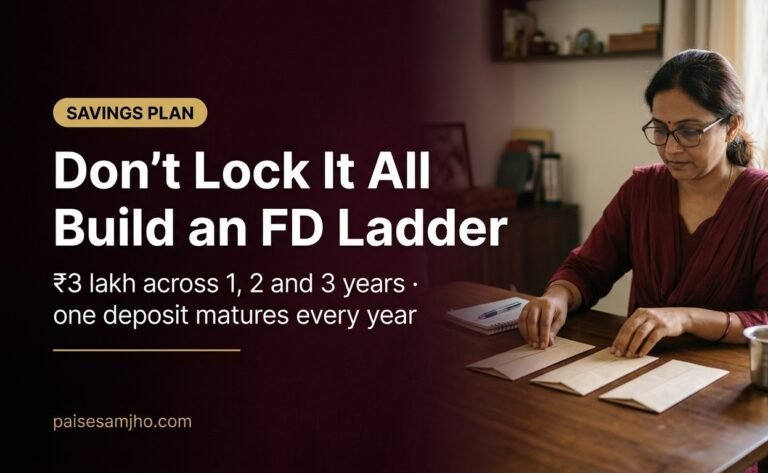
All figures are our calculations using simple interest. The longer the money sits, the bigger the gap. Our FD ladder guide shows one way to stagger maturities so this is easier to manage.
When maturity falls on a holiday
RBI’s directions protect you here. If a term deposit matures on a non-business working day, a commercial bank must pay interest “at the originally contracted rate on the original principal deposit amount” for the days until the next working day, when the proceeds are paid. For reinvestment and recurring deposits, interest for those days is paid on the maturity value. Co-operative banks follow the same rule for Sundays, holidays and non-business days.
On a ₹5 lakh FD at 7%, one extra day is worth about ₹96, and a two-day weekend about ₹192. Small, but it should appear in your statement. If it does not, ask.
Auto-renewal: how it works and what to check
Most banks let you choose at the time of opening: renew principal only, renew principal and interest, or credit everything to savings. Auto-renewal avoids the overdue-rate problem, but check four things:
- The rate on renewal is the card rate on the maturity date, not your old rate. If rates have fallen, you get less.
- The tenor is usually the same as the original, unless you set a different one.
- Tax-saving FDs with a five-year lock-in do not usually renew into another tax-saving FD automatically; check the bank’s terms.
- Senior citizen rates are applied on renewal only if your age and status are recorded correctly.
Under RBI’s rules on inoperative accounts, an auto-renewal instruction counts as a customer-induced transaction, so an auto-renewing FD does not become inoperative just because you have not visited the bank.
Breaking an FD before maturity
Premature withdrawal is a different case. RBI’s directions say interest on premature withdrawal is paid “at the rate applicable to the amount and period for which the deposit remained with the bank and not at the contracted rate”, and no interest is paid if the deposit is withdrawn before the minimum seven-day tenor. Banks may also levy a penalty under a board-approved policy, but only if the penalty was disclosed when you opened the deposit. Term deposits of ₹1 crore or less from individuals must have a premature withdrawal facility. Our premature withdrawal guide has worked examples.
When a depositor dies
Two rules help families:
- RBI’s 2025 directions on settling claims of deceased customers require banks to put a clause in the account opening form allowing premature termination of term deposits without any penal charge on the depositor’s death, even within a lock-in period.
- For joint FDs, premature closure on the death of one holder needs the consent of the surviving holders and the legal heirs of the deceased, unless all holders gave a specific mandate allowing survivors to withdraw early. Splitting a deceased depositor’s FD among claimants without changing the period or total amount attracts no premature withdrawal penalty.
A matured FD in a deceased depositor’s name earns interest under the bank’s policy framework. Our nominee and legal heir guide explains the claim process and timelines.
Unclaimed for years: the DEA Fund
If a matured FD is never claimed, the money does not disappear. RBI’s rules on inoperative accounts and unclaimed deposits require banks to review, at least once a year, term deposits where there is no renewal mandate and the proceeds have not been withdrawn or moved to a savings or current account after maturity. Banks must write to depositors by letter, email or SMS. Any amount unclaimed for ten years or more must be transferred to the Depositor Education and Awareness (DEA) Fund maintained by RBI.
You or your legal heirs can still claim it from the bank at any time, with interest as per RBI’s rules for the DEA Fund. RBI’s UDGAM portal lets you search for such deposits across banks; our UDGAM guide shows how.
Tax on interest after maturity
Interest earned after maturity, whether at the overdue rate or on renewal, is taxable in the year it accrues, like any FD interest. Banks deduct TDS once your interest crosses the applicable threshold. If your total income is below the taxable limit, you can submit the declaration that replaced Forms 15G and 15H; our Form 121 guide explains it. This is a general summary, not tax advice; thresholds depend on the current Income Tax Act and your circumstances.
Edge cases
- Bulk deposits. Deposits above the bank’s bulk threshold earn bulk rates. On renewal, check whether the bulk card rate applies to the renewed amount.
- Interest rounding. RBI’s directions require interest on rupee deposits to be rounded off to the nearest rupee.
- Same rate for everyone. Rates must be uniform across branches and customers for deposits of similar amount accepted on the same date, and are not open to negotiation. A branch cannot quietly offer you a better renewal rate than the card.
- Co-operative bank deposits follow similar maturity and holiday rules. Insurance cover from DICGC, the RBI-owned deposit insurer, applies up to ₹5 lakh per depositor in the same capacity, including interest.
- Frozen accounts. Savings interest is credited even on accounts frozen by enforcement agencies, so proceeds credited to a frozen savings account still earn the savings rate.
Recurring deposits and senior citizen FDs
A recurring deposit (RD) matures like an FD. If its maturity date falls on a non-business day, RBI’s directions say interest for the intervening days is paid on the maturity value, not just the principal. If an RD’s maturity proceeds are left with the bank, the same overdue logic applies as for an FD.
Banks may, at their discretion, run term deposit schemes for resident Indian senior citizens with higher fixed rates. RBI’s directions say this facility is not offered on deposits in the name of a Hindu Undivided Family (HUF) or its Karta, even if the Karta is a senior citizen. When a senior citizen’s FD renews, check that the senior rate has been applied to the new deposit.
If your bank changes hands
Bank branches are sometimes taken over by another bank, especially in rural and semi-urban areas. RBI’s directions say deposits transferred this way continue on the original terms, and the same rate is payable until maturity as was payable at the time of takeover. What happens after maturity then follows the new bank’s policy, so renew with care.
If the bank paid the wrong rate
Compare the interest credited with your FD advice and the bank’s published card rate for the date of renewal. If the overdue rate was applied when you had an auto-renewal instruction, or holiday interest is missing, write to the branch with the FD number and dates and ask for a correction. If you get no satisfactory reply in 30 days, you can complain to the RBI Ombudsman through RBI’s complaint portal.
A five-minute maturity routine
- Keep a list of all FDs with maturity dates, amounts and banks, in a notebook or spreadsheet.
- Set a reminder two weeks before each maturity.
- Check current FD rates at your bank and one or two others.
- Decide: renew, move to another bank, or use the money.
- Give the instruction in net banking or at the branch before maturity, and keep the confirmation.
- After maturity, check the new FD advice or the credit in your savings account, including any holiday interest.
Done once a quarter, this routine takes minutes and keeps every matured FD earning the rate you chose.
FAQs
What interest does a matured FD earn if I do not renew it?
The savings account rate or the original FD rate, whichever is lower, on the unpaid amount, under RBI’s directions.
Can I renew a matured FD from the maturity date?
It depends on your bank’s policy. Many allow back-dated renewal within a short window; ask before you renew.
What if my FD matures on a Sunday or bank holiday?
You get the original FD rate on the principal for the days until the next working day.
What happens if a matured FD is never claimed?
After ten years the bank transfers it to RBI’s DEA Fund. You or your heirs can still claim it from the bank.
Does auto-renewal lock in my old rate?
No. Renewal is at the bank’s card rate on the maturity date.
Takeaway: A matured FD left unclaimed earns only the savings rate or the old FD rate, whichever is lower. Set an auto-renewal instruction or act before maturity, check holiday interest, and keep a maturity list so no deposit drifts into the DEA Fund.
RBI rules referred to
- RBI: Master Direction – Interest Rate on Deposits, 2025 (1 Apr 2025)
- RBI: Inoperative Accounts / Unclaimed Deposits – Revised Instructions (1 Jan 2024)
- RBI: Settlement of Claims in respect of Deceased Customers of Banks Directions, 2025 (26 Sep 2025)
Partly verified, 22 Oct 2026, 8:18 PM IST. Overdue, holiday, premature and senior-citizen rules are from RBI’s Master Direction on Interest Rate on Deposits (1 Apr 2025); DEA Fund and annual review from RBI’s 1 Jan 2024 circular; death-related rules from RBI’s 2025 deceased-claims directions. Back-dated renewal windows, tax-saving FD renewals and TDS points are general and vary by bank and tax law.