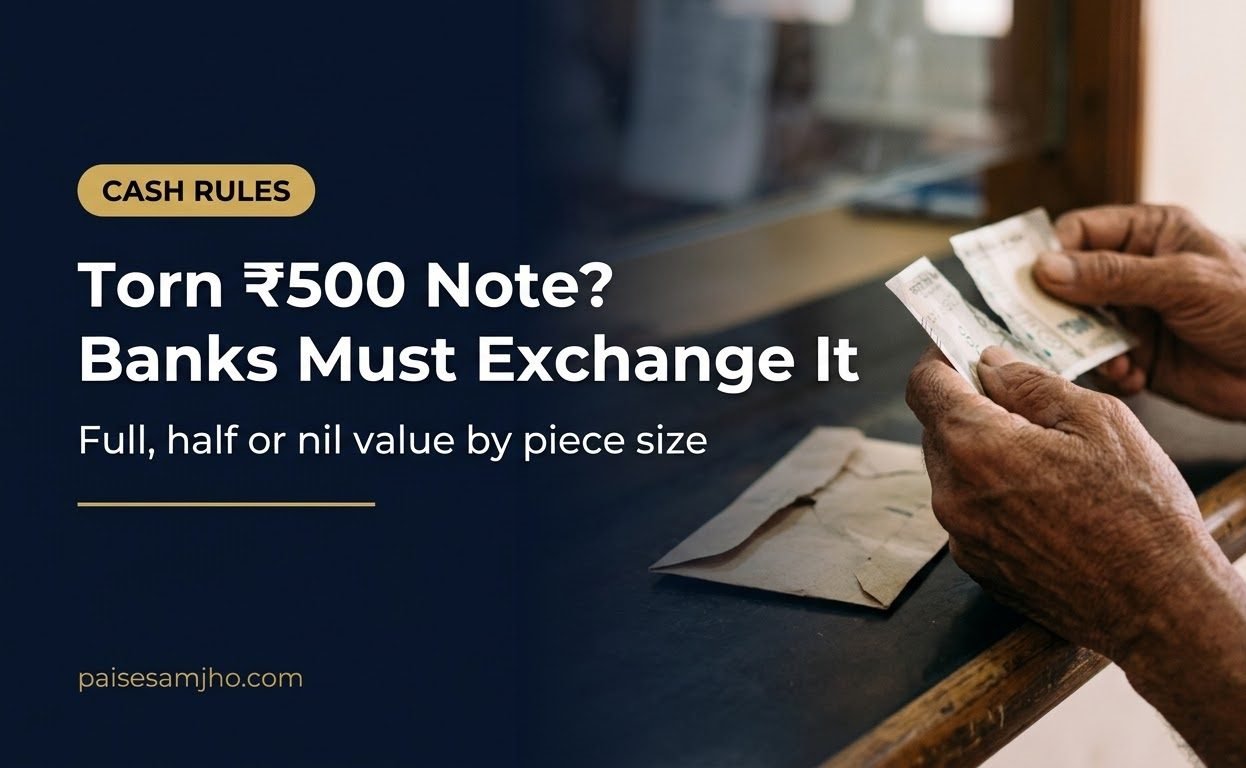
Torn Note Exchange Rules: How Much a Bank Pays for a Damaged ₹500 Note
At a bank counter, the torn ₹500 note usually comes out of an envelope with an apology, as if the customer expects to be turned away. They shouldn’t. RBI’s Master Direction says “None of the bank branches shall refuse to accept coins and/ or small denomination notes”, and it requires every branch to exchange damaged notes for customers and non-customers alike, free of cost. The torn note exchange rules decide only how much you get back: full value, half value or nothing. That depends on how much of the note is left.
The governing documents are RBI’s Master Direction – Facility for Exchange of Notes and Coins (RBI/DCM/2026-27/395, DCM (NE) No.G-2/08.07.18/2026-27, 1 April 2026, updated as on 1 September 2026) and the Reserve Bank of India (Note Refund) Rules, 2009, as amended in 2018.
Soiled, mutilated or imperfect: the category decides the route
| Type | RBI’s definition (Master Direction) | What the branch does |
|---|---|---|
| Soiled | “dirty due to normal wear and tear”, including a two-piece note pasted together where both pieces belong to the same note “with no essential feature missing” (para 3) | Exchanges or credits to your account |
| Mutilated | “a portion is missing or which is composed of more than two pieces” (para 4.1) | Adjudicates under the Note Refund Rules (full, half or nil) |
| Imperfect | “wholly or partially, obliterated, shrunk, washed, altered or indecipherable” (para 4.2) | Adjudicates, if the note can withstand normal handling |
| Brittle, charred or stuck together | Cannot “withstand normal handling” (para 5) | Not accepted at branches. Send to an RBI Issue Office, in person or by insured post with your bank details |
Torn note exchange rules: how much a damaged ₹500 note fetches
For notes of ₹50 and above, Rule 8(2) of the Note Refund Rules pays full value if the single largest undivided piece is more than 80% of the note’s area. It pays half value at 40% to 80%. Below 40%, “no value shall be payable”. Table 2 of the Rules turns this into square centimetres:
| Note | Area (cm²) | Minimum piece for full value (cm²) | Minimum piece for half value (cm²) |
|---|---|---|---|
| ₹500 | 99.00 | 80 | 40 |
| ₹200 | 96.36 | 78 | 39 |
| ₹100 (new MG series) | 93.72 | 75 | 38 |
| ₹50 (new MG series) | 89.10 | 72 | 36 |
Our check: 80% of 99 cm² is 79.2, which rounds up to 80, and 40% is 39.6, which rounds up to 40. That matches RBI’s table (scripts/calc.py).
One ₹500 note, three outcomes
- Largest piece measures 85 cm²: ₹500 (full value).
- Largest piece measures 60 cm²: ₹250 (half value).
- Largest piece measures 35 cm²: ₹0, and the claim is rejected.
There is one exception that helps. Under Rule 8(2)(iv), if a ₹50-or-higher note comes in two pieces of the same note and each piece is at least 40% of the area, the claim “may be refunded for full value”. For notes below ₹50, Rule 8(1) is stricter: full value if the largest piece is more than 50% of the area, otherwise rejected. There is no half value. For the new ₹10 note, the threshold in Table 1 is 39 cm².
How many notes at once, and how fast you are paid
| What you bring | Rule | Example |
|---|---|---|
| Soiled: up to 20 pieces and ₹5,000 a day | Exchanged over the counter, “free of charge” (para 6.1.1) | 8 soiled ₹500 notes (₹4,000): paid on the spot |
| Soiled: more than 20 pieces or ₹5,000 | Accepted against a receipt; payment date on the receipt “shall not exceed 7 days”. Banks “may levy reasonable service charges” (para 6.1.2) | 30 soiled ₹100 notes (₹3,000) or 12 soiled ₹500 notes (₹6,000): receipt, credit within 7 days |
| Mutilated: up to 10 pieces | Branch “shall normally adjudicate” and pay over the counter (para 6.2.2) | One torn ₹500 note: decided at the counter |
| Mutilated: more than 10 pieces or ₹5,000 | Accepted against a receipt for later credit (para 6.2.3) | Bundle damaged in a flood |
| Branch without a currency chest can’t adjudicate | Sent to the linked chest branch; payment date on the receipt “shall not exceed 30 calendar days” (para 6.2.4) | Small rural branch |
From the banker’s desk: don’t tape the pieces together and don’t trim ragged edges. Notes “found to be deliberately cut, torn, altered or tampered with” are rejected under Rule 6(3)(ii). A neat-looking repair can look like tampering. Bring the pieces loose in an envelope.
What gets a note rejected under the rules
- Political or religious slogans written across it. Such a note “ceases to be a legal tender” (para 10.2.4).
- A “PAY”, “PAID” or “REJECT” stamp from an earlier adjudication (para 10.1.2).
- Signs of deliberate cutting (para 10.3).
Under the torn note exchange rules, scribbling and colour or oil stains alone don’t make a note invalid. Para 10.2.5 says such notes “continue to be legal tender” and can be deposited or exchanged at any branch.
If the branch refuses
Para 9 of the Master Direction says you can complain to the branch, and if there’s no reply in 30 days, or you aren’t satisfied, take it to the RBI Ombudsman through cms.rbi.org.in. Every branch must also display a board reading “SOILED/ MUTILATED NOTES AND COINS ARE ACCEPTED AND EXCHANGED HERE” (para 13). Point to it if the counter turns you away. Our guides on depositing cash, ATM charges and minimum-balance rules cover the other everyday cash questions.
Notes on what’s unconfirmed: (1) The Master Direction (updated 1 September 2026) still names the 2021 Integrated Ombudsman Scheme in para 9, although RBI says the 2026 scheme replaced it from 1 July 2026. We take that as a reference not yet updated, which is our inference. (2) “Reasonable service charges” for bulk soiled notes aren’t fixed in rupees. They depend on your bank’s schedule. (3) We didn’t check whether any bank has published its own counter-level limits beyond RBI’s.
So before the FAQ, the torn note exchange rules in one line: measure the largest piece, keep the pieces untaped, and expect the decision at the counter for up to 10 mutilated notes.
FAQ
Can a bank refuse to exchange a torn note if I don’t have an account there?
No. Para 1.3 requires branches to offer exchange “not only to their customers but also others”. Small finance banks in their first two years and payment banks may do so “at their option” for mutilated notes.
Is there a fee to exchange damaged notes?
Small lots of soiled notes and the adjudication of mutilated notes are free. For bulk soiled notes, banks “may levy reasonable service charges”.
What about a burnt note?
If it can’t withstand normal handling, branches won’t accept it. Send it to an RBI Issue Office for adjudication under a special procedure.
Is a note with pen marks still valid?
Yes. RBI says notes with scribbling or stains “continue to be legal tender”. Notes with political or religious messages written on them do not.
Takeaway: every bank branch must take your damaged note. How much you get back is decided by measuring the largest piece, not by the cashier’s judgement.
Where the numbers come from
RBI Master Direction – Facility for Exchange of Notes and Coins, RBI/DCM/2026-27/395, DCM (NE) No.G-2/08.07.18/2026-27, 1 Apr 2026 (updated 1 Sep 2026): paras 1.3, 1.5, 3, 4.1, 4.2, 5, 6.1.1, 6.1.2, 6.2.2–6.2.4, 9, 10.1.2, 10.2.4, 10.2.5, 10.3, 13.
Reserve Bank of India (Note Refund) Rules, 2009, as amended by the Note Refund (Amendment) Rules, 2018 (RBI publication dated 28 Dec 2018): Rules 6(3)(ii), 8(1), 8(2)(i)–(iv), Tables 1–2.
RBI FAQs on RB-IOS 2026: replacement of the 2021 scheme from 1 Jul 2026.
Last verified: 6 Oct 2026, 11:17 PM IST. Checked: RBI Master Direction RBI/DCM/2026-27/395 (updated 1 Sep 2026), Note Refund Rules 2009 as amended 2018, RBI RB-IOS 2026 FAQs.