Form 121 (Earlier Form 15G/15H): How to Avoid TDS on FD & Bank Interest
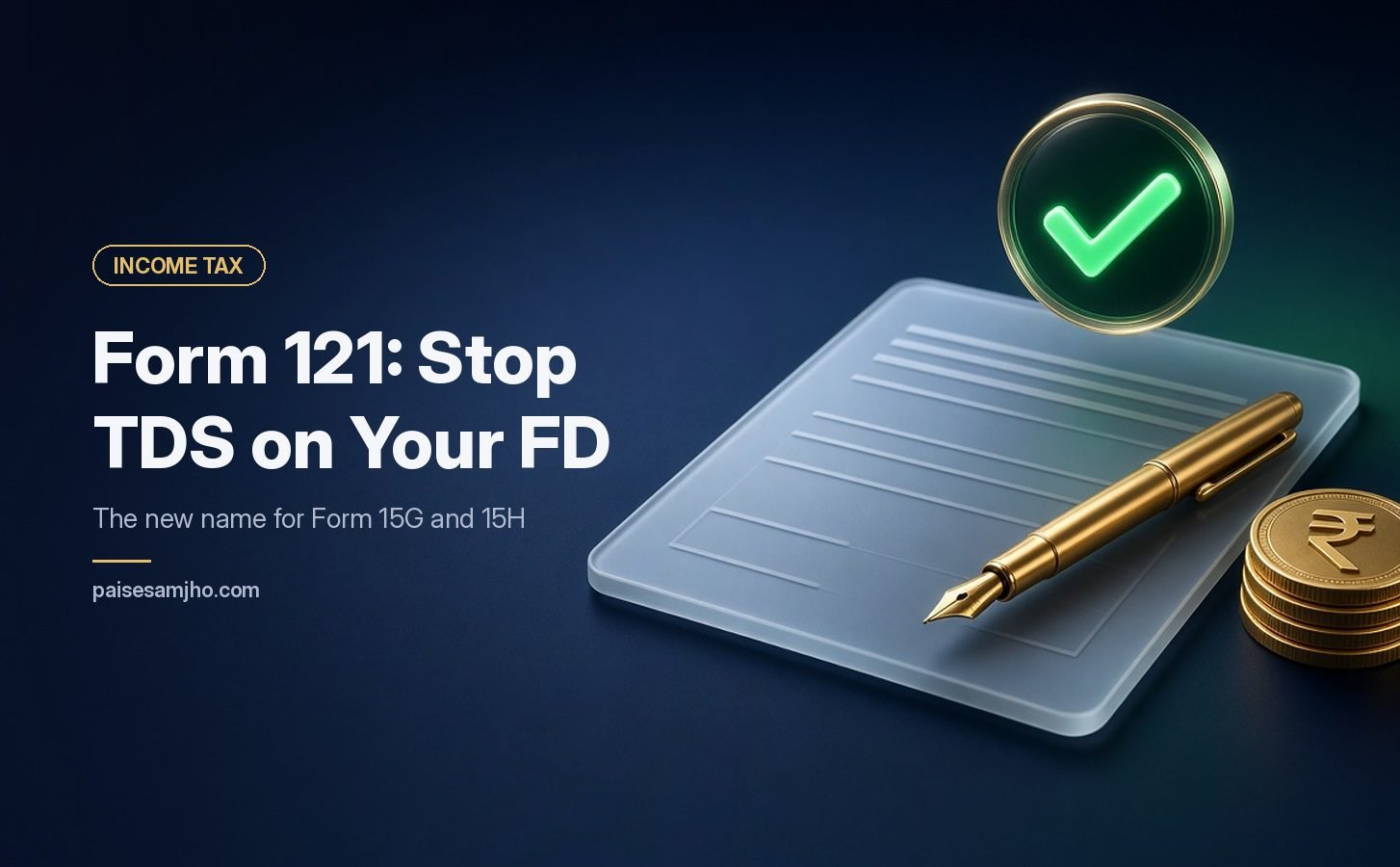
Bank just credited FD interest and quietly cut TDS — even though you believe your total tax for the year is nil. For years, the fix was Form 15G (non-seniors) or 15H (seniors). From the tax year beginning on or after 1 April 2026, those declarations are replaced by a unified Form No. 121 under the Income-tax Rules, 2026. If you are still searching “Form 15G 15H”, this guide maps the old names to Form 121 and explains how to avoid unnecessary TDS on FD and other interest, without inventing exemptions you do not have. The focus keyword people type is often Form 15G 15H Form 121 TDS FD — same problem, new form number.
Official references include the Income Tax Department’s forms help on incometax.gov.in and the dedicated Form 121 FAQs. Threshold changes under Section 194A from Finance Act 2025 are explained in professional summaries such as TaxGuru’s Budget 2025 note on Section 194A. For product context on deposits, see RBI FD rules 2026; for cash-reporting hygiene, bank cash deposit rules; for income components on the payslip, salary slip guide.
Why do banks deduct TDS on FD interest?
When a bank, co-operative bank or specified Post Office credit pays you interest on deposits, Section 194A of the Income-tax law can require Tax Deducted at Source if interest crosses the annual threshold. TDS is not a final tax demand by itself. It is an advance collection mechanism. If your actual tax liability is lower, you reclaim via ITR or refund. Form 121 exists so eligible residents can declare that tax on their estimated total income is nil, and the payer need not deduct TDS on specified payments.
One mindset shift matters: nil TDS is not the same as tax-free interest. Interest remains part of your income computation unless a specific exemption applies. Form 121 only addresses the withholding event at the payer.
What changed from Form 15G / 15H to Form 121?
Per Income Tax Department FAQ framing, from the tax year beginning on or after 01.04.2026, the nil-TDS declaration is Form No. 121. Forms 15G and 15H are replaced for that new framework. The legal basis sits in Section 393(6)/(7) of the Income-tax Act, 2025 (corresponding to the old Section 197A idea).
Search engines will keep showing “15G/15H” for years. Mentally translate: same job (nil-tax declaration to payer), new form number, new Act references. Banks’ net-banking menus may still say 15G/15H during transition. Follow the form number actually generated and the tax year’s instructions.
Who can submit Form 121?
High-level eligibility from the Form 121 FAQ framing: resident individuals, HUFs and other permitted categories can submit; companies and firms cannot. For people under 60, estimated tax on total income must be nil, and the aggregate of specified incomes covered by the declaration must sit within the basic exemption limit logic the FAQ describes. For senior citizens (60+), you still need nil estimated tax, but the second test is relaxed relative to under-60s (as the FAQ contrasts).
If you have salary taxed under PAN, capital gains, or business income that creates a tax liability, do not casually tick “nil tax” just to stop FD TDS. Wrong declarations create compliance risk. When unsure, compute estimated income carefully (or with a professional), then decide.
When does Section 194A actually trigger TDS?
Finance Act 2025 revised Section 194A thresholds with effect from 01.04.2025. For banks, co-operative banks and specified post-office interest, TDS is generally required only if interest exceeds ₹50,000 in a year for non-senior resident payees, or ₹1,00,000 in a year for resident senior citizens.
Below the threshold, many savers will not see TDS even without Form 121. Above the threshold, eligible nil-tax residents still use Form 121 to prevent withholding. Thresholds and payer categories can be nuanced (different payers, different sections). Read the bank’s TDS circular and the Act text for your case.
Illustrative teaching example: Priya (age 35) expects ₹62,000 interest from Bank A FDs in FY 2026-27 and has no other income. If her estimated tax is truly nil and she meets Form 121 tests, she submits Form 121 to Bank A before interest crediting. Rohan (age 35) earns salary with positive tax liability. Form 121 is not his tool; he lets TDS happen or uses other legally available certificates if any.
How do you submit the declaration to each bank?
- Estimate your total income and tax for the tax year honestly.
- Confirm you meet Form 121 residential, category and nil-tax tests.
- List every bank, co-op bank, Post Office or other payer that will credit interest above thresholds.
- Submit Form 121 (or the bank’s e-declaration that maps to it) to each payer — preferably before interest is credited or compounded into TDS.
- Save acknowledgement / UIN details the payer shares.
- Revisit if you open a new FD with a new bank mid-year — that new payer needs its own declaration.
One Form 121 at Bank A does not cover Bank B. This is the most common failure mode.
What are UIN and your ongoing responsibilities?
Payers allot or report unique identification details for declarations and upload them in the prescribed TDS statement cycle (including quarterly reporting obligations under the TDS system). Your jobs are to give correct PAN (operative and linked as required), not reuse last year’s declaration blindly without checking the new form and tax year, update the payer if your estimate changes from nil-tax to taxable, and keep copies for ITR time.
If PAN is inoperative, expect friction on interest reporting and refunds. Fix Aadhaar–PAN linking before you fight TDS.
What mistakes still get TDS deducted?
Common failure patterns: submitting after the interest credit or TDS event for the quarter; submitting to one bank but holding FDs in three; assuming senior-citizen age alone is enough without nil estimated tax; ignoring RD, savings interest or recurring sweep products that also aggregate under 194A toward the threshold; using Form 121 when tax is clearly payable (then facing notices); and wrong PAN or name mismatch so the payer rejects the declaration.
Does stopping TDS mean you can skip the ITR?
No. Even if Form 121 stops TDS, you may still need to file ITR because of other criteria (income above basic exemption, reporting requirements, carry statements, and so on). AIS and Form 26AS will still show interest income reported by banks. Match them when you file. Stopping TDS is not the same as hiding interest.
What if TDS was already cut?
- Log in to the e-filing portal and open Form 26AS / AIS.
- Confirm the TDS entry under the bank’s TAN.
- Claim credit in the correct ITR schedule when you file.
- If TDS was incorrect, pursue rectification with the bank and, if needed, follow Department grievance paths.
- For the next credit cycle, place Form 121 early if you are eligible.
Refunds take their own processing time. Prevention via timely Form 121 is kinder to cashflow than reclaiming later.
Checklist for Tax Year 2026-27
- I know Form 15G/15H maps to Form 121 for tax years beginning on/after 01.04.2026
- I estimated tax liability (not just FD interest)
- I checked 194A thresholds (₹50,000 / ₹1,00,000 senior framing from 01.04.2025 changes)
- I submitted to every interest payer
- PAN is operative; nomination and FD advice are filed
- I will still review AIS and file ITR if required
- I re-read Department Form 121 FAQs before signing
Worked scenarios (illustrative only)
Scenario A. Under-60, low income, multi-bank FDs: Meera is 40, has freelance income below the basic exemption after deductions she is legally entitled to, and holds FDs in two private banks plus a Post Office TD. Combined interest may exceed ₹50,000. She prepares one Form 121 per payer, submits in April of Tax Year 2026-27, and archives acknowledgements. If a third bank FD is opened in December, she files a fresh declaration there before the first interest credit.
Scenario B. Senior with pension: Suresh is 67 with taxable pension and FD interest of ₹1,20,000 at one bank. Even though the senior 194A threshold is ₹1,00,000, his estimated total tax is not nil. Form 121 does not fit. He accepts TDS or adjusts advance tax and claims credit via 26AS in the ITR.
Scenario C. Threshold only: Ananya is 30 with a single bank FD ladder producing ₹40,000 interest and no other payer. Under the post-01.04.2025 ₹50,000 bank-interest framing, TDS may not trigger at all. She still monitors AIS in case other interest aggregations appear.
These scenarios teach decision trees. They are not assessments of any reader’s tax liability.
Does Post Office interest work the same way?
Whether interest comes from a scheduled bank FD, a co-operative bank deposit, or a specified Post Office product covered by Section 194A, the Form 121 idea is the same: eligible resident payee declares nil tax to that payer. Menus differ — net banking upload, branch form, or India Post counter — but “one declaration covering every institution in India” does not exist. Walk payer by payer.
When you compare FD rates across banks after the October 2026 disclosure discipline, add a compliance column to your sheet: “Form 121 submitted? UIN/ack saved?” Rate shopping without TDS hygiene is how April surprises happen. Pair this habit with the transparency points in our RBI FD rules explainer.
Frequently asked questions
What is Form 121 income tax 2026 about?
Form 121 is the unified nil-TDS declaration replacing Forms 15G and 15H for tax years beginning on or after 1 April 2026, under Income-tax Rules 2026 / Act 2025 framework as explained in Department FAQs.
How do I submit Form 15G online through bank menus now?
Use your bank’s e-declaration journey for the relevant tax year. Confirm the generated form is Form 121 (or the bank’s mapped equivalent) rather than an outdated template. Prefer submitting before interest credit.
What is the TDS on FD interest Section 194A threshold?
From 01.04.2025 changes, bank/co-op/specified PO interest generally attracts TDS only above ₹50,000 a year (₹1,00,000 for resident senior citizens), subject to the exact payer rules.
Can HUFs use Form 121?
Resident HUFs are within the permitted non-company categories in the FAQ framing; companies and firms are out. Follow the FAQ’s exact entity list.
I am 62 with taxable pension, can I use Form 121 on FD?
Only if estimated tax on total income is nil under the senior test. Taxable pension usually means Form 121 is the wrong tool.
Does Form 121 make FD interest tax-free?
No. It can stop TDS at source when you are eligible. Interest still enters your income computation unless exempt under law.
Where do I read the official Form 121 FAQs?
Income Tax Department document: form-121-faqs on incometaxindia.gov.in, plus the e-filing forms help hub.
So what should you do before the next interest credit?
This week, list every bank, co-op bank and Post Office that will credit you interest in Tax Year 2026-27. Estimate your full-year tax honestly. If you truly qualify for nil estimated tax under the Form 121 tests, submit the declaration to each payer before the next credit cycle, and save the acknowledgements. If you do not qualify, stop chasing 15G/15H folklore and plan for TDS credit via 26AS instead.
Also check that your PAN is operative. Fighting TDS with an inoperative PAN wastes more time than the form itself.
Disclaimer: Educational summary of Income Tax Department Form 121 guidance and Finance Act 2025 / Section 194A threshold reporting as of 24 Sep 2026 IST. Rules, portals and bank menus change, verify on incometax.gov.in and with your payer before submitting any declaration.