Paytm Payments Bank Removed From RBI’s Second Schedule: What Depositors Should Know
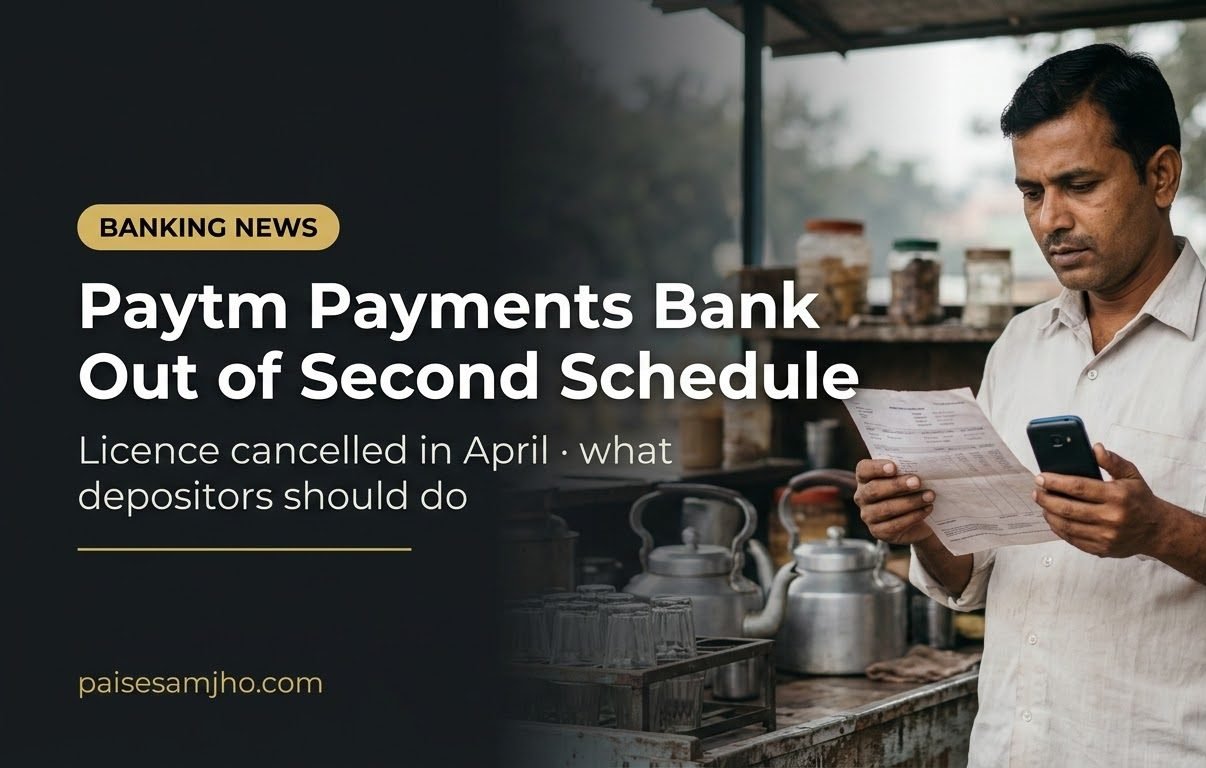
“Paytm Payments Bank Limited has been excluded from the Second Schedule to the Reserve Bank of India Act, 1934.” That single sentence was RBI’s whole announcement on Wednesday 7 October (press release 2026-2027/1273). The exclusion itself took effect through a notification dated 31 July 2026, published in the Gazette of India on 7 September. For anyone who still has money in a Paytm Payments Bank account, this is mostly paperwork catching up with a decision taken in April.
What the Second Schedule exclusion means
Banks named in the Second Schedule of the RBI Act are “scheduled banks”. The exclusion follows from what RBI did on 24 April 2026: under Section 22(4) of the Banking Regulation Act, it cancelled the bank’s licence “effective from close of business on April 24, 2026”. From then on, the bank was “prohibited from conducting the business of ‘banking'” (RBI PR 2026-2027/143). A bank that is no longer allowed to do banking business does not stay on the schedule.
| Date | Step | RBI document |
|---|---|---|
| 11 Mar 2022 | Told to stop onboarding new customers | Referred to in PR 2026-2027/143 |
| 31 Jan and 16 Feb 2024 | Business restrictions; no further deposits, credits or top-ups in existing accounts and wallets | PR 2026-2027/143; RBI FAQs of 16 Feb 2024 |
| 24 Apr 2026 | Banking licence cancelled; RBI to seek winding up before the High Court | PR 2026-2027/143 |
| 31 Jul 2026 | Notification excluding it from the Second Schedule | DoR.LIC.No.S3674/16.13.215/2026-27 |
| 7 Sep 2026 | Notification published in the Gazette (Part III, Section 4) | As per PR 2026-2027/1273 |
| 7 Oct 2026 | RBI press release announcing the exclusion | PR 2026-2027/1273 |
136 days passed between the licence cancellation and the Gazette notice.
Why RBI cancelled the licence
The April release lists four grounds under Section 22(3) of the Banking Regulation Act:
- the affairs of the bank “were conducted in a manner detrimental to the interest of the bank and its depositors” (clause b);
- the “general character of the management” was “prejudicial to the interest of depositors as also the public interest” (clause c);
- “No useful purpose or public interest would be served by allowing the bank to continue” (clause e);
- the bank failed to comply with the conditions of its payments bank licence (clause g).
Paytm Payments Bank deposits: what RBI has said about repayment
The most useful line for depositors is in the April release: “[The bank] has enough liquidity to repay its entire deposit liability upon winding up of the bank.” The phrase “upon winding up” matters. RBI said it would apply to the High Court for winding up, and repayment goes through that process rather than through any app.
Payments banks could hold only small balances. RBI’s FAQs from February 2024 refer to the cap of “₹2 lakh per individual customer at the end of day” (RBI FAQs on Paytm Payments Bank). Those FAQs date from the 2024 restrictions, so treat their operational answers as historical.
What we could not confirm from an official source: whether the High Court has made a winding-up order, who the liquidator is, and when or how depositors will be paid. Some news reports say a winding-up order has been passed. We found no RBI or court notice we could check, so we are not giving a date or a process here.
What account holders can do now
- Keep proof of your balance. Save your last statement, passbook view or app screenshots showing the account number and balance, plus the KYC details on the account.
- Watch official channels only. Claim instructions should come from the court-appointed liquidator or be referred to by RBI. Ignore calls or links offering “fast refunds” for a fee.
- Move recurring payments. Any salary credit, subsidy or EMI mandate still pointing to this account should already have been moved, because credits have been barred since 2024. Update them with the payer if you haven’t.
- Check your UPI setup. If an old UPI ID was linked to this bank, link a different bank account. Our guide to UPI and UPI Lite limits covers the basics, and for bank transfers there is NEFT vs IMPS vs RTGS.
- Complain in writing if something is stuck. Keep dated copies of every complaint you send.
Money left untouched in a regular bank account for years can end up with the Depositor Education and Awareness Fund. That is a different route from a winding-up, but if you are tracing old balances generally, see our explainer on unclaimed deposits and UDGAM.
The bank is a separate company from the Paytm app’s operator. This piece covers only the bank; it does not cover the app’s other services.
The answers below cover the questions depositors raise most often.
FAQ
Is my money in the bank lost?
RBI’s April statement says the bank has enough liquidity to repay “its entire deposit liability upon winding up”. Repayment depends on that court-led process. Its timing has not been officially announced.
Does the Second Schedule exclusion change anything for me?
Very little in practice. It is a formal step that follows the April licence cancellation.
Can I still add money to my wallet or account there?
No. Top-ups and credits have been barred since 2024, and the bank has had no licence since 24 April 2026.
Who will pay depositors?
Under a winding-up, payment normally runs through the liquidator the court appoints. Wait for an official notice before sharing documents with anyone.
Takeaway: save proof of your balance today, and act only on notices from RBI, the court or the court-appointed liquidator.
RBI documents relied on
- RBI PR 2026-2027/1273, 7 Oct 2026: full text (single paragraph)
- RBI PR 2026-2027/143, 24 Apr 2026: paras 1–4 (cancellation, liquidity line, four grounds, earlier restrictions)
- RBI FAQs on Paytm Payments Bank, 16 Feb 2024: ₹2 lakh balance cap reference
Last verified: 8 Oct 2026, 2:53 AM IST for the three RBI documents listed. Not verified: winding-up order status, liquidator and repayment timeline (no official notice found).