
EPFO Wage Ceiling ₹25,000 Sep 2026: Take-Home Impact
EPFO Wage Ceiling Raised to ₹25,000 from 17 Sep 2026: Will Your Take-Home Salary Fall?
If your September payslip looks thinner and you are wondering whether HR suddenly “increased PF,” you are not imagining it. The Union Cabinet cleared a long-awaited revision on 16 September 2026, and the Labour Ministry’s Gazette notification S.O. 5109(E) published on 17 September 2026 made it effective the same day: the EPFO mandatory wage ceiling moves from ₹15,000 to ₹25,000 a month.
This is the first hike since September 2014. For lakhs of salaried Indians earning between ₹15,001 and ₹25,000 basic (or “PF wages”), it can mean a higher EPF deduction — and a lower take-home — from the next payroll cycle. For employers, the matching contribution and EPS share also climb. The flip side: a bigger retirement corpus, a higher EPS pension base, and stronger EDLI life-cover linkage for newly covered workers.
Here is a clear, number-heavy walk-through of the EPFO wage ceiling 25000 September 2026 change — who it hits, how much take-home can fall, what employers pay extra, and what you should check with HR before the next salary credit.
What changed — ₹15,000 → ₹25,000 wage ceiling
Under the Employees’ Provident Funds and Miscellaneous Provisions Act framework, EPFO uses a wage ceiling to decide who must be covered and (in many payroll setups) the wage figure on which statutory contributions are calculated when an employer contributes only up to the ceiling.
Until mid-September 2026, that ceiling was ₹15,000 per month. It had sat there since September 2014 even as salaries, rent and food inflation moved on. The Cabinet approval and Gazette together raise it to ₹25,000 per month.
In practical payroll language:
- Employees whose PF wages fall in the ₹15,001–₹25,000 band become part of the mandatory EPFO coverage net if they were earlier outside because of the old ceiling.
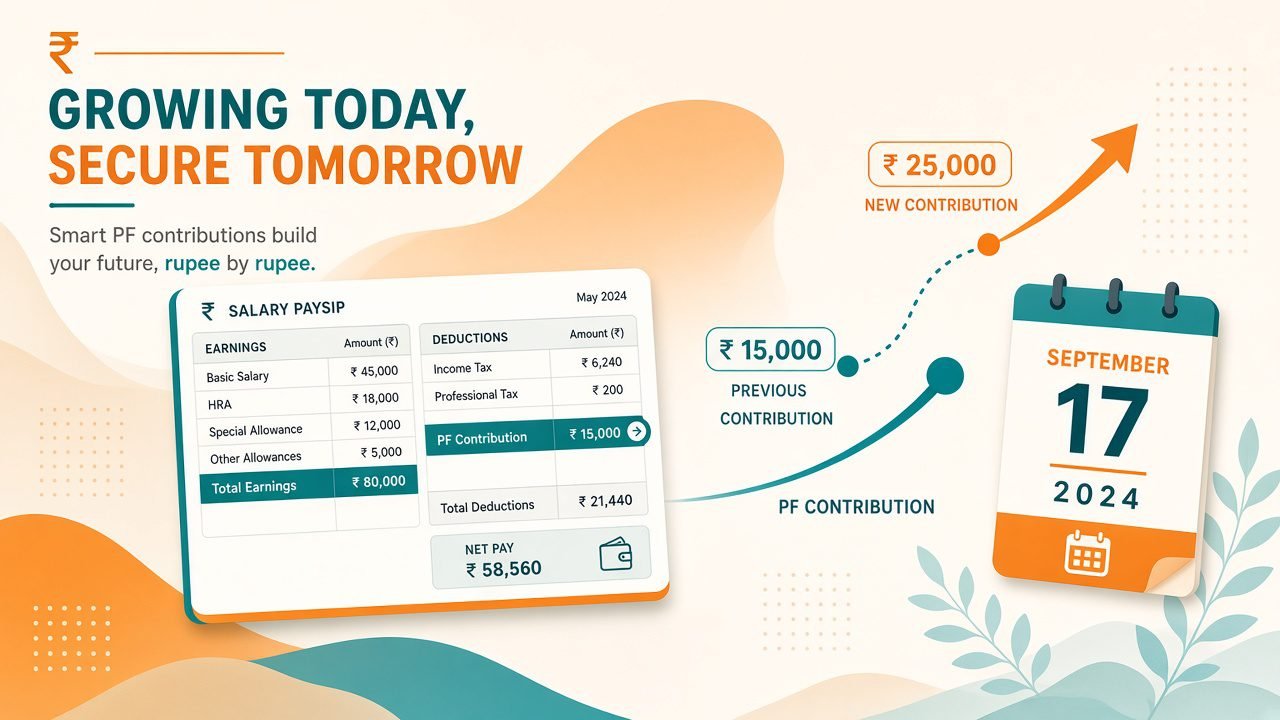
- Where contributions were capped at the old ₹15,000 wage, the employee’s 12% PF share can jump from ₹1,800 to ₹3,000 — a ₹1,200 monthly hit to take-home in the classic illustration.
- Employer cost rises in parallel (PF share plus the EPS allocation rules), so both sides of the payslip move.
The phrase you will see in news and HR mails — EPF wage limit increased 15000 to 25000 — is exactly this ceiling revision. It does not rewrite every voluntary “contribute on actual wages” arrangement overnight, but it does reset the statutory floor for who must be in and what the capped contribution looks like.
When does it apply? (Cabinet 16 Sep + Gazette S.O. 5109(E) from 17 Sep 2026)
Two dates matter, and they are easy to mix up:
- 16 September 2026 — Union Cabinet approval of the ceiling revision.
- 17 September 2026 — Labour Ministry Gazette S.O. 5109(E) published; the change is effective from the Gazette date.
So for September 2026 payroll, many establishments will treat the new ceiling as live for wages paid for the September cycle (exact cut-over depends on when wages are computed and when ECR is filed). If your company runs payroll mid-month or has already locked September numbers, ask HR whether the adjustment appears in September itself or from October — do not assume either way without checking the ECR and your wage register.
Official EPFO / Labour Ministry communications and your establishment’s PF consultant remain the final word on the filing month. Treat news explainers as guidance, then confirm against the Gazette text and your payroll software settings.
Who is newly covered — employees earning ₹15,001–₹25,000
The headline coverage peg is large: more than 51 lakh additional employees are expected under mandatory EPFO, and the Labour Minister has spoken of roughly 1 crore subscriber-expansion potential over time. Context helps: EPFO already reports roughly 7.98 crore contributing members across about 7.68 lakh establishments, with around 82 lakh EPS pensioners.
Who feels it first?
- New joiners whose PF wages sit between ₹15,001 and ₹25,000 — mandatory EPFO coverage new employees in this band is the clearest “in” case.
- Existing staff who were earlier outside mandatory cover solely because wages crossed ₹15,000 but stayed at or below ₹25,000.
- Contract / staffing arrangements where the principal employer or contractor had structured cover around the old ceiling — these need a careful reading of the engagement terms and EPFO circulars on contract labour.
If you already earn well above ₹25,000 and your company contributes PF on actual wages (a common private-sector practice for retention), you may see little or no immediate change to the employee deduction line. The ceiling revision still matters for EPS / EDLI linkages and for anyone whose contribution was strictly capped at ₹15,000.
Will your take-home salary fall? Worked examples
This is the question that fills WhatsApp groups every salary week. The honest answer: it depends on whether your PF was capped at the old ceiling or already calculated on a higher / actual wage.
Contribution capped at old ₹15,000 ceiling → employee PF ₹1,800 → ₹3,000 (+₹1,200)
Classic illustration used across explainers after the Cabinet decision:
- Old statutory wage for capped contribution: ₹15,000
- Employee PF at 12%: ₹1,800
- New statutory wage ceiling: ₹25,000
- Employee PF at 12%: ₹3,000
- Extra deduction from take-home: ₹1,200 per month
Over a year, that is roughly ₹14,400 less in hand — money that is not “lost,” but locked into your EPF account (plus employer share). For someone whose in-hand was already tight after rent EMI and school fees, ₹1,200 a month is real. This is the core PF contribution take home salary impact story for capped-wage employees.
Example narrative: Priya draws PF wages of ₹22,000. Earlier, if her employer contributed only up to ₹15,000, her employee PF was ₹1,800. After the ceiling move, if contribution tracks the new ₹25,000 cap (or her actual ₹22,000 where rules require), her deduction rises. At a full new-ceiling illustration of ₹3,000, she sees ₹1,200 less every month — and should also see a matching employer credit into the EPFO ecosystem.
Already contributing on actual wages — often little immediate change
Many IT, consulting, and large manufacturing employers already run PF on actual basic / PF wages above ₹15,000. If you and your employer were already contributing 12% on, say, ₹40,000 basic, your employee PF line does not suddenly jump because the statutory ceiling moved to ₹25,000 — you were already above it.
What can still change for that cohort:
- EPS allocation and wage used for pensionable salary (employer share towards EPS has its own ceiling logic — see below).
- EDLI coverage calculations linked to wage ceilings.
- New joiners in the same company who fall into the newly mandatory band.
So before you panic at a smaller net salary, open last month’s payslip and this month’s side by side. Look for the PF employee line, not just “net pay.” If PF was already on actuals, the September story may be quieter than the headlines.
Employer side — PF + EPS + EDLI cost jump
Employees feel the take-home pinch; employers feel the cash-cost and compliance pinch. Matching employer PF roughly tracks the same ₹1,200 monthly illustration when moving from a ₹15,000 to ₹25,000 capped wage — subject to how much of the employer 12% is routed to EPF versus EPS.
Government EPS support estimates reported with the decision: about ₹11,339 crore per year (versus roughly ₹10,250 crore earlier), or around ₹56,696 crore over five years. That fiscal line exists because EPS has a government co-contribution / support structure alongside employer remittances — useful context when you hear “this will cost industry X.”
EPS employer share illustration: ₹1,250 → ₹2,082.50 (8.33% of new ceiling)
A widely cited illustration for the employer’s EPS portion:
- At the old ₹15,000 ceiling, 8.33% towards EPS ≈ ₹1,250
- At the new ₹25,000 ceiling, 8.33% ≈ ₹2,082.50
That is the pension-side step-up. The remainder of the employer’s 12% typically goes to the EPF account (exact split follows EPFO allocation rules). EDLI (Employees’ Deposit Linked Insurance) premiums / cover also link to wage definitions — so HR and finance teams are not only changing one PF percentage field; they are rechecking EPS and EDLI setups in payroll software.
For MSMEs and staffing firms with thin margins, the combined PF + EPS + EDLI jump on a large headcount in the ₹15k–₹25k band is material. Expect more questions in October about whether “voluntary higher wage” arrangements continue, and tighter documentation on who is excluded versus newly included.
What you gain — higher EPF corpus, EPS pension, EDLI cover
Lower take-home is the painful headline. The quieter benefit is compound retirement math.
EPF corpus: An extra ₹1,200 a month from you (plus employer share) is forced saving at EPFO’s declared interest rate environment. Over a 20–25 year career, that incremental contribution is not trivial — especially if you were earlier stuck at the old ₹15,000 cap while your lifestyle costs had already inflated.
EPS pension: Pensionable salary and service-linked pension formulas care about the wage base used for EPS. Moving the ceiling up expands the base for newly covered and ceiling-capped members. That does not mean everyone gets a huge pension overnight — EPS rules, service years, and wage history still dominate — but the direction of travel is a higher pensionable reference for those who were stuck at ₹15,000.
EDLI cover: Deposit-linked insurance cover for nominees is part of the EPFO stack. A higher wage linkage generally means stronger insurance-side protection within scheme rules. For families of workers in the newly covered band, this is often under-discussed compared with the take-home debate.
Think of it as a forced nudge toward retirement adequacy for a segment that was left behind by a 2014 ceiling. Annoying on payday; useful at age 58.
Checklist for employees & HR before next payroll
Employees — do this once:
- Download last three months’ payslips and highlight the PF employee deduction.
- Note your “PF wages” / basic figure used for PF — ask HR if unclear.
- Check UAN → passbook on the EPFO member portal / UMANG after the next ECR credit to confirm the higher contribution landed.
- If take-home fell by about ₹1,200 and you were on a capped wage, that is consistent with the classic illustration — not necessarily a payroll bug.
- Update nomination and KYC if pending; a higher corpus makes nomination hygiene more important.
HR / payroll — do this before ECR:
- Map every employee whose PF wages sit in ₹15,001–₹25,000.
- Confirm whether contribution was “ceiling only” or “actual wages.”
- Reconfigure EPS wage and EDLI parameters in the payroll product.
- Brief managers so they do not invent wrong explanations on the shop floor.
- Keep the Gazette reference (S.O. 5109(E), 17 Sep 2026) in the internal FAQ.
FAQs — voluntary >₹25k contributors, contract staffing, Code on Social Security link
1. I already contribute PF on a salary above ₹25,000. Does the EPFO wage ceiling 25000 September 2026 change cut my take-home?
Usually not on the employee PF line, if you and your employer were already contributing on actual wages above the new ceiling. Watch EPS / EDLI configuration and any policy change your employer makes after the Gazette.
2. Can I opt out of the higher contribution to protect take-home?
Mandatory coverage and statutory contribution rules are not a casual opt-out menu. Voluntary higher contributions above statutory norms have their own consent frameworks; reducing below statutory requirements is not something you “choose” in the cafeteria. Speak to HR / a labour advisor for your exact category.
3. I am on a contract / third-party payroll. Who remits the higher PF?
Typically the establishment that is your immediate employer for PF purposes (often the contractor), with principal-employer oversight in many arrangements. Get clarity in writing — contract staffing is where mistakes and under-remittance disputes cluster.
4. Does this link to the Code on Social Security?
The wage-ceiling revision sits in the live EPFO / EPF Act ecosystem via Cabinet + Gazette. Broader labour-code implementation timelines are a separate track. Do not assume Code provisions auto-replace EPFO circulars unless an official notification says so.
5. Will EPS pension jump immediately for existing pensioners?
Existing pensioners follow their sanctioned pension. The ceiling hike mainly reshapes contributions and pensionable wage going forward for contributing members. Always verify personal EPS status on the EPFO pension portals rather than extrapolating from news maths.
6. How much can government EPS support rise?
Public briefings around the decision cited roughly ₹11,339 crore a year versus about ₹10,250 crore earlier, and about ₹56,696 crore over five years. Treat these as government estimates reported with the policy — not your personal pension quote.
7. Where should I verify if my company has applied the new ceiling?
Payslip PF line + EPFO passbook credit after ECR. For disputes, use EPFO grievance channels and keep salary slips and appointment letters ready. Soft reminder: always cross-check numbers against official EPFO / Labour Ministry sources before making irreversible budget decisions.
Key takeaway
From 17 September 2026, the EPFO mandatory wage ceiling is ₹25,000, up from ₹15,000 — the first revision since 2014. If your PF was capped at the old ceiling, expect employee PF to move from about ₹1,800 to ₹3,000 in the standard illustration (₹1,200 less take-home), with employer PF/EPS costs rising in step (EPS share illustration ₹1,250 → ₹2,082.50). If you already contribute on actual wages above ₹25,000, your in-hand story may barely change. Either way, open the payslip, check the UAN passbook, and confirm with HR — then treat the extra deduction as forced retirement saving, not a random cut.
Disclaimer: This article is for general information based on publicly reported Cabinet / Gazette details and news explainers as of 20 September 2026. Contribution splits, EPS rules and establishment-specific practices can differ. Always verify with official EPFO and Labour Ministry notifications, your employer’s PF consultant, and your own payslip / UAN records before acting.
RBI New FD Rules 2026: What Changes from 1 October? Will Your Existing FD Be Affected?






One Comment