EPS Eligibility After ₹25,000 Wage Ceiling: Who Gets Pension Cover, EPFO Clarifies
Earn ₹25,000 or less and wondering whether you now get a pension? On 12 October, EPFO put out a clarification on who is eligible for the Employees’ Pension Scheme (EPS) after the wage ceiling was raised from ₹15,000 to ₹25,000 a month. The short version: EPS eligibility now covers employees earning up to ₹25,000, subject to the scheme’s conditions, but anyone earning above ₹25,000 who was never an EPS member cannot join afresh. Here is what changed, who qualifies, and what to check on your payslip.
What changed on 17 September 2026
The Union Cabinet approved the Labour Ministry’s proposal to raise the wage ceiling for mandatory EPFO coverage from ₹15,000 to ₹25,000 a month, PIB said on 17 September 2026. The ceiling had last been revised in September 2014. The government expects more than 51 lakh additional employees to come under mandatory coverage. PIB put the extra annual outgo at about ₹11,339 crore. EPFO already has 7.98 crore contributing members and 82 lakh pensioners, as per the same release.
| Point | Before | From 17 Sep 2026 |
|---|---|---|
| Wage ceiling for mandatory EPFO coverage | ₹15,000 a month | ₹25,000 a month |
| Pensionable wage cap for EPS | ₹15,000 | ₹25,000 |
| Maximum employer EPS share (8.33%) | ₹1,250 (₹1,249.50) | about ₹2,083 (₹2,082.50) |
| Schemes covered | EPF, EPS and EDLI (life insurance) | |
We explained the ceiling change itself in our EPFO ₹25,000 wage ceiling report. Sources: PIB release, 17 Sep 2026; EPFO’s post of 12 Oct 2026 as reported by India Today. The 8.33% figures are worked out by us.
EPS eligibility after the ₹25,000 limit: who qualifies
EPFO’s graphic, as reported, makes three points.
- Earning up to ₹25,000 a month: you can be covered under EPS, subject to the scheme’s eligibility conditions. For eligible employees in this band, pension membership is mandatory.
- Earning above ₹25,000 and not an EPS member before: you are not eligible for fresh EPS membership. Your full employer contribution goes to your EPF account instead.
- Already an EPS member: your past membership and the scheme rules decide how you continue. Existing members do not lose their membership because their salary rose.
So EPS eligibility depends on two things together: your current wage and whether you were an EPS member earlier. A raised ceiling does not open the scheme to everyone.
Three examples
| Employee | Monthly wage (basic + DA) | Was an EPS member before? | Position after 17 Sep |
|---|---|---|---|
| A, new joiner | ₹22,000 | No | Mandatory EPF coverage; EPS cover subject to conditions |
| B, three years’ service | ₹18,000 | No (was above the old ₹15,000 limit when joining) | Now within the ₹25,000 ceiling; check with employer and EPFO how the change applies |
| C, new joiner | ₹32,000 | No | Not eligible for fresh EPS membership |
Case B is where most questions will come up. EPFO has not, in what we read, set out a step-by-step process for people already working who earn between ₹15,000 and ₹25,000. Your HR or payroll team should have EPFO’s circular; ask them for it.
How the contribution split works
You pay 12% of wages to EPF. Your employer also pays 12%. Out of the employer’s share, 8.33% goes to EPS (up to the pensionable wage cap) and the balance to your EPF account. The EPS part is not an extra deduction from your salary; it comes out of the employer’s 12%.
| Monthly wage | Your 12% (to EPF) | Employer to EPS (8.33%) | Employer to EPF (balance) |
|---|---|---|---|
| ₹18,000 | ₹2,160 | ₹1,499.40 | ₹660.60 |
| ₹22,000 | ₹2,640 | ₹1,832.60 | ₹807.40 |
| ₹25,000 | ₹3,000 | ₹2,082.50 | ₹917.50 |
Our arithmetic, assuming EPS cover applies and contributions are on full wages. Actual figures depend on your pensionable wage and the scheme rules.
At the top of the band, the maximum EPS share rises by ₹833 a month, or ₹9,996 a year, compared with the old cap. India Today’s report stresses that this does not mean every employee earning up to ₹25,000 will see ₹2,083 going to EPS each month. What actually goes in depends on eligibility and pensionable wages. We covered the take-home side of the change in how the new PF deduction affects your October salary.
Why EPS eligibility matters to you
EPF builds a lump sum you get at retirement or when you withdraw. EPS pays a monthly pension, generally after at least 10 years of eligible service. The two behave very differently:
- EPF money earns interest and can be withdrawn under set conditions (see our PF withdrawal rules guide).
- EPS money does not sit in your name earning interest; it buys you a pension entitlement based on service and pensionable salary.
- A higher pensionable wage cap can mean a higher eventual pension for eligible members, but a smaller monthly addition to the EPF balance.
Whether more in EPS suits you depends on how long you expect to stay in EPFO-covered jobs. Someone likely to complete 10 years of service gets a pension; someone who leaves earlier gets a withdrawal benefit under EPS rules instead.
What to check on your payslip and passbook
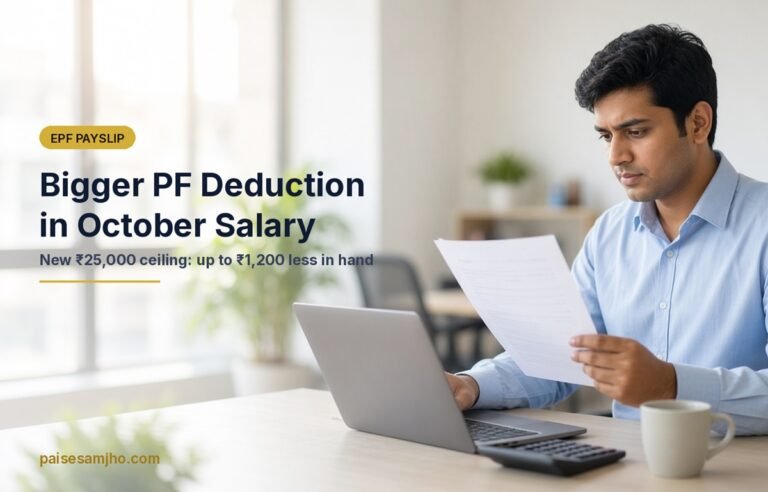
- October payslip: look for a PF deduction if your wage is ₹25,000 or less and you were not covered before.
- EPFO passbook: after the employer files the monthly return, the passbook on the member portal shows separate entries for EPF (employee and employer) and pension (EPS).
- UAN: if you are newly covered, your employer should generate or link a UAN. Activate it and link Aadhaar and your bank account.
- Nomination: file an e-nomination; it covers EPF, EPS and EDLI.
If the contribution is not being deducted
EPFO’s advice, as reported, is to raise it with your employer first. If the employer does not act, you can file a complaint on EPFiGMS, EPFO’s online grievance portal. Keep your salary slips and appointment letter handy, since they show your wage and joining date.
Answers to the most common EPS questions follow.
FAQs
Is EPS mandatory for employees earning up to ₹25,000?
EPFO’s post says pension membership is mandatory for eligible employees earning up to the revised ceiling, subject to the scheme’s conditions.
I earn ₹30,000 and joined my first job this year. Can I join EPS?
As per EPFO’s clarification, employees above ₹25,000 who were not EPS members before cannot take fresh membership.
Will my take-home pay fall because of EPS?
The EPS share comes from the employer’s 12%, not from your salary. Your own 12% EPF deduction is separate.
From which date does the new ceiling apply?
17 September 2026, as per the Labour Ministry details cited in reports and PIB.
Takeaway: EPS eligibility now extends to employees earning up to ₹25,000 a month, subject to conditions, but there is no fresh entry above that if you were never a member. Check your payslip and passbook, and raise it on EPFiGMS if your employer does not respond.
Sources
- PIB: Cabinet approves EPFO wage ceiling increase to ₹25,000 (17 Sep 2026)
- EPFO official website
- India Today, 12 Oct 2026, reporting EPFO’s EPS eligibility post
Partly verified, 12 Oct 2026, 7:05 PM IST. Read: PIB release of 17 Sep 2026. EPFO’s 12 Oct post on EPS eligibility is as reported by India Today (10:57 AM IST); we did not read the post or an EPFO circular directly. The process for existing employees earning ₹15,000–₹25,000 is not confirmed here.