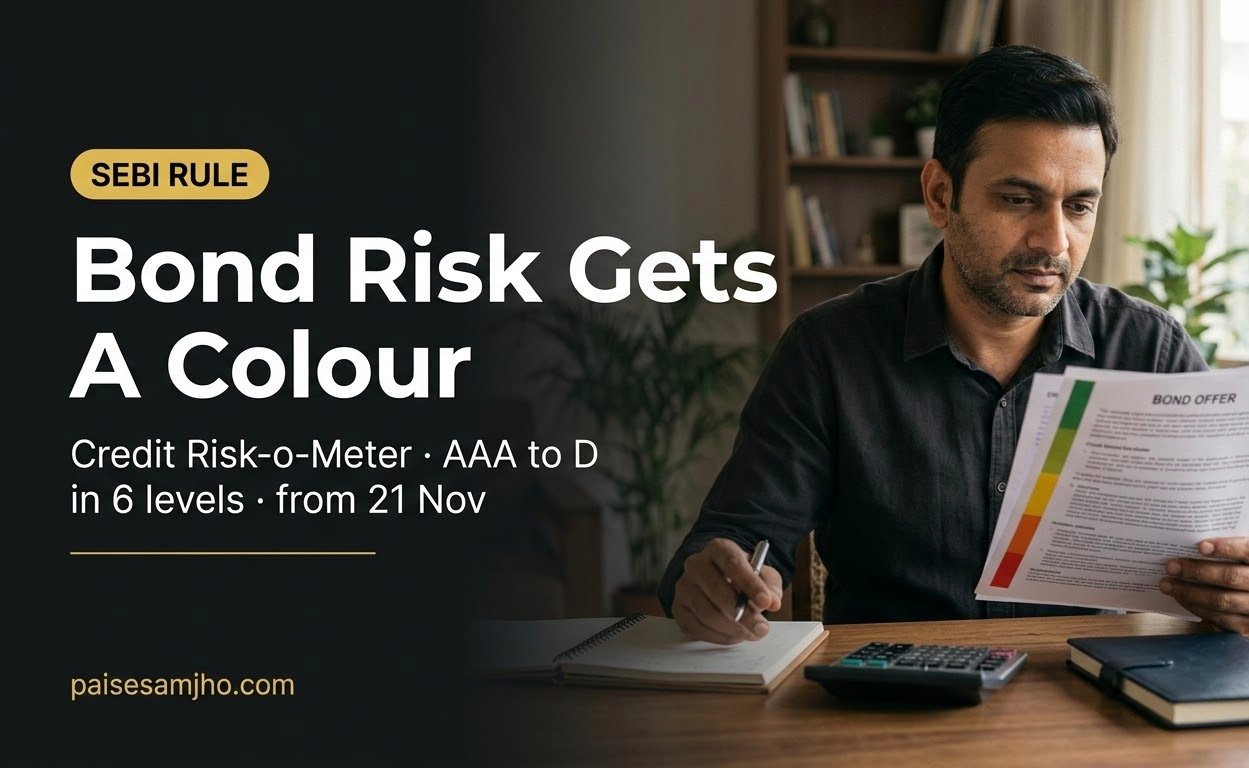
SEBI Credit Risk-o-Meter: Bonds and Bond Apps Must Show a Six-Colour Risk Dial From 21 November
SEBI is making bond sellers show you a colour. A circular dated 7 October 2026 introduces a “Credit Risk-o-Meter”, a six-level, colour-coded dial, on every listed or to-be-listed debt security. It applies to offer documents, abridged prospectuses, private placement memorandums, all issuer and bond platform advertisements, and the websites and apps of online bond platforms. It comes into force 45 days after issue, which by our count is 21 November 2026.
If you buy corporate bonds on an app because the yield beats your FD, this is aimed at you. The meter is meant to show, before you invest, how much credit risk sits behind that extra yield. A bond paying three or four percentage points more than a bank deposit is usually paying you for something, and until now the rating was a few letters in small print.
How the Credit Risk-o-Meter maps ratings to colours
SEBI’s annexure ties the meter to the rating a credit rating agency has already given the security. There is no new score; the meter is a picture of the existing credit rating.
| Meter level | Long-term ratings | Short-term ratings | Colour (SEBI code) |
|---|---|---|---|
| Lowest credit risk | AAA | A1+ | Irish Green (#08A04B) |
| Very low credit risk | AA+, AA, AA- | A1 | Chartreuse (#7FFF00) |
| Low credit risk | A+, A, A- | A2 | Neon Yellow (#FFFF33) |
| Moderate credit risk | BBB+, BBB, BBB- | A3 | Caramel (#C68E17) |
| Moderate risk of default | BB+, BB, BB- | A4+ | Dark Orange (#FF8C00) |
| High to very high risk of default | B+, B, B-, C+, C, C-, D | A4, D | Red (#F70D1A) |
Notice where the “moderate” label starts. BBB- is the lowest investment-grade rating, yet on the meter it sits in the fourth of six levels, coloured caramel. Anything below BBB- turns orange or red.
What else must appear under the meter
The circular lists text disclosures that have to sit below the dial:
- The name of the credit rating agency.
- The actual credit rating, in text.
- For unsecured instruments, the word “unsecured” in bold red text.
- If more than one agency rates the security, the meter must show the lowest rating. The others may be shown alongside.
- If the rating agency says the “Issuer is Not Cooperating” (INC), the meter’s arrow points to INC and the text must say so.
There is a fixed disclaimer too: the meter “is based on evaluation of the credit risk of the issuer and does not constitute investment advice or a recommendation to invest. Investments in debt securities are also subject to market and liquidity risks.” Unsecured perpetual bonds, such as AT1 bonds, get an additional disclaimer.
Who it covers
All listed and proposed-to-be-listed non-convertible securities, commercial papers, securitised debt instruments, security receipts, and structured debt or market-linked debentures. That holds whether they are sold by public issue or private placement. Online bond platform providers must add the meter to the minimum disclosures for every security they list, as a new clause 14.
How to use it as a bond buyer
The meter tells you about one risk only: the chance the issuer does not pay. SEBI’s own disclaimer says it does not capture market risk (prices fall when rates rise) or liquidity risk (you may not find a buyer before maturity). With RBI raising the repo rate to 5.50% on 7 October, both of those matter. Our MPC decision explainer covers the rate move.
A simple routine once the meter is live:
- Look at the colour first. If it is orange or red, the high yield is pay for a real chance of default.
- Read the text below it. “Unsecured” in red means there is no specific asset backing your money.
- Check the agency name and whether any agency has flagged INC.
- Compare the yield with a government security of similar tenure. Our Treasury bills guide shows how to see the risk-free rate on RBI Retail Direct.
Remember that a bond is not a bank deposit. There is no DICGC cover, as our deposit insurance explainer explains.
The meter follows SEBI’s other investor-awareness moves this month, including the broker-app messages we covered in SEBI’s investor messages on broker apps.
Before the FAQs, one caveat: the 21 November date is our count of 45 days from 7 October. SEBI’s circular states “45 days from the date of issuance” and gives no calendar date.
FAQs
When does the Credit Risk-o-Meter start?
45 days after the circular’s 7 October 2026 date, which we count as 21 November 2026.
Does a green meter mean the bond is safe?
No. It means the lowest credit risk on SEBI’s scale. Market and liquidity risk remain.
Which rating is used if two agencies disagree?
The lowest one.
Will it show on bond platform apps?
Yes. Web and mobile platforms of online bond platform providers are named in the circular.
Takeaway: from late November, read a bond’s Credit Risk-o-Meter colour and the “unsecured” label before its yield.
Source: SEBI circular HO/17/11/22(1)2026-DDHS-POD1/I/23092/2026, 7 Oct 2026, paras 1–5 and Annexure-A paras 1, 2.1–2.11 (PDF read in full) · Also: RBI MPC resolution, 7 Oct 2026. Last verified: 11 Oct 2026, 3:20 PM IST against the full SEBI circular of 7 Oct 2026 (PDF, Annexure-A). The 21 Nov 2026 start date is our count of 45 days; SEBI gives no calendar date.