RBI Bars Withdrawals at Tiruvalla Urban and Afzalpur Co-operative Banks: DICGC ₹5 Lakh Timeline
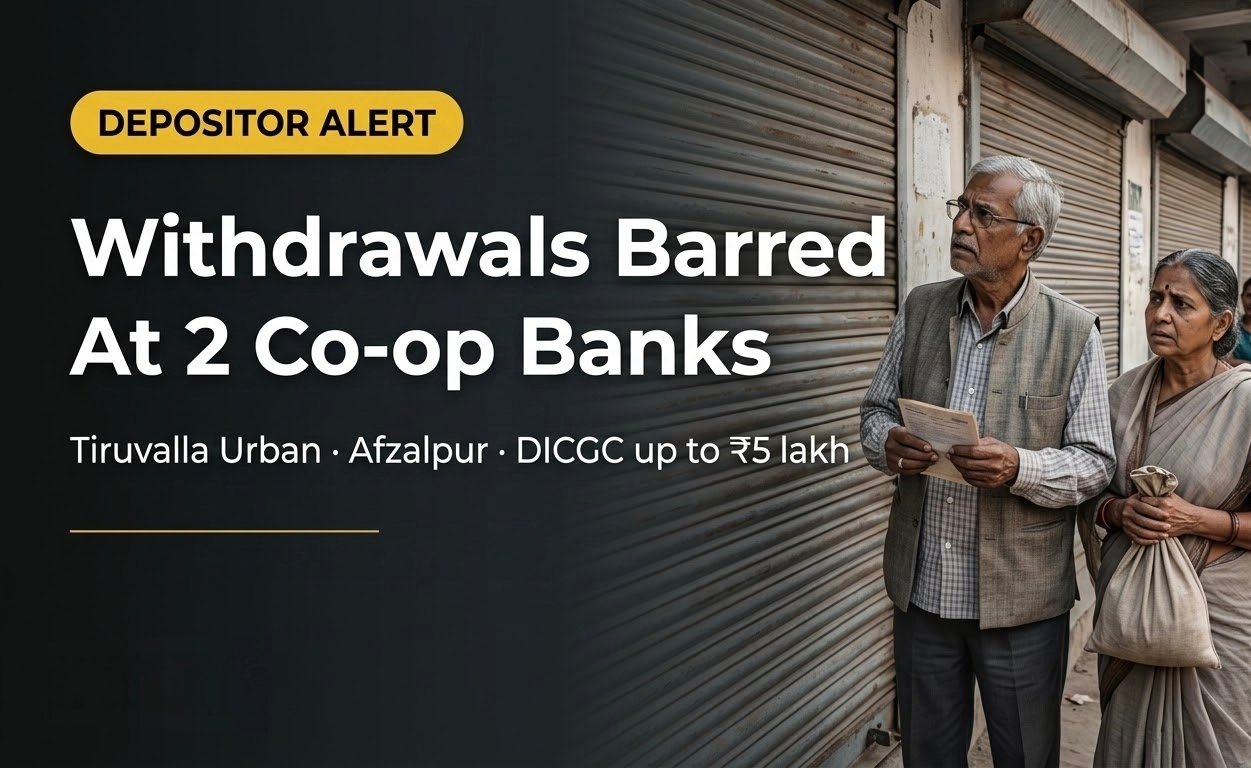
“The bank has been directed not to allow withdrawal of any amount from savings bank or current accounts or any other account of a depositor.” RBI used that sentence in two press releases on 8 October 2026: one for The Tiruvalla Urban Co-operative Bank Ltd. in Pathanamthitta district of Kerala, the other for Sri Mahatma Basaveshwar Co-operative Bank Ltd., Afzalpur, in Karnataka. Both banks have been under the RBI directions since close of business that day. Here is what depositors can and cannot do now, and the DICGC timeline that has started running.
Co-operative bank RBI directions: what the two orders say
| Detail | Tiruvalla Urban Co-op Bank | Sri Mahatma Basaveshwar Co-op Bank, Afzalpur |
|---|---|---|
| RBI directive | TVM.DOS.SED.No.S485/12-04-221/2026-2027, dated 7 Oct 2026 | BLR.DOS.SSMS.No.S1220/09-01-243/2026-2027, dated 7 Oct 2026 |
| Effective from | Close of business, 8 Oct 2026 | Close of business, 8 Oct 2026 |
| Withdrawals | None allowed from any account | None allowed from any account |
| Valid for | Six months, subject to review | Six months, subject to review |
| Press release | PR 2026-2027/1285 | PR 2026-2027/1286 |
Six months from close of business on 8 October runs to 8 April 2027. RBI can change or extend the directions before then.
What the banks can and cannot do
Under paragraph 1 of each release, without RBI’s prior written approval, the bank shall not:
- grant or renew any loans and advances, or make any investment;
- take any liability, including borrowing or “acceptance of fresh deposits”;
- make any payment, enter into any compromise or arrangement, or sell or transfer its assets.
The banks can still pay for “essential items such as salaries of employees, rent, electricity bills”. They can also “set off loans against deposits subject to the conditions stated” in the directions. If you have both a loan and a deposit with the bank, you may be able to have one adjusted against the other. Ask the branch for the conditions in writing.
Paragraph 4 says the directions should not “per se be construed as cancellation of the banking license”. The bank remains licensed, with restrictions.
Your money and the ₹5 lakh insurance
Both releases say eligible depositors are entitled to a deposit insurance claim “up to a monetary ceiling of ₹5,00,000/-” from DICGC, “in the same capacity and in the same right”. The claim is paid after depositors submit a willingness declaration and the claims are verified.
| Your deposits in one capacity at the bank | Covered by DICGC | Not covered |
|---|---|---|
| ₹3,40,000 | ₹3,40,000 | Nil |
| ₹7,00,000 | ₹5,00,000 | ₹2,00,000 |
The uncovered portion depends on what the bank eventually recovers. Neither release gives a recovery timeline.
The 45-day and 90-day clock
DICGC’s guide says that under Section 18A of the DICGC Act, a bank placed under these directions must send DICGC “a list showing the outstanding deposits of each depositor” within 45 days. DICGC must then pay within a total of 90 days from the date the directions were imposed (DICGC guide).
| Step | Deadline counted from 8 Oct 2026 |
|---|---|
| Bank sends depositor list to DICGC | By about 22 Nov 2026 (45 days) |
| DICGC pays depositors | By about 6 Jan 2027 (90 days) |
The guide adds that if the bank delays or fails to send the data within 45 days, that “shall constrain the corporation” from settling claims on time. If the bank is slow, the 90 days may not hold.
Steps for depositors this week
- Get a written statement of every account and FD in your name. For joint accounts, note who holds it in which capacity; our guide to joint account modes explains how coverage can differ.
- Check that the nominee details on each deposit are correct. See nominee vs legal heir.
- Submit the willingness declaration when the bank asks for it, and keep your copy.
- If you have a loan with the same co-operative bank, ask in writing whether it can be set off against your deposit.
For FDs held at other banks, early-closure rules are in our FD premature withdrawal guide.
Here is what depositors at these two co-operative banks are asking.
Frequently asked
Can I withdraw anything for medical needs?
The press releases do not mention any hardship withdrawal. They allow no withdrawal “of any amount”. Ask the bank whether the full directions provide an exception.
Has RBI cancelled the licence?
No. RBI says the directions are not a licence cancellation.
How much will DICGC pay?
Up to ₹5 lakh per depositor in the same capacity and right, after verification.
When could the money come?
Under Section 18A, within 90 days of the directions, about 6 January 2027, provided the bank sends its list on time.
Takeaway: collect your account statements and file the DICGC willingness declaration as soon as the bank asks for it. The 90-day clock runs only if the paperwork does.
| Source | Paragraphs used |
|---|---|
| RBI PR 2026-2027/1285 (Tiruvalla Urban Co-op Bank), 8 Oct 2026 | 1–5 |
| RBI PR 2026-2027/1286 (Sri Mahatma Basaveshwar Co-op Bank), 8 Oct 2026 | 1–5 |
| DICGC, A Guide to Deposit Insurance (Section 18A questions) | 45-day list, 90-day payment, delay caveat |
Last verified: 10 Oct 2026, 8:00 AM IST. Checked: RBI PR 2026-2027/1285 and 1286, DICGC guide (Section 18A). Not read: the full directions, which RBI says are displayed on the banks’ websites or premises.