GST Council Meeting on 7 October: What to Expect From the 57th Meeting, From ITC on Group Insurance to GST on UPI MDR
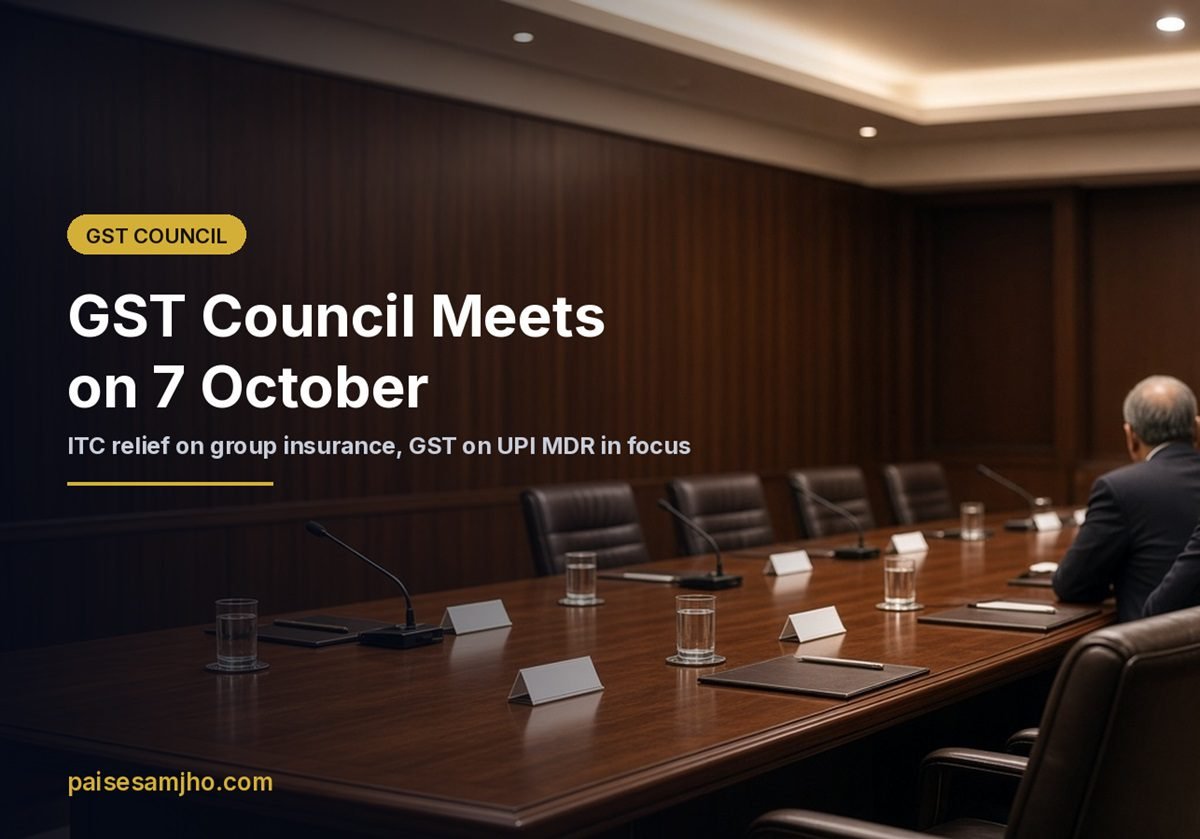
The 57th meeting of the GST Council will be held on Wednesday, 7 October 2026, in New Delhi from 11 AM, according to a GST Council Secretariat office memorandum dated 6 September that moved it from 12 September. Officers will meet on 5 and 6 October, and the final agenda has not been made public. Reports ahead of the GST Council meeting on 7 October point to process changes rather than new tax rates: unblocking input tax credit (ITC) on group insurance and some other business costs, faster refunds, simpler registration for small online sellers, and a possible review of the 18% GST on UPI merchant fees that begin on 15 October.
It will be the Council’s first meeting in more than a year, Moneycontrol reported, and it falls on the same day as the RBI’s monetary policy decision.
What is on the reported agenda?
| Proposal | What has been reported | Reported by |
|---|---|---|
| ITC under Section 17(5) | Law Committee has recommended five amendments to unblock credit on life and health insurance (mainly group policies for employees), outdoor catering, free samples, and goods destroyed or written off on expiry. No consensus on motor vehicles; left to the Council | BusinessLine, citing a senior official |
| Refunds | A system-generated risk score to decide which refund claims qualify for automatic release; would need an amendment to the GST Act | Moneycontrol |
| Services by global capability centres | Amendment so that work done on goods sent by overseas group companies can count as an export, with no GST charged | Moneycontrol |
| Registration for small online sellers | Registration in another state on the strength of the home-state registration, using the e-commerce platform’s warehouse as place of business; limited to micro enterprises | Moneycontrol |
| GST on UPI MDR | Council may take a view on the 18% GST on merchant fees for UPI payments above ₹2,000 | PTI, Mint |
| Tax rates | No rate changes expected; focus on simplifying processes | PTI, Moneycontrol |
None of these items has been confirmed officially for the GST Council meeting on 7 October. The Council Secretariat said the venue and final agenda “will be communicated in due course”, and decisions are usually announced after the meeting on the GST Council’s meetings page.
57th GST Council meeting: why ITC on group insurance is in focus
Section 17(5) of the CGST Act lists goods and services on which businesses cannot claim credit for the GST they pay, even when the spending is for business; the text of the Act is on the CBIC GST Acts page. Life and health insurance are on that list.
The official quoted in BusinessLine’s report on the ITC relief proposals said that since individual life and health insurance were removed from the tax net, mainly group insurance remains taxable, and it is “prima facie a business expense”. Blocking the credit creates an inconsistency, he said. If the Council agrees, companies that buy group health or life cover for staff would be able to set the GST on premiums against their output tax, lowering the net cost of those policies. Whether that leads to wider cover for employees would be up to each employer.
The other proposals follow similar reasoning. Outdoor catering for business events and staff functions, free samples in sectors such as pharmaceuticals and FMCG, and goods destroyed because their shelf life expired were all described as normal business costs. On cars, some Law Committee members worried that vehicles for personal use could be routed through businesses, with “major revenue implications”, so that question goes to the Council without a recommendation.
GST on UPI MDR: what could change
From 15 October, person-to-merchant UPI payments above ₹2,000 will carry a merchant discount rate (MDR) of 0.4%, capped at ₹300. Because the MDR is a service charge, it attracts 18% GST. On a ₹10,000 payment, that is ₹40 of MDR and ₹7.20 of GST, by our calculation. Our explainer on UPI MDR charges from 15 October has the full slab table.
On 24 September, government sources told PTI that the Council would take a view on the 18% levy “in the larger interest of consumers as was done in case of insurance premium”. Mint also said a review of GST on UPI MDR was likely to come up at the GST Council meeting on 7 October. Registered merchants can claim input tax credit on the GST they pay on MDR, which softens the cost, but small traders outside the GST system have no credit to claim. The Supreme Court has separately declined to stay the MDR itself, as covered in our report on the UPI MDR Supreme Court hearing.
A busy 7 October
The RBI’s Monetary Policy Committee meets from 5 to 7 October, according to the schedule the central bank published in March, so its decision will land on the same day as the GST Council meeting on 7 October. A rate change by the RBI would affect floating-rate loans; our explainer on how an RBI rate hike affects home loan EMIs shows the arithmetic.
The Council meets with revenue on a firm footing. Gross GST collections rose 14.7% to ₹2.04 lakh crore in September, with import GST up 25.9%, according to provisional official data covered in our report on GST collection in September 2026.
FAQ: GST Council meeting on 7 October
When and where is the 57th GST Council meeting?
On Wednesday, 7 October 2026, in New Delhi, from 11 AM.
Will GST rates change at this meeting?
Probably not. Government sources told PTI and Moneycontrol that the focus is on processes, and an official said there is “no further exercise at present to rationalise the rates”.
Will customers pay GST on UPI payments?
No. The MDR and the GST on it are charged to the merchant, not the person paying, although shops may pass costs on through prices.
Is GST on UPI MDR officially on the agenda?
Not confirmed. Sources quoted by PTI and Mint expect it to be discussed.
Disclaimer: The agenda items above are reported expectations from BusinessLine, Moneycontrol, PTI and Mint, not official decisions; the meeting date is from the GST Council Secretariat’s memorandum. We will update this report after the meeting.