UPI MDR Charges From October 15 2026: What Merchants and Customers Should Know
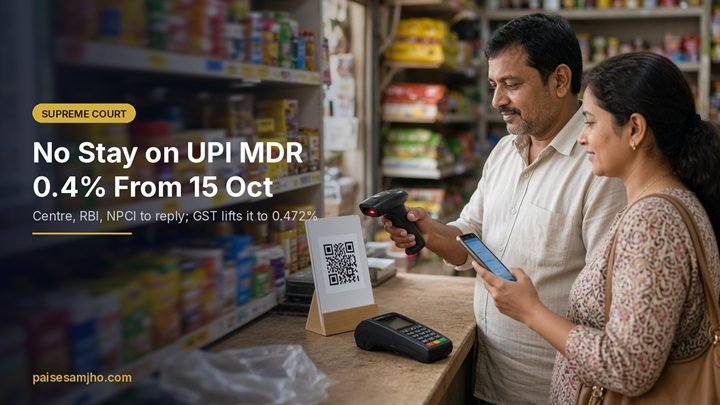
From 15 October 2026, a thin slice of UPI merchant payments stops being free for the shop — while staying free for the person scanning the QR. That is the core of the new UPI MDR charges framework: 0.4% merchant discount rate on specified person-to-merchant (P2M) UPI transactions above ₹2,000, capped at ₹300 when the ticket hits ₹75,000 or more. NPCI’s FAQ (dated 15 September 2026) and multiple ministry clarifications spell this out without much poetry.
If you run a mid-size electronics counter in Pune, pay school fees online, or just split dinner on PhonePe, you need different parts of this story. Merchants care about margin maths. Customers care whether the chaiwala or the mall billing desk starts adding a “UPI fee” line. Finance Minister Nirmala Sitharaman, speaking to PTI, has been blunt: this is not a tax, cess or surcharge, and the money does not go to the Consolidated Fund of India.
Below is a practical map of UPI charges from October 15, who pays, who stays exempt, and how the rupee arithmetic actually looks on a ₹3,000 grocery run versus a ₹1 lakh appliance bill.
What UPI MDR charges mean in plain Hindi-English
MDR — merchant discount rate — is the fee a business pays to accept a digital payment. It is not a customer convenience fee by design. Under the NPCI framework, eligible P2M UPI above ₹2,000 attracts 0.4%. At ₹75,000 and above, the percentage calculation stops climbing and the merchant pays a flat ₹300 ceiling.
Person-to-person transfers stay free. Self-transfers stay free. P2M tickets up to ₹2,000 stay free even for large merchants. NPCI says those sub-₹2,000 merchant payments make up more than 95% of UPI P2M volume, which is why the political messaging keeps repeating “everyday UPI remains free”.
UPI app providers are told not to levy a separate platform fee on UPI payments. Merchants on-boarded under the framework are not supposed to pass MDR to buyers — consumers should pay only the posted price. Whether every kirana in India obeys that on Day 1 is a compliance and consumer-protection question; the written rule is no pass-through.
UPI charges from October 15: a quick rupee table
| Transaction (P2M) | MDR for merchant |
|---|---|
| Up to ₹2,000 | ₹0 |
| ₹3,000 | ₹12 (0.4%) |
| ₹50,000 | ₹200 (0.4%) |
| ₹75,000 and above | ₹300 capped |
| ₹1,00,000 | ₹300 (not ₹400) |
That last row is the one CFOs notice. Without the cap, 0.4% of ₹1 lakh is ₹400. With the cap, the merchant keeps ₹100 that would otherwise have leaked as processing cost. Compared with typical credit-card MDR bands of roughly 1.5%–2.5%, UPI still looks cheap on paper — which is the ecosystem’s defence when retailers complain.
MDR on UPI above 2000: who actually pays inside the pipe
Sitharaman’s PTI comments put an approximate share split on record: about 40% to the customer’s bank, 30% to the payment gateway, 20% to the UPI app, and 10% to the sponsor bank of the app. Treat those shares as the publicly cited split from the finance minister’s briefing, not as a law you can sue on. Operational parameters and fee distribution models sit with the UPI and Services Steering Committee chaired by NPCI.
Two clarifying points that cut through WhatsApp forwards. First, MDR is an ecosystem charge among banks and payment players; it is not collected by the government as revenue. Second, customers are not meant to see a separate UPI levy at checkout. If a merchant adds “UPI surcharge ₹12” on a ₹3,000 bill, that behaviour conflicts with the stated framework — raise it with the merchant’s acquirer or consumer forums rather than assuming the charge is official.
I still expect some messy first weeks. Indian retail has a long history of soft-passing card costs through “cash discount” gimmicks. Watch for the same theatre in reverse: “pay cash, save 0.4%”. That is a pricing choice by the merchant, not an NPCI-mandated customer fee.
Small P2PM merchants and the ₹1 lakh monthly shield
This is the paragraph street vendors and neighbourhood shops should screenshot. Under NPCI’s Person-to-Person-Merchant (P2PM) category, small merchants receiving up to about ₹1 lakh per month through UPI QR into their accounts continue with zero MDR — including on tickets above ₹2,000. Categorisation, not the size of one bill, drives the charge.
So a florist in Indore who collects ₹80,000 in a month via QR can accept a ₹5,000 bouquet payment without the 0.4% bite, provided she stays inside the P2PM exemption. If inward UPI credits cross ₹1 lakh per month for three consecutive months, acquiring banks are expected to migrate the merchant into the regular P2M bucket, where the new MDR on UPI above 2000 starts applying.
GST registration is not required to keep the P2PM zero-MDR protection. Existing QR standees and soundboxes do not need to be replaced for the rule change. That matters for the unorganised sector, where asking a thela vendor to “upgrade KYC for MDR” would have killed adoption overnight.
Flat ₹5 MDR categories — railways, fuel, telecom, insurance, utilities
NPCI’s FAQ states that for specific merchant categories such as railways, telecom, insurance and fuel (among others), a flat MDR of ₹5 per transaction applies for amounts above ₹2,000, instead of the 0.4% formula. Utility bill collections (electricity, water, piped gas) are similarly described under an industry-programme style flat ₹5 treatment above ₹2,000.
Label this carefully: it is what the NPCI FAQ document says for those designated categories. Exact MCC mapping and edge cases will be enforced by acquiring banks and the steering committee. If you run a fuel station or an insurer’s collection desk, get the category confirmation in writing from your acquirer before you build P&L models on the flat ₹5 assumption.
Capital-market flows (mutual funds, brokers, securities) sit in yet another tier in the same FAQ: a nominal 0.02% with a ₹300 cap. That is separate from the retail 0.4% story and mainly relevant if you build fintech rails for investments.
A merchant’s monthly maths (opinionated, with coffee stains)
Take a mid-size apparel store doing ₹40 lakh a month in UPI, of which ₹12 lakh comes in tickets above ₹2,000. At a blunt 0.4%, MDR outgo is roughly ₹48,000 a month — ₹5.76 lakh a year — before you adjust for the ₹300 cap on big tickets and for any mix that falls into flat-₹5 MCCs. Against card MDR, that still may be cheaper. Against the previous years of zero UPI MDR charges, it feels like a new cost line that finance teams will hunt to recover somehow.
My view: stores with thin 8–12% gross margins will feel this more than high-margin services. The honest response is to treat UPI MDR charges as a cost of acceptance, the way card fees always were, and to stop pretending digital payments are a free public utility forever. The dishonest response is silently hiking the sticker price by 0.4% and blaming “UPI tax” in the WhatsApp status. Customers should push back on the second pattern.
AutoPay / UPI mandates for utilities, OTT and recurring investments are described in the FAQ as not carrying the prescribed MDR charge for those automated instructions. If your business depends on mandates, re-read that section of the NPCI document rather than relying on a news paraphrase.
What customers should do about UPI MDR charges on and after 15 October
Keep paying with UPI the way you do now — UPI MDR charges are not a customer fee by design. P2P stays free. Sub-₹2,000 merchant pays stay free. Large merchant pays should not show an extra line item for MDR. If an app tries a “platform fee” for UPI, that conflicts with the FAQ language — switch app or complain with evidence.
Daily bank / NPCI transaction limits (often in the ₹1–5 lakh zone depending on category) remain risk controls, not fee tiers. Do not confuse a security cap with a charge threshold.
For rumours, prefer NPCI, RBI, PIB or the Ministry of Finance over forwarded PDFs with Comic Sans stamps. The NPCI MDR FAQ PDF is the primary text worth bookmarking.
UPI merchant discount rate versus cards — a reality check
NPCI’s own comparison puts credit-card MDR roughly in the 1.5%–2.5% band and debit-card MDR capped around 0.90%, against UPI’s 0.4% above ₹2,000 with a ₹300 ceiling. Merchants who already accept cards are not entering a uniquely harsh regime; they are exiting a multi-year period when UPI was unusually free relative to every other rail.
That historical free period built India’s QR habit. The new UPI MDR charges / merchant discount rate mix tries to fund infrastructure, cybersecurity and competition among apps without putting the bill on retail customers. Whether small towns keep preferring UPI over cash after merchants internalise the cost is the open economic question — not something a FAQ can settle in September.
Frequently asked questions on UPI MDR charges
Will I pay UPI MDR charges when I send money to my sister?
No. P2P stays free for payer and beneficiary, any permitted amount.
Can my local vegetable vendor charge me 0.4% extra from October 15?
Depends on how that vendor is classified. Many small QR merchants under P2PM with monthly UPI collections up to ~₹1 lakh remain fully exempt. Even where MDR applies to the merchant, the framework says it should not be passed to you as a surcharge.
Is the 0.4% a government tax?
FM Sitharaman’s line, via PTI: not a tax, not a cess, not a surcharge, and not going to the Consolidated Fund. It stays inside the payments ecosystem share split.
What about MDR on UPI above 2000 at a petrol pump?
NPCI FAQ points to a flat ₹5 MDR for fuel (and certain other designated categories) on tickets above ₹2,000, rather than 0.4%. Confirm category coding with the pump’s acquirer if you operate one.
Do RuPay credit-on-UPI payments follow this 0.4%?
Credit-linked UPI (including RuPay credit card on UPI / credit lines) is described in the FAQ as following separate credit-product MDR rules, not this debit-style P2M amendment. Read the credit-side schedule; do not assume the 0.4% retail P2M rate.
When do UPI charges from October 15 actually start?
15 October 2026, per NPCI’s effective-date language, giving banks and aggregators time to update billing engines.
For merchants, the homework before mid-October is simple and slightly boring: confirm your MCC and P2PM versus P2M status with the acquirer, model 0.4% on the slice of tickets above ₹2,000, and decide whether your pricing already absorbs acceptance costs. For customers, the homework is shorter — keep scanning, refuse unexplained surcharges, and ignore apocalyptic forwards. The new UPI MDR charges regime is real for a minority of merchant value; it is not the end of free everyday UPI.
Informational only — not legal, tax or business advice. Cross-check NPCI FAQs and your acquiring bank before changing pricing or payment mix.