Key Facts Statement for Loans: How to Read APR, Charges Before You Sign
Rohit, 29, was offered a ₹2 lakh personal loan “at just 12%”. The EMI looked fine: ₹6,643 a month for three years. Then he read the Key Facts Statement the lender had to give him. After a 2% processing fee plus GST and a ₹3,000 insurance charge were taken out, he would get ₹1,92,280 in hand, and the Annual Percentage Rate (APR) worked out to about 14.8%, not 12%. The Key Facts Statement (KFS) is the one-page summary RBI rules require for every retail loan. Here is how to read it in five minutes.
What the Key Facts Statement is
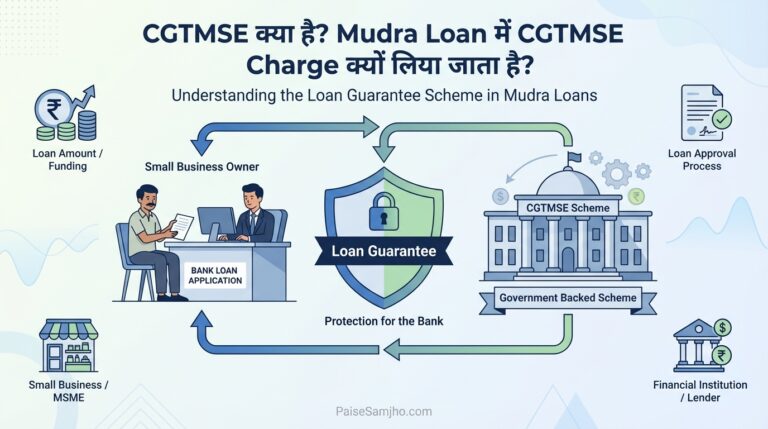
Since 1 October 2024, every bank, NBFC and co-operative bank must give a KFS to anyone taking a retail or MSME term loan, before the loan agreement is signed, the RBI’s circular of 15 April 2024 says. Credit cards are exempt. The main rules:
| Rule | What it means for you |
|---|---|
| Standard format, in a language you understand | You can compare offers from different lenders side by side |
| Contents must be explained; you sign an acknowledgement | Ask questions before you sign |
| Unique proposal number; valid for at least 3 working days (1 working day for loans under 7 days) | You get time to compare; the lender is bound by the KFS terms if you accept within that time |
| Includes an APR computation sheet and full repayment schedule | You see the true yearly cost and every EMI |
| Third-party charges (insurance, legal) collected by the lender form part of the APR | “Extra” charges can’t hide outside the rate |
| Any fee not in the KFS cannot be charged without your explicit consent | Surprise charges later are not allowed |
Source: RBI circular RBI/2024-25/18 on Key Facts Statement for Loans and Advances, 15 April 2024.
Interest rate vs APR: Rohit’s numbers
| Item | Amount |
|---|---|
| Loan sanctioned | ₹2,00,000 |
| Interest rate (reducing balance) | 12% a year |
| Tenure | 36 months |
| EMI | ₹6,643 |
| Total interest over 3 years | ₹39,143 |
| Processing fee 2% + 18% GST | ₹4,720 |
| Insurance premium collected by lender | ₹3,000 |
| Amount actually received | ₹1,92,280 |
| APR (annual cost including charges) | about 14.76% |
Our illustration, with assumed fees. APR is the rate at which the 36 EMIs equal the money actually received; we calculated it the same way as RBI’s illustrative annex, on a monthly basis multiplied by 12.
The interest rate tells you only what the lender charges on the balance. APR adds the fees, so it is the better number for comparing two offers. A loan at 11.5% with a 3% fee may cost more than one at 12% with no fee.
How to read a Key Facts Statement in five minutes
- Check the amounts. Loan sanctioned and amount to be disbursed. A big gap means heavy upfront charges.
- Check the rate type. Fixed or floating? If floating, which benchmark (repo, MCLR, T-bill) and what spread? Floating rates move when the benchmark moves, as happened after the RBI’s 7 October rate hike.
- Find the APR. Compare this, not the headline rate, across lenders.
- Scan the fee list. Processing fee, insurance, documentation, stamp duty, legal and valuation charges. Ask what each is for and whether any is optional.
- Read the contingent charges. Penal charges for late payment, cheque or mandate bounce charges, foreclosure or part-prepayment charges, and loan switch fees.
- Look at the repayment schedule. Number of EMIs, first EMI date and amount. Make sure there is no “broken period interest” you did not expect.
- Note the grievance contacts. The KFS format includes the lender’s grievance redressal details. For digital loans, look for the cooling-off period too.
Digital loans: cooling-off period
For loans taken through apps, RBI’s digital lending rules give you a cooling-off (look-up) period, during which you can exit by paying back the principal and the proportionate APR without a penalty. The lender’s board sets the period, but it cannot be less than one day, the April 2024 circular says. Before borrowing through an app, check that it is linked to an RBI-regulated lender; our fake loan app guide explains how.
Red flags in a loan offer
- No KFS, or a KFS handed over only after you sign. Ask for it first.
- An APR much higher than the quoted rate, without a clear explanation.
- Insurance bundled as compulsory without being listed in the KFS.
- Pressure to sign the same day when the KFS is valid for at least three working days.
- “Flat rate” quotes. A flat 12% rate costs far more than 12% on a reducing balance.
Before taking a loan, it helps to know how much EMI your income can carry; our loan eligibility by salary guide shows the usual limits. And plan for missed payments: what happens when you miss an EMI explains the SMA and NPA stages.
If the lender charges something not in the KFS
RBI’s rule is clear: a fee not mentioned in the KFS cannot be charged at any stage without your explicit consent. If it happens, write to the lender’s grievance officer with a copy of your KFS. If there is no reply within 30 days, or you are not satisfied, you can complain to the RBI Ombudsman (see how to file an RBI Ombudsman complaint).
Here are the short answers.
FAQs
Is a Key Facts Statement compulsory?
Yes, for all retail and MSME term loans by RBI-regulated lenders sanctioned on or after 1 October 2024, including fresh loans to existing customers.
Does it apply to credit cards?
No. Credit card receivables are exempt under the 2024 KFS circular; cards have their own KFS rules under the credit card directions.
What is a good APR?
There is no single number. Compare the APR on two or three offers for the same amount and tenure; the lower APR costs less.
Can I take time to decide?
Yes. The KFS must be valid for at least three working days for loans of seven days or more.
Takeaway: The Key Facts Statement shows a loan’s real yearly cost through the APR, plus every fee. Compare APRs, not headline rates, and refuse any charge that is not in the KFS.
RBI rules referred to
- RBI circular: Key Facts Statement for Loans & Advances (RBI/2024-25/18, 15 Apr 2024)
- RBI Complaint Management System
Last verified: 13 Oct 2026, 6:25 AM IST against RBI circular RBI/2024-25/18 (15 Apr 2024). Not checked: whether these paragraphs have since moved into a consolidated RBI Direction. The loan example uses assumed fees; the APR is our calculation.