How to improve CIBIL score Without a Promised Overnight Jump
Meera, 34, paid a credit-card bill 22 days after the due date and then applied for a personal loan the same month. The lender’s decision, when it came, mentioned her credit information report. That sequence is ordinary, and it is also the right place to talk about how to improve CIBIL score without promising that any one step will raise a number by a stated amount. TransUnion CIBIL is one of the licensed credit information companies in India. Other companies also maintain reports. What follows is general practice and official-consumer sense, not a score-raising service.
How to improve CIBIL score: start by reading the report
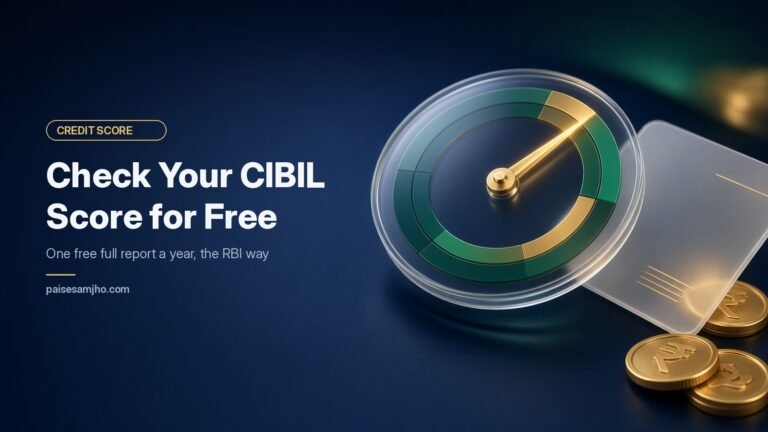
You cannot usefully “fix” a score you have not read. The official first step is to obtain your own credit information report — including, where the law and the company provide it, a free report at the official interval — and to check every account, every overdue remark, and every personal-detail line. This site already has a separate guide on how to check a free CIBIL score online. Use an official CIBIL or other CIC channel, or a bank’s official “credit report” service. A look-alike site that asks for a UPI payment to “unlock a 50-point rise” is not that channel.
When you have the report, mark three things in writing: accounts that are not yours, amounts that are already paid but still shown as overdue, and enquiries or new accounts you do not recognise. Those are dispute candidates. A low score that accurately reflects missed payments is a different problem: it is not “wrong,” and the remedy is conduct over time, not a paid “repair” agent.
Pay on the due date, not on the date you remember
Payment history is the line most readers can actually change, because it is behaviour, not a secret formula. Pay credit-card bills and loan EMIs by the due date on the official statement, not “sometime this month.” If you only pay the minimum amount due on a card, the account may remain current and you will still owe interest under the card’s official terms — see our note on the minimum amount due. Current is better than overdue. It is not the same as paying the full statement balance.
If a payment has already been missed, pay the overdue amount through the official channel, keep the receipt, and then check whether the furnisher (the bank or NBFC) updates the CIC in a later reporting cycle. Updates are not instant. Do not pay a third party who claims they can delete an accurate overdue remark for a fee. If the remark is inaccurate, use the official dispute path at the CIC and at the lender; our earlier note on loan settlement and CIBIL is a reminder that a settlement, even when agreed, can still appear on a report in the form the lender reports.
How to improve CIBIL score is not a one-week project
New, accurate information has to be reported and then incorporated. A score you check tomorrow morning will not already include a payment you made tonight. Anyone who sells a “same-day jump” is selling something the official reporting cycle does not describe. Meera’s late card payment, if it was reported, will not vanish because she later paid in full; it may age, and future on-time payments may be reported too. That is a long process, and this article will not attach a number of points to it.
Credit utilisation, new applications and old accounts
Running a credit card close to its official limit, month after month, is often a sign of stress on the report even when the bill is paid on the due date. Paying down the outstanding amount, or asking the issuer — through its official channel — about a limit review, is ordinary account management. An unsolicited limit increase is a separate question this site has discussed under official rules; do not assume a higher limit will be granted, and do not spend a higher limit only to look less utilised if you cannot pay it.
Many applications in a short window can add official enquiries. Apply when you have a real need, not as an experiment to “see if it goes through.” Closing an old, well-conducted card in order to “look neater” can also have effects you did not intend, because the age and mix of accounts are part of what a report contains. If you do want to close a card, do it through the official closure path after the outstanding amount is paid, and keep the closure confirmation; we have a separate card-closure note.
Personal-loan shopping is a frequent trigger for a cluster of enquiries. If you are comparing offers, complete the paperwork you already have, rather than opening four applications in two days and hoping one will stick.
Disputes, fraud and what this guide will not do
If an account is not yours, or a balance is wrong, dispute it on the official CIC portal and with the furnisher, and keep ticket numbers. If you suspect identity fraud, use the official fraud or freeze paths the CIC and your bank publish, and consider a police complaint where appropriate. This is not legal advice; it is a pointer to official channels.
This guide will not publish a “good score” cut-off as if it were a regulation. Lenders set their own eligibility, and those cut-offs are not a CIBIL official “pass mark.” It will not tell you that a paid app, a particular credit card, or a “secured card” will raise a score by a promised amount. It will not tell Meera, or you, to take a new loan only to build history if you do not need the loan and cannot pay it. Taking credit you do not need is a costly way to “build” a report.
Hindi-reading users can also see our earlier CIBIL score kaise badhaye note. The English steps here are the same idea: official report, official disputes, on-time payment, fewer casual applications. There is no unofficial side door.
What “utilisation” looks like in rupees
Suppose a card’s official limit is ₹1,00,000 and the statement outstanding is ₹85,000. That is a high outstanding relative to the limit, even if you intend to pay it on the due date. Paying the bill down to a lower outstanding, and then leaving that lower usage in place for later reporting cycles, is ordinary. This article does not prescribe a “safe” percentage as an official CIC rule, because a published official cut-off of that kind is not what we are citing here. The practical point is simpler: a limit you routinely brush against is a limit you should either pay down or, if your income supports it, discuss with the issuer through official channels.
The same rupee arithmetic applies to a personal loan or a consumer-durable loan: an EMI that already takes a large share of monthly income is harder to pay on time, and a missed EMI is the reporting event that hurts more than a theoretical utilisation ratio. If the EMI calendar is already tight, “how to improve CIBIL score” starts with not adding another EMI, not with a new loan taken only to create a fresh repayment history.
Joint credit, a facility you have stood surety for, or an overdraft that is technically current but routinely close to the sanctioned limit, can also appear on a report. If you have signed as a co-borrower, official reporting can include that account even when you are not the person using the money. Read the report for those lines before you assume a score is “only about my card.”
When Meera later checks a new official report, she should compare it with the PDF she saved, line by line, rather than looking only at the three-digit score. A score can move because an old enquiry dropped off, because a limit changed, or because an overdue became current — and she will not know which unless she reads the accounts. That comparison, dated, is also the evidence she would attach to an official dispute if a closed account reappears or a paid amount is shown as open.
Employers, landlords and lenders who pull a report with your official consent see a record you should already have seen yourself. There is no separate “clean” version of a report that a paid agent can generate for interviews. The official report is the report.
A practical order of operations
- Get the official report and score from an official channel, and save the PDF with the date.
- Dispute only what is inaccurate; pay what is genuinely overdue through the lender’s official payee.
- Put every genuine EMI and card due date on a calendar you actually look at, and aim to pay before the due date, not on the last evening of the due date if your bank’s payment cut-off is earlier.
- Wait for a later official report to see whether the furnisher has updated the line. Do not refresh a score every day or pay for daily “alerts” that add no new official data.
- Apply for new credit only when you need it, with documents ready, after the report you have already read.
If a lender still declines an application, ask, in writing if you can, which information on the report was material. Sometimes the answer is income or documents, not the score. That question is more useful than buying a “repair” package.
If you are already in a genuine hardship — a job loss, a medical bill, a business interruption — speak to the lender’s official hardship or restructuring desk before the account is reported as overdue for longer. Any arrangement you agree should be in the lender’s official written terms. Informal “settle for less and we will wipe the report” promises, especially from people who are not the lender, are not a substitute for that official path.
Finally, treat the score as one input, not a character certificate. People with thin files (few official accounts) and people with long, slightly imperfect files can look very different at the same three-digit number, and a lender may read them differently. Building a longer, cleaner official history takes official accounts that you can actually repay. That is slower than an advertisement, and it is the process this guide is describing. A short, accurate official report that you have already read is more useful than a frequent unofficial “score check” that does not show the underlying accounts.
FAQs
Will paying an overdue bill this week raise my score this week?
Usually not in a week. The lender has to report the updated status, and the CIC has to incorporate it. Anyone promising a same-day official rise is not describing that cycle.
Is there an official CIBIL number above which every loan is approved?
No official pass mark of that kind is used in this article. Lenders set their own eligibility, which can include income, existing EMIs and documents as well as a credit score. A “750 is approved in every case” message is not a regulation.
How this was framed. Last verified: 17 Nov 2026, 8:00 PM IST. This is general guidance on official credit-information-report access, official dispute and payment channels, and why a same-day ‘score rise’ is not how reporting works. TransUnion CIBIL is one licensed CIC; other CICs also issue reports. No official lender pass-mark and no promised point increase are stated. The ‘Meera’ illustration is a worked example, not a real person’s file. Not a credit-repair service.
This is general consumer guidance on reading an official credit information report, using official dispute and payment channels, and avoiding paid “score repair” claims. TransUnion CIBIL is one licensed credit information company; other CICs also issue reports. Official company and Reserve Bank consumer pages, and the lender’s own statement, remain the primary sources for a specific account. Related official-channel explainers on this site are linked above. The illustration of “Meera” is a worked example, not a real person’s file. This is not a credit-repair service, not a lender’s eligibility policy, and not a promise that a score will rise by any stated amount. For the regulator’s broader consumer material see rbi.org.in. For CIBIL’s official consumer access, use cibil.com or the access path your bank officially provides.