Post Office Interest Rates October 2026: SCSS, Sukanya at 8.2%, PPF 7.1%, All Unchanged
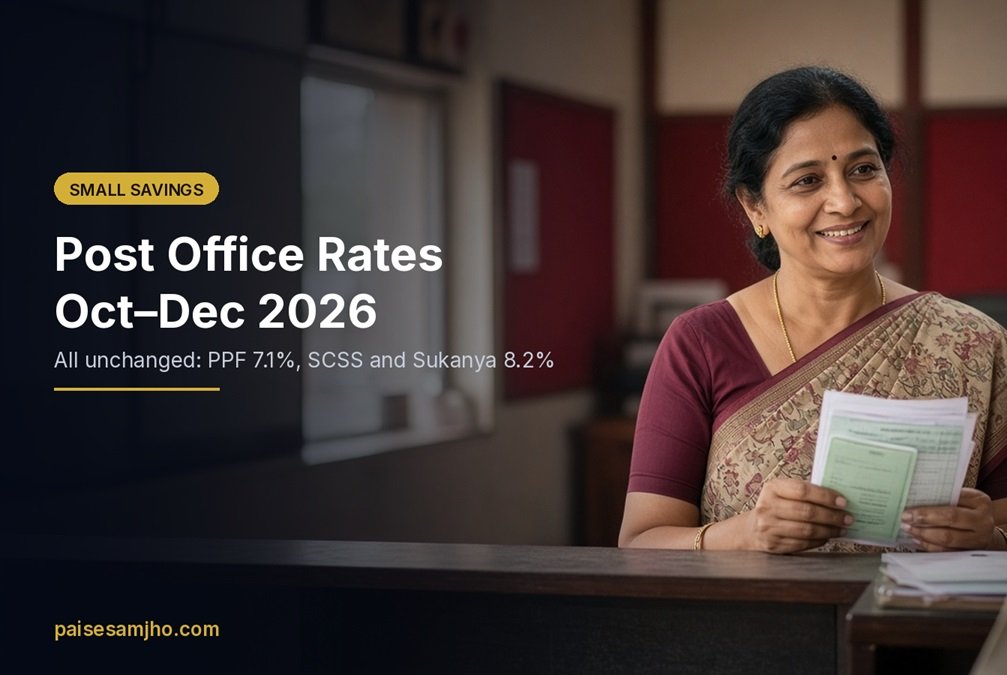
The Finance Ministry on 30 September 2026 left every small savings rate unchanged for the October–December quarter, so post office interest rates October 2026 stay exactly where they were in July–September. The Senior Citizens’ Savings Scheme (SCSS) and Sukanya Samriddhi Yojana (SSY) continue at 8.2%, the Public Provident Fund (PPF) at 7.1% and the National Savings Certificate (NSC) at 7.7%. The Department of Economic Affairs issued the decision through Office Memorandum F.No.1/4/2019-NS dated 30 September, covering 1 October to 31 December 2026, and India Post circulated it to all post offices the same day as SB Order No. 12/2026.
Rates on these schemes have now been unchanged since the January–March 2024 quarter, when the government last revised some of them, according to PTI. The freeze comes at a time when government bond yields have climbed and several economists expect the Reserve Bank of India to raise the repo rate on 7 October.
Full list of post office interest rates October 2026
| Scheme | Rate, 1 Oct–31 Dec 2026 | Rate, 1 Jul–30 Sep 2026 | Key feature |
|---|---|---|---|
| Post Office Savings Account | 4.0% | 4.0% | Minimum balance ₹500 |
| 1-year Time Deposit | 6.9% | 6.9% | Premature closure after 6 months |
| 2-year Time Deposit | 7.0% | 7.0% | — |
| 3-year Time Deposit | 7.1% | 7.1% | — |
| 5-year Time Deposit | 7.5% | 7.5% | — |
| 5-year Recurring Deposit | 6.7% | 6.7% | From ₹100 a month |
| Senior Citizens’ Savings Scheme | 8.2% | 8.2% | Interest paid quarterly; ₹30 lakh cap |
| Monthly Income Scheme | 7.4% | 7.4% | ₹9 lakh single, ₹15 lakh joint |
| National Savings Certificate | 7.7% | 7.7% | 5-year tenure |
| Public Provident Fund | 7.1% | 7.1% | ₹1.5 lakh a year; 15 years |
| Kisan Vikas Patra | 7.5% | 7.5% | Matures in 115 months |
| Sukanya Samriddhi Yojana | 8.2% | 8.2% | ₹250 to ₹1.5 lakh a year |
These post office interest rates October 2026 are from the DEA memorandum and India Post order of 30 September. Deposit limits and features are as listed by the Financial Express in its coverage of the announcement. The rate that applies to NSC, KVP, SCSS, MIS and time deposits is the one in force on the day you invest, and it stays fixed for the whole tenure. PPF, SSY, RD and the savings account move with each quarterly notification.
How long have small savings interest rates been frozen?
The last change came for January–March 2024. Since then, every quarterly review has ended with the same numbers, which PTI counts as the tenth straight quarter of no change. We have simply described it as unchanged since the January–March 2024 quarter. PTI’s report also quoted the quarter as ending on 30 December; the memorandum itself says 31 December, and that is the date that applies.
PPF has been at 7.1% for considerably longer. Our guide to PPF rules covers the deposit limit, lock-in and partial withdrawals if you are opening or extending an account this quarter.
SCSS interest rate vs bank FD rates: how wide is the gap?
At 8.2%, the SCSS interest rate is well above what large banks currently pay senior citizens on five-year deposits. The table below sets post office interest rates October 2026 against card rates from the banks’ own websites for deposits under ₹3 crore.
| Bank (rates effective from) | Tenure | General public | Senior citizen |
|---|---|---|---|
| SBI (15 Dec 2025) | 5 to 10 years | 6.05% | 7.05% (incl. We-care premium) |
| SBI (15 Dec 2025) | 1 to under 2 years | 6.25% | 6.75% |
| HDFC Bank (19 Aug 2026) | 4 years 7 months 1 day to 5 years | 6.40% | 6.90% |
| HDFC Bank (19 Aug 2026) | 1 year to under 15 months | 6.25% | 6.75% |
| PNB (1 Jun 2026) | 1,205 days to 5 years | 6.35% | 6.85% (7.15% for 80+) |
| Post office SCSS | 5 years | — | 8.2% |
| Post office 1-year TD | 1 year | 6.9% | 6.9% |
Sources: SBI retail term deposit rates, HDFC Bank FD rates and PNB deposit rates, checked on 30 September 2026.
In rupee terms, ₹30 lakh in SCSS pays ₹2,46,000 a year, or ₹61,500 every quarter. The same amount in SBI’s five-year senior citizen FD at 7.05% earns about ₹2,11,500 a year on a simple-interest basis, roughly ₹34,500 less. Interest from both is taxable, so the gap largely survives tax for retirees in the same bracket.
For a girl child’s savings, SSY at 8.2% is also ahead of the five-year general FD rates above, which sit between 6.05% and 6.40%. SSY allows only ₹1.5 lakh a year and locks money until the account matures after 21 years, with partial withdrawal for education allowed once the girl turns 18 or passes Class 10. Those who prefer shorter horizons tend to compare the post office 1-year TD at 6.9% with one-year bank FDs, which at these three banks are at 6.25%.
What about banks outside this list?
Small finance banks and some private banks pay more than the large banks shown here, occasionally above 8% for seniors. Bank deposits are insured by DICGC only up to a fixed limit per depositor per bank, while small savings schemes carry a sovereign guarantee. The two are therefore not like-for-like on risk.
Why rates stayed put despite rising bond yields
The Financial Express noted that the government held rates even though the 10-year government bond yield has risen significantly in recent weeks. Higher yields would normally strengthen the case for raising small savings rates, which are reviewed every quarter.
The interest rate cycle may be turning. On 30 September, Crisil’s chief economist D.K. Joshi, Nomura and HSBC told Business Today they expect the RBI to raise the repo rate by 25 basis points in October and again in December, while BofA Securities now forecasts 100 basis points of hikes through the first half of 2027. If banks raise deposit rates after such hikes, the gap between post office schemes and bank FDs would narrow. We have worked through what the same forecasts mean for borrowers in our home loan EMI calculator for a rate hike.
The next review of small savings interest rates, for January–March 2027, is due at the end of December.
Who gains the most from the unchanged rates?
With post office interest rates October 2026 left untouched, retirees with money to park get another quarter to invest in SCSS at 8.2%, and that rate stays locked for the five-year term once invested. Monthly Income Scheme investors can still get 7.4%; on the single-account maximum of ₹9 lakh that works out to ₹5,550 a month. PPF and SSY investors see no change in how their balances grow this quarter.
Savers comparing a fresh FD with a PPF contribution will find the trade-offs laid out in our PPF vs FD comparison. The official scheme rules and forms are on the India Post website.
FAQ
What is the PPF interest rate for October–December 2026?
7.1%, unchanged from the previous quarter.
Has the SCSS interest rate changed from 1 October 2026?
No. It stays at 8.2% a year, paid quarterly, for the October–December 2026 quarter.
If rates rise in January, will my existing NSC or SCSS earn more?
Depends on the scheme. NSC, KVP, SCSS, MIS and time deposits keep the rate that applied on the day of investment for their full term. PPF, SSY and RD balances earn whatever rate is notified for each quarter, so they would benefit.
When will the next small savings rates be announced?
Towards the end of December 2026, for the January–March 2027 quarter.
Post office interest rates October 2026 apply from 1 October at every post office and at banks that offer PPF, SSY and SCSS accounts.
Disclaimer: Rates are from the Finance Ministry memorandum and India Post order of 30 September 2026; bank FD rates are as displayed on bank websites on that date and can change without notice. This article is for information and is not investment advice.