Gold and Silver Price Today: Second Day of Falls on 29 September, IBJA Rates
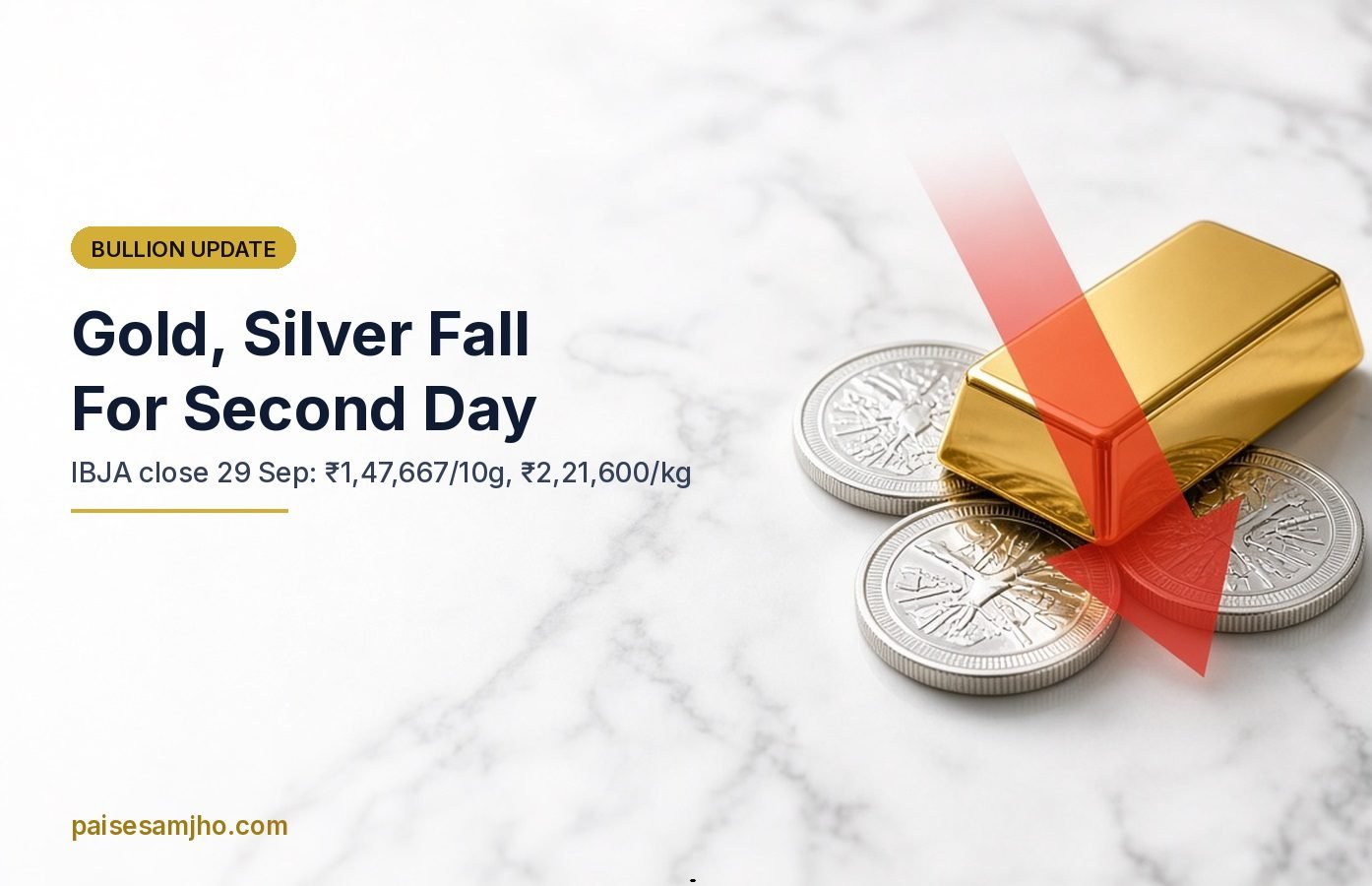
Gold and silver fell for a second straight session on Tuesday, 29 September 2026. The India Bullion and Jewellers Association (IBJA) closing rate for 24-carat gold was ₹1,47,667 per 10 grams, down ₹313 from Monday, and 999 silver closed at ₹2,21,600 per kg, down ₹1,453. The declines were far smaller than Monday’s 4% crash in silver, but they took the two-day loss to about ₹4,450 per 10 grams for gold and ₹10,750 per kg for silver. Here is the gold and silver price today in detail, what moved the market and what it means for festive buyers.
Gold and silver price today: IBJA closing rates, 29 September
The IBJA rate is the benchmark used by banks for gold loan valuation and by the government for Sovereign Gold Bond pricing. It excludes GST and making charges. The figures below are IBJA’s published afternoon (closing) rates, available on ibjarates.com.
| Metal (IBJA, excl. GST) | 28 Sep close | 29 Sep close | Change |
|---|---|---|---|
| Gold 999 / 24K (per 10g) | ₹1,47,980 | ₹1,47,667 | −₹313 (−0.21%) |
| Gold 916 / 22K (per 10g) | ₹1,35,550 | ₹1,35,263 | −₹287 |
| Gold 750 / 18K (per 10g) | — | ₹1,10,750 | — |
| Silver 999 (per kg) | ₹2,23,053 | ₹2,21,600 | −₹1,453 (−0.65%) |
The morning IBJA rate on 29 September was lower still for gold, at ₹1,47,400 per 10 grams, with silver at ₹2,21,680 per kg. Haribhoomi reported the morning fall at ₹648 for gold and ₹1,512 for silver against Monday morning. Gold recovered a little through the day.
Two-day change since Friday
Against the 25 September close, 24K gold is down ₹4,446 (about 2.9%) and silver is down ₹10,750 (about 4.6%). 22K gold, which is what most jewellery is made of, is down ₹4,073 per 10 grams over the two sessions.
MCX silver and gold futures
Futures moved in the same direction. By about 11:50 am, the December gold contract on MCX was at ₹1,48,410 per 10 grams, down ₹487 or 0.33%, according to Free Press Journal. December MCX silver was at ₹2,25,338 per kg, down ₹2,104 or 0.93%, after touching a low of ₹2,24,500. CNBC-TV18 also reported MCX silver down about 0.93%, or roughly ₹2,000 a kilo, in morning trade. Futures prices run above spot because they include the cost of carrying the metal to the contract’s expiry.
Why gold and silver are falling
The reasons are the same ones that caused Monday’s slide, now carrying over. Monday’s international moves were sharp: IBJA’s market report put Comex December gold at $4,168.40 an ounce, down 3.54%, and silver at $61.72, down 4.76%.
US bond yields are the main pressure. The 10-year US Treasury yield is around 5.2%, its highest in about 19 years, which makes gold, which pays no interest, less attractive to hold. Oil is the second factor. Brent crude has been trading around $105 to $107 a barrel since US President Donald Trump rejected Iran’s proposal on the Strait of Hormuz, and that has raised fears of higher inflation and more rate hikes. Markets were pricing roughly a 70% chance of a US Federal Reserve hike in October, according to reports.
Gold has lost about 7% in September. Silver, a smaller and more volatile market with heavy industrial use, has fallen faster. Two US data releases could move prices again this week: personal consumption expenditure (PCE) inflation on 30 September and the jobs report on 2 October.
What it costs at a jeweller
The gold and silver price today quoted on news sites is not the bill amount. Add 3% GST to the IBJA rate, then the jeweller’s making charges. At the 29 September close, 10 grams of 24K gold works out to about ₹1,52,097 with GST, and 22K to about ₹1,39,321. A kilo of silver comes to about ₹2,28,248 with GST, or roughly ₹228 per gram. Making charges vary widely, from a few hundred rupees per gram on plain chains to much more on detailed work. City rates also differ slightly from the IBJA benchmark.
Check for the BIS hallmark and six-character HUID on every piece; the BIS hallmarking page explains the marks. Buying without a bill for a cash discount is being reported again this season, and it creates problems later; our explainer on how much gold you can keep at home covers why.
Should festive buyers wait?
Dhanteras falls on Friday, 6 November, and the wedding season starts from mid-October. Nobody can say where prices will be then. Analysts quoted by CNBC-TV18 suggested staggering purchases over the coming weeks instead of betting on a single day. That approach makes sense for anyone buying for use. If gold keeps falling, the later purchases come in cheaper; if it rebounds, part of the budget is already spent at today’s level.
For background on Monday’s crash, see our report on why silver fell 4% on 28 September. Our earlier look at buying gold near ₹1.5 lakh is still relevant for anyone deciding on timing. If you have a gold loan, a falling IBJA rate lowers the value of your pledged jewellery, and lenders may ask for a top-up when the loan-to-value ratio rises; our gold loan guide explains how that works.
FAQ: gold and silver price today
What is the gold and silver price today, 29 September 2026?
IBJA’s closing rates were ₹1,47,667 per 10 grams for 24K gold, ₹1,35,263 for 22K and ₹2,21,600 per kg for silver, all excluding GST.
Why did gold fall today?
High US bond yields, oil above $100 and expectations of another US rate hike, the same factors that drove Monday’s larger fall.
Is the IBJA rate the price I pay at the shop?
No. Add 3% GST and making charges, and allow for small city-level differences.
Prices are likely to stay jumpy until the US data on 30 September and 2 October is out. If you are tracking the gold and silver price today for a purchase, compare it with the IBJA close rather than an intraday futures quote, since that is the rate jewellers and lenders anchor to.
Disclaimer: Prices are IBJA published rates and MCX levels reported on 29 September 2026, excluding GST and making charges. General information, not investment advice.