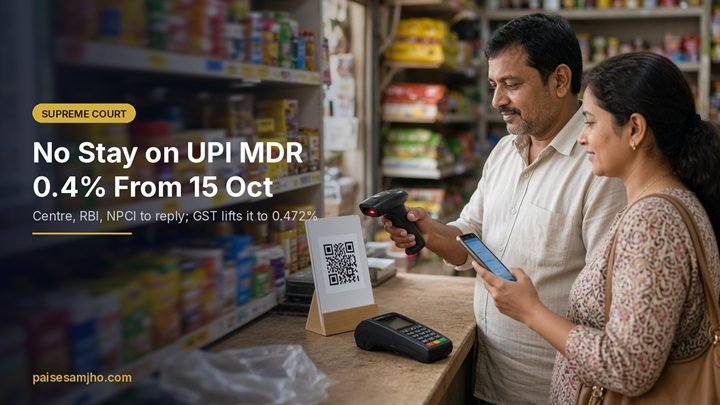
UPI MDR Supreme Court: No Stay on 0.4% Merchant Charge From 15 October
The Supreme Court on 28 September 2026 declined to stay the new 0.4% merchant discount rate (MDR) on UPI payments above ₹2,000, which is due to take effect on 15 October. In the UPI MDR Supreme Court hearing, a bench of Chief Justice Surya Kant and Justices Joymalya Bagchi and V Mohana issued notice to the Centre, the Reserve Bank of India and the National Payments Corporation of India, and asked them to file their replies within four weeks, according to the Times of India and India Today. The charge is capped at ₹300 per transaction. On top of it, 18% GST applies to the MDR, which takes the effective cost to 0.472% of the payment for most merchants.
What happened in the UPI MDR Supreme Court hearing?
The petition, a public interest litigation filed by advocate Anjan Datta, challenges the Finance Ministry’s framework notified in mid-September that allows MDR on some person-to-merchant UPI payments. It also questions the amended section 10A of the Payment and Settlement Systems Act, 2007, and asks why RuPay debit card payments keep an uncapped exemption while UPI does not.
The petitioner asked for an interim stay. The bench did not grant one, describing the issue as “less legal and more technical”, according to the reports. Justice Bagchi asked the government whether the charge was “a tax or a fee” and what the executive basis was for what he called an expropriation.
Additional Solicitor General N Venkataraman, appearing for the Centre, said the charge was “neither a tax nor a fee” and that the government was “not taking even a single rupee”. He described it as a settlement fee between payment aggregators and banks, and told the court that about 96% of UPI transactions would remain exempt. Notice was also issued to the UPI and Services Steering Committee, the Times of India reported.
The UPI MDR Supreme Court order, in short, leaves the timetable untouched for now. With replies due in four weeks, the next substantive hearing is likely to fall after 15 October. Unless the court or the government acts earlier, the 0.4% MDR is on track to start as notified. Case details can be tracked on the Supreme Court’s website.
The 0.4% MDR framework, in brief
We covered the full framework in our earlier explainer on UPI MDR charges from 15 October. The main slabs are:
| Payment type | MDR | Cap |
|---|---|---|
| Person-to-person (P2P) | Free | — |
| Person-to-merchant up to ₹2,000 | Free | — |
| Person-to-merchant above ₹2,000 | 0.4% | ₹300 |
| Railways, telecom, insurance, fuel, agri inputs | Flat ₹5 | — |
| Mutual funds, securities, brokers | 0.02% | ₹300 |
| Small merchants with UPI receipts up to ₹1 lakh a month | Exempt | — |
Recurring mandates such as utility bills, SIPs and OTT subscriptions sit outside the charge. The ₹300 cap is reached at a ₹75,000 payment. MDR is paid by the merchant, not the customer. Whether merchants pass it on through prices or surcharges is a separate question. P2P transfers, which stay free, make up about 37% of UPI volume and 70% of value, according to figures cited in earlier reports.
GST on MDR: why the real cost is 0.472%
MDR is a service fee, so GST at 18% applies to it, as the Financial Express and PTI reported earlier this month. On a ₹10,000 payment, the 0.4% MDR is ₹40, and GST on MDR adds ₹7.20, for a total of ₹47.20, or 0.472%.
| Payment | MDR | GST at 18% | Total | Effective rate |
|---|---|---|---|---|
| ₹2,500 | ₹10 | ₹1.80 | ₹11.80 | 0.472% |
| ₹10,000 | ₹40 | ₹7.20 | ₹47.20 | 0.472% |
| ₹50,000 | ₹200 | ₹36 | ₹236 | 0.472% |
| ₹1,00,000 | ₹300 (capped) | ₹54 | ₹354 | 0.354% |
| Fuel bill, any amount | ₹5 | ₹0.90 | ₹5.90 | — |
Registered merchants can claim input tax credit on this GST if they have a proper invoice or statement from their payment aggregator, so for them the net cost is closer to 0.4%. Merchants selling exempt goods, and composition dealers who cannot claim input credit under general GST rules, bear the full 0.472%. The GST Council is scheduled to meet on 7 October, the Financial Express reported, though there is no indication that MDR is on its agenda. The GST portal carries Council notifications once issued.
Who is protesting the 0.4% MDR
The All India Mobile Retailers Association has called a “No UPI Day” on 2 October, the Times of India reported. BusinessLine reported that a Kerala gold and silver merchants’ body plans a protest on 15 October; we have not seen that confirmed elsewhere. Mobile phone and jewellery shops handle many payments above ₹2,000 and on thin margins, which is why these trades have been the most vocal.
What customers and merchants can do now
For customers, nothing changes at the payment screen; the charge sits with the merchant. Watch for shops adding a surcharge or nudging you to cash for bigger bills. Some merchants may also push card payments or bank transfers for large amounts. The differences between NEFT, IMPS and RTGS are worth knowing if a seller asks for a transfer instead, and our note on UPI and UPI Lite limits covers the per-day caps.
For merchants, the practical steps are to check with the payment aggregator how MDR and GST will appear on statements, make sure GSTIN is registered with them for input credit, and confirm whether monthly UPI receipts stay under ₹1 lakh. NPCI’s UPI page will carry operating circulars as they are issued.
FAQ: UPI MDR Supreme Court case
Did the Supreme Court stop the UPI MDR?
No. It declined an interim stay on 28 September and sought replies from the Centre, RBI and NPCI within four weeks.
Will customers pay the 0.4% MDR?
The merchant pays it. Some shops may pass it on through prices.
How much is GST on MDR?
18% of the MDR amount, which makes the effective cost 0.472% on payments between ₹2,000 and ₹75,000. Registered merchants can usually claim it back as input tax credit.
The UPI MDR Supreme Court case will be back once the government files its reply, probably in late October. Merchants should plan on the charge applying from 15 October in the meantime, and we will update this post if the bench, the RBI or the Finance Ministry changes anything before then.
Disclaimer: Based on reports by the Times of India, India Today, Outlook Money, Financial Express and PTI up to 29 September 2026. Court proceedings are ongoing. General information only.