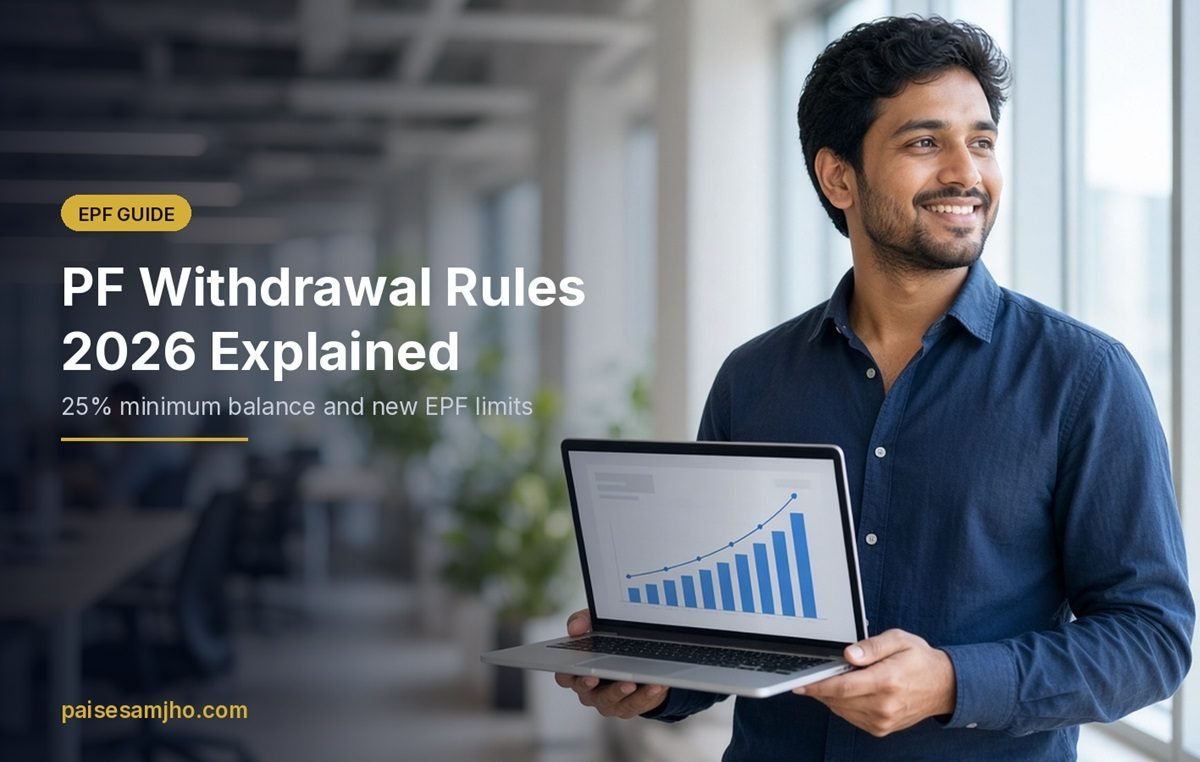
PF Withdrawal Rules 2026: How Much EPF You Can Withdraw Under the New Scheme
Ravi, 31, has ₹4 lakh in his EPF account and a sister’s wedding in December. Two years ago he would have had to work out which of a dozen withdrawal categories applied, how many years of service each needed and what share of which balance he could touch. Under the PF withdrawal rules in the new Employees’ Provident Funds Scheme, 2026, the answer is shorter: ₹1 lakh stays locked as a minimum balance, and he can take up to ₹3 lakh for the wedding. That is the core of the new system, and it applies to every EPF member.
The Labour Ministry notified the EPF Scheme, 2026 through GSR 525(E) on 29 June 2026, replacing the 1952 scheme’s patchwork of partial-withdrawal paragraphs. This guide covers the PF withdrawal rules purpose by purpose: the partial withdrawal limits, the 25% minimum balance, what changes when you leave a job, tax on withdrawals and how to file a claim.
PF withdrawal rules in 2026: the new structure
The old scheme had separate rules for illness, marriage, education, housing, lockouts, natural calamities and more, each with its own service requirement and limit. The 2026 scheme folds these into three broad purposes plus a “special circumstances” category, and uses one formula for how much is available.
That formula has two parts. First, a minimum balance equal to 25% of your total contributions (your share, your employer’s share and the interest credited) must stay in the account. Second, whatever sits above that minimum is your Eligible Member Balance, or EMB. For most purposes, you can withdraw up to 100% of the EMB.
How does the 25% minimum balance work?
This is the part people misread most often, so here it is with numbers. The 25% minimum balance is worked out on the aggregate of employee contributions, employer contributions and interest, which in practice is your full EPF balance. It is not 25% of your own share alone.
| Total EPF balance | 25% minimum balance | Eligible Member Balance (EMB) |
|---|---|---|
| ₹1,00,000 | ₹25,000 | ₹75,000 |
| ₹4,00,000 | ₹1,00,000 | ₹3,00,000 |
| ₹10,00,000 | ₹2,50,000 | ₹7,50,000 |
| ₹25,00,000 | ₹6,25,000 | ₹18,75,000 |
Each withdrawal must be at least ₹1,000. The idea behind the floor is to keep a retirement cushion growing at the EPF rate no matter how many times a member dips in.
EPF partial withdrawal limits by purpose
An EPF partial withdrawal generally needs 12 months of membership. After that, here is how the purposes compare:
| Purpose | How much | How many times |
|---|---|---|
| Illness (self or family) | Up to 100% of EMB | As needed |
| Education (self or children) | Up to 100% of EMB | Up to 10 times |
| Marriage (self, children, siblings) | Up to 100% of EMB | Up to 5 times |
| Housing: buying a house or site, construction, loan repayment, renovation | Up to 100% of EMB | Up to 5 times |
| Special circumstances | Up to 100% of EMB | Up to 2 times per financial year |
The counts restart from the date the 2026 scheme came in, so withdrawals you made under the old rules do not use up your new quota. Mint, Financial Express and Business Standard have all reported the same limits.
Housing deserves a note. Under the old scheme, housing withdrawals needed five years of service and came with a lifetime limit. Now, a member with 12 months of service can use EMB for a down payment or to prepay a home loan. If you are deciding between a PF withdrawal and a bigger loan, run the numbers on both; our guide on home loan eligibility by salary shows how lenders size the loan.
Should you withdraw at all?
Easier PF withdrawal rules make it tempting to dip in. Any money taken out stops earning EPF interest, which is tax-free within limits and set every year by the EPFO’s trustees. Taking ₹3 lakh out at 31 costs far more than ₹3 lakh by 58, because of the compounding you lose. For short-term needs, compare with a personal loan’s cost; our look at personal loans in India covers typical rates. Sometimes paying 12% for a year is cheaper than losing decades of compounding on a larger sum.
PF withdrawal after leaving job
Rules for PF withdrawal after leaving job changed significantly. Under paragraph 49 of the new scheme, full withdrawal is allowed straight away on:
- retirement at or after 55
- permanent incapacity to work
- migration abroad permanently
- retrenchment
- voluntary retirement
In other cases, a member who stops working can withdraw the entire balance only after 12 months of continuous unemployment. The old rule allowed 75% after one month and the rest after two months. Mint reports that under the 2026 scheme, about 75% (the EMB) can be withdrawn immediately on losing a job, and the 25% minimum balance after 12 months. Women who resign to get married do not have to wait.
Paragraph 46(5) adds a small but useful clause. Someone who leaves a job before completing 12 months of membership can still withdraw up to their EMB, even though partial withdrawals normally need a year.
If you are switching jobs rather than leaving work, transfer the account instead of withdrawing. Your UAN stays the same, and continuous service matters for tax, as the next section explains.
Tax on PF withdrawals
Tax is the one area the new PF withdrawal rules did not touch. EPF withdrawals are tax-free after five years of continuous service, which includes service with previous employers if the account was transferred. Before five years, the withdrawal is taxable, and TDS at 10% applies if the amount is ₹50,000 or more and PAN is linked. Without PAN, TDS is higher.
If your total income is below the taxable limit, you can submit a declaration to avoid TDS. Under the new Income-tax Act, the old Forms 15G and 15H have been replaced by Form 121; see our guide on Form 121. The withdrawal must also be shown in your return if it is taxable, and you can file that on the income tax e-filing portal.
EPS pension money is separate. Withdrawal and pension rules for EPS-95 did not change with the EPF Scheme, 2026, and the pension part cannot be taken out once you have 10 years of service. The recent wage ceiling change also affects EPS contributions; we covered that in EPFO’s wage ceiling decision.
How to file a PF withdrawal claim online
- Log in to the EPFO member portal with your UAN and password.
- Check that Aadhaar, PAN and bank account are linked and verified under KYC.
- Go to Online Services and choose the claim form.
- Enter the last four digits of your bank account to verify.
- Select the purpose and amount. The portal shows the eligible amount based on your balance.
- Submit with the Aadhaar OTP.
The UMANG app offers the same service. Keep an eye on the claim status on the portal; rejections most often come from name or date-of-birth mismatches between Aadhaar and EPFO records, or from bank details that do not match.
How long does settlement take?
The scheme says claims should be settled within 20 days of receipt. If EPFO delays beyond that without reason, paragraph 54 provides for penal interest at 12% a year on the amount. Auto-settled claims have typically been credited within a few working days. The EPFO website has the grievance link if yours is stuck.
Other points in the new scheme
Beyond the PF withdrawal rules, a couple of other changes are worth knowing. Members earning above the wage ceiling can make voluntary contributions on higher pay under paragraph 19, with the employer’s consent. Your salary slip shows whether this is happening; our explainer on reading a salary slip points out the PF lines.
FAQ: PF withdrawal rules
How much PF can I withdraw under the new rules?
Up to 100% of your Eligible Member Balance, which is your total balance minus the 25% minimum balance. Each withdrawal must be at least ₹1,000.
Is the 25% minimum balance calculated on my share only?
No. It covers employee and employer contributions and interest together.
Can I withdraw my full PF immediately after resigning?
Not unless you are retiring, emigrating, retrenched, taking VRS or permanently incapacitated. Otherwise the EMB is available right away and the rest after 12 months without work, going by the scheme and Mint’s reading of it.
Is a PF withdrawal taxable?
Only if you have less than five years of continuous service. TDS of 10% applies on withdrawals of ₹50,000 or more in that case.
Do earlier withdrawals count towards the new limits?
They do not, according to the scheme’s transition provisions as reported; the counts start afresh.
For Ravi, the practical path is to apply for the marriage withdrawal in October so the money is in by December, keep the ₹1 lakh minimum untouched, and restart his EPF habit in January. The PF withdrawal rules now make access easy enough that the harder discipline is leaving the money alone when there is no real need.
Disclaimer: Based on the EPF Scheme, 2026 (GSR 525(E), 29 June 2026) and reports by Mint, Financial Express and Business Standard. Check the EPFO portal for your eligible amount before applying. General information, not financial advice.