NPS Swasthya Launches 1 October: Health Cover, 25% Withdrawal and Costs Explained
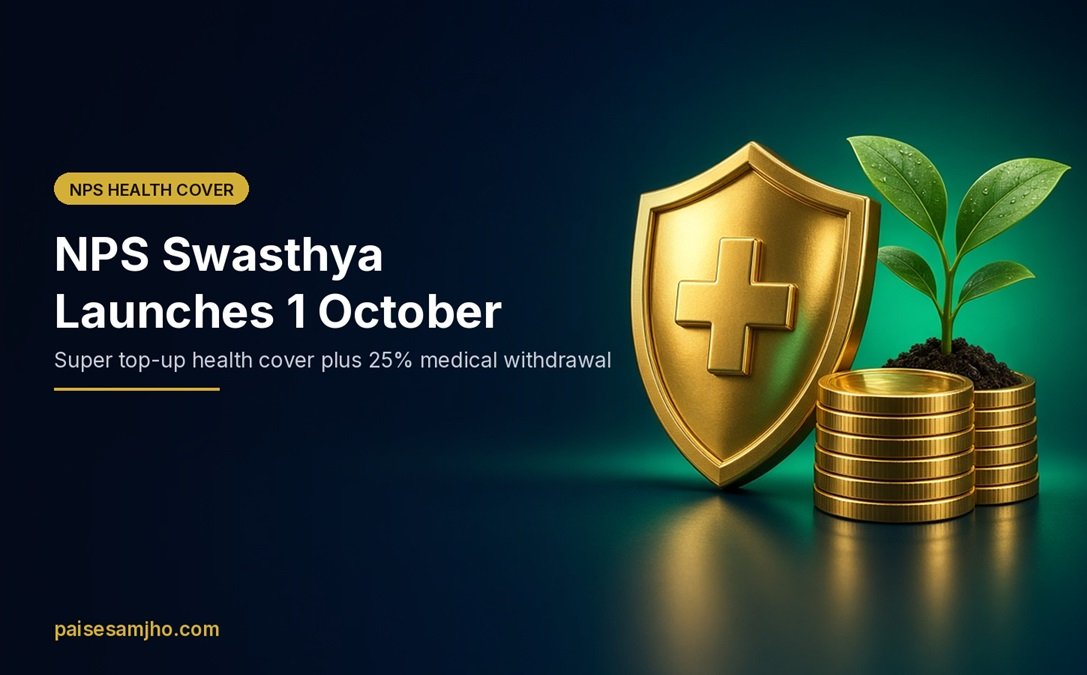
NPS Swasthya, the Pension Fund Regulatory and Development Authority’s new health-linked product under the National Pension System, is set to be launched on Thursday, 1 October 2026, which PFRDA marks as NPS Diwas. Finance Minister Nirmala Sitharaman is expected to launch it, according to Mint and Business Standard. PFRDA’s operational guidelines, issued on 18 September 2026, describe a separate NPS Swasthya investment account paired with a compulsory super top-up family floater health policy. Subscribers can withdraw up to 25% of their own contributions to pay medical bills, with no waiting period and no cap on the number of withdrawals.
Premiums and the list of insurers had not been announced when this was written on 29 September. What is public is the structure: who can join, how the money moves, what the health policy covers and how the account closes. Everything below comes from the PFRDA circular and reporting that matches it.
What is NPS Swasthya?
Think of NPS Swasthya as two products sold together. The first is an investment account inside NPS where you contribute money and it is invested, much like your existing NPS. The second is a health policy that kicks in only after your family’s hospital bills in a year cross a fixed amount, called the deductible. PFRDA’s circular treats the two as legally distinct: the investment account is regulated under the NPS framework, while the policy is a regular health insurance contract issued by an insurer.
The link between them is what makes the product unusual. Money sitting in the NPS Swasthya account can be pulled out to pay medical costs, and the renewal premium for the policy can also be paid from the corpus. So the account works as a savings pot that funds the deductible, and the super top-up handles the large bills beyond it. You can read the full guidelines on the PFRDA circular page for NPS Swasthya.
One point that is easy to miss: this is a separate account. Opening it does not change your existing All Citizen NPS Tier I or Tier II, and closing it later does not touch those accounts either.
Who can join, and who the policy covers
Entry age is 18 to 70. Once you are in, the health policy can be renewed until you turn 85. The family floater covers you, your spouse and up to two dependent children. Parents are not covered, which will disappoint many people who were hoping to use this for elderly parents. If that was your main reason for looking at NPS Swasthya, a separate senior-citizen policy is still the route.
Premiums will be priced in three age cohorts: 18 to 40, above 40 up to 60, and above 60 up to 70. Enrolment is on a Good Health Declaration, and the circular does not require pre-policy medical tests.
Deductible and sum insured options in the NPS Swasthya health insurance
The NPS Swasthya health insurance comes in four fixed pairings. The deductible is an annual aggregate for the whole family, meaning the policy pays only after the family’s combined eligible hospital bills in a policy year cross that figure.
| Option | Annual family deductible | Super top-up sum insured |
|---|---|---|
| 1 | ₹10,000 | ₹1 lakh |
| 2 | ₹50,000 | ₹5 lakh |
| 3 | ₹1 lakh | ₹10 lakh |
| 4 | ₹3 lakh | ₹30 lakh |
Take option 3 as an example. If your family runs up ₹1.4 lakh of admissible hospital bills in a year, the first ₹1 lakh is yours to pay, from pocket, from an existing base policy or from the NPS Swasthya account. The insurer pays the remaining ₹40,000. The switch between options is allowed at renewal.
How a super top-up differs from a regular policy
A regular health policy pays from the first rupee. A super top-up deductible policy pays nothing until the deductible is crossed, which is why premiums for super top-ups tend to be much lower for the same sum insured. The “super” part means the deductible is counted across all claims in the year, not per hospitalisation. For a family that already has a ₹5 lakh base cover from an employer, a ₹5 lakh deductible top-up is the usual pairing. NPS Swasthya’s pairings are fixed, so check how they line up with the cover you already have. Our explainer on how health insurance works covers deductibles and floaters in more detail.
What the policy covers
The circular sets out a fairly generous standard wording for the super top-up:
- Single private room, and ICU charges at actuals
- Pre-hospitalisation expenses for 30 days and post-hospitalisation for 60 days
- Ambulance up to ₹2,500 per hospitalisation
- No co-payment and no disease-wise sub-limits
Waiting periods are standard for the industry. There is an initial 30-day waiting period (accidents are covered from day one), 12 months for pre-existing diseases and 12 months for a list of specified illnesses. Controlled type 2 diabetes and hypertension are covered after the 12-month wait.
Service timelines are also written into the guidelines. Cashless pre-authorisation is to be decided within one hour, discharge authorisation within three hours, and reimbursement claims settled within 15 days. These are in line with what IRDAI has been pushing insurers towards; our note on IRDAI’s new rules for policy buyers covers that side.
The 25% withdrawal rule, explained
This is the feature most people are asking about. You can withdraw up to 25% of your own contributions to the NPS Swasthya account to pay for outpatient (OPD) or inpatient (IPD) treatment. There is no waiting period before the first withdrawal and no limit on how many times you can withdraw. The money is paid directly to the healthcare provider, not to your bank account.
Note the base: it is 25% of contributions, not 25% of the corpus including returns. If you have put in ₹50,000 over two years and the account has grown to ₹56,000, the limit is worked out on the ₹50,000, so ₹12,500.
There is also a larger exit door. If a single hospitalisation bill exceeds what the 25% limit allows, the circular permits a premature exit: the corpus pays the bill, any balance left is moved to your All Citizen NPS account, and the health policy continues until the end of its current term.
You can also move money into NPS Swasthya from your All Citizen NPS account, but only up to the amount of your chosen deductible. That lets existing NPS subscribers fund the deductible without fresh cash, though it does reduce their retirement corpus.
What it costs to start
The minimum first payment is made up of three parts:
- The first year’s health insurance premium, including taxes
- An annual health benefit administration charge of ₹200 plus taxes
- A minimum investment of ₹1,000 into the NPS Swasthya account
After that, contributions can be as small as ₹10. The investment account follows the Central Government Scheme pattern, the same mix used for government employees’ NPS.
Ongoing charges are the usual All Citizen NPS charges plus up to 0.08% a year of assets under management, plus the ₹200 annual charge. On a ₹50,000 balance, 0.08% is ₹40 a year, so the fixed ₹200 matters more for small accounts than the percentage.
The premium itself is the big unknown. Until insurers publish rates, nobody can say whether NPS Swasthya is cheaper than buying a standalone super top-up. Anyone quoting a premium figure before 1 October is guessing.
Renewal, lapse and closure
The renewal premium can be paid from your NPS Swasthya corpus. The pension fund is supposed to send reminders 90, 60 and 30 days before renewal. If the premium is still unpaid after the grace period, the account is closed and the corpus moves to your All Citizen NPS account.
The account closes in four situations: normal exit, premature exit, lapse and death. Normal exit follows the exit rules for non-government NPS subscribers. None of these closures affects your other NPS accounts.
NPS Diwas launch: what is still missing
Several things will only become clear once NPS Swasthya actually goes live on NPS Diwas:
| Question | Status on 29 September |
|---|---|
| Premium for each cohort and option | Not published |
| Which insurers will offer the policy | Not named |
| Tax treatment of contributions and withdrawals | No specific notification seen |
| Where to enrol (CRA portals, POPs, apps) | Expected at launch |
On tax, we have not seen any notification that extends section 80CCD-style deductions to this account or that treats the health premium under the health insurance deduction. Do not assume either until the government says so.
Should you consider NPS Swasthya?
It depends on what cover you already have. For a salaried person with a group health policy, one of the higher-deductible options could sit on top of the employer cover, and the NPS Swasthya account would build a small fund for OPD bills and the gap years between jobs. For a young self-employed couple with no cover at all, a super top-up on its own is not enough, because the family pays the full deductible on every claim until it is crossed. A base policy still comes first.
Compare it with a standalone top-up once premiums are out. If the premium is similar, NPS Swasthya’s extra is the linked savings account; if it is costlier, you are paying for that convenience. People who already park long-term money in PPF may find the NPS Swasthya lock-in easier to accept, since only 25% of contributions is accessible without an exit. Our guide on how PPF withdrawals work is a useful comparison, and so is our new explainer on EPF withdrawal limits for anyone thinking of their EPF as a medical backstop. The IRDAI website lists registered health insurers if you want to compare standalone top-up products.
FAQ: NPS Swasthya
When does NPS Swasthya launch?
It is expected to be launched on 1 October 2026, NPS Diwas.
Can I cover my parents under NPS Swasthya?
No. The family floater covers the subscriber, spouse and up to two dependent children only.
How much can I withdraw for medical bills?
Up to 25% of your own contributions, paid directly to the hospital or provider, with no waiting period and no limit on the number of withdrawals. A single large inpatient bill beyond that can trigger a premature exit.
Does NPS Swasthya affect my existing NPS account?
Only if you choose to transfer money from it, which is capped at your deductible. Otherwise the two accounts are separate, and closing NPS Swasthya sends its balance to All Citizen NPS.
What is the premium?
Not announced yet. It will vary by age cohort and by the deductible option you pick, and should be published by insurers around the launch. Details will also appear on the NPS Trust website.
If you are keen, wait for the premium tables after 1 October, put them next to a standalone super top-up quote for the same family and deductible, and decide on the numbers. The product will not disappear if you take two weeks to compare.
Disclaimer: Based on PFRDA’s operational guidelines dated 18 September 2026 and media reports up to 29 September 2026. Premiums, insurers and tax treatment were not announced at the time of writing. This is general information, not financial or insurance advice.