Tax on Lottery Winnings: Why the ₹30 Crore Onam Bumper Prize Shrinks to ₹16.47 Crore
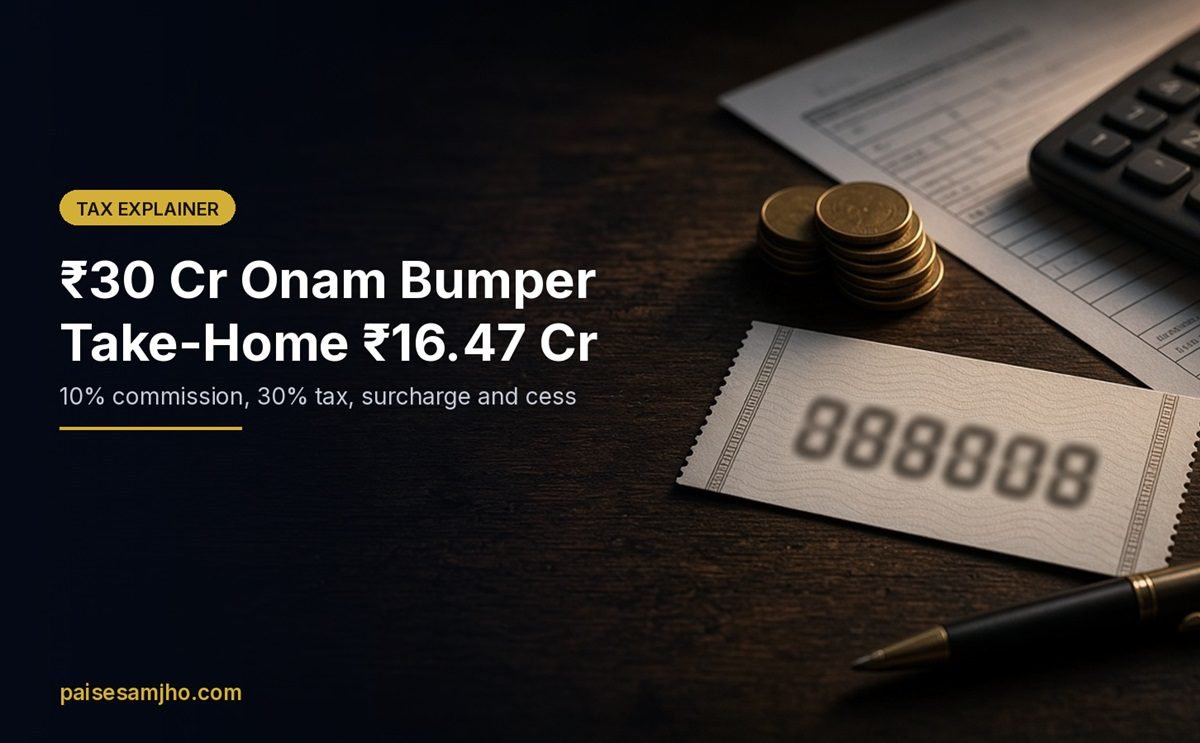
The ₹30 crore first prize in Kerala’s Thiruvonam Bumper BR-111 lottery, drawn on 26 September 2026, will shrink to roughly ₹16.47 crore in the winner’s hands once the agent’s commission and the tax on lottery winnings are taken out. The winning ticket, TL 360615, was sold by a vendor in Taliparamba in Kannur district, according to Onmanorama and Mathrubhumi. The winner had not been identified publicly as of 29 September. Kerala printed about 90 lakh tickets at ₹500 each for this draw, a turnover of around ₹450 crore.
Different outlets have quoted different take-home figures, from about ₹15.5 crore to over ₹17 crore. The gap comes almost entirely from which surcharge rate is assumed. Below is the calculation step by step, the rules that apply under the new Income-tax Act, 2025, and what they mean for smaller prizes too. For clarity: this is not a suggestion to buy tickets. With one first prize against tens of lakhs of tickets, the odds for any single ticket are tiny.
Onam Bumper 2026: how ₹30 crore becomes about ₹16.47 crore
Two deductions come off the top. The first is the agent’s commission. Kerala pays the selling agent 10% of the prize amount, and this is deducted from what the winner receives. The second is income tax, charged on the prize after commission.
| Step | Amount |
|---|---|
| First prize, Onam Bumper 2026 | ₹30.00 crore |
| Less 10% agent commission | ₹3.00 crore |
| Prize after commission (taxable) | ₹27.00 crore |
| Tax at 30% | ₹8.10 crore |
| Surcharge at 25% of tax | ₹2.025 crore |
| Health and education cess at 4% of (tax + surcharge) | ₹0.405 crore |
| Total tax | ₹10.53 crore |
| Approximate take-home | ₹16.47 crore |
Mathrubhumi’s calculation also lands at ₹16.47 crore, using the same 25% surcharge. The effective tax works out to exactly 39% of the post-commission prize.
Why do the take-home figures differ?
The base rate of 30% is fixed by law, and nobody disputes it. The disagreement is over surcharge, which rises with total income. For an individual whose income crosses ₹5 crore, the highest surcharge is 25% under the new tax regime and 37% under the old regime.
| Surcharge assumed | Total tax on ₹27 crore | Take-home |
|---|---|---|
| 15% | ₹9.69 crore | ₹17.31 crore |
| 25% (new regime cap) | ₹10.53 crore | ₹16.47 crore |
| 37% (old regime top slab) | ₹11.54 crore | ₹15.46 crore |
Goodreturns was reported to have used 37%, which gives the lower ₹15.46 crore. Since the new regime is now the default, 25% is the more likely outcome for a winner who does not opt out of it, though the final number depends on the winner’s full return for the year.
TDS versus the final tax bill
There is a second reason for the confusion. When the prize is paid, the lottery department deducts tax at source. The TDS on lottery prize money is the 30% base, plus cess, and surcharge where applicable, depending on how the payer computes it. If the deduction at payment is lower than the final liability, the winner has to pay the difference through advance tax or self-assessment tax before filing the return. So the amount credited to the bank account on day one may be higher than what the winner finally keeps after filing. Our explainer on how TDS works covers the basic mechanism.
Tax on lottery winnings under the Income-tax Act, 2025
The new Act took effect on 1 April 2026, and the section numbers have changed. The substance of the tax on lottery winnings has not.
| Rule | Income-tax Act, 1961 | Income-tax Act, 2025 |
|---|---|---|
| Flat 30% tax on lottery, crossword, game show winnings | Section 115BB | Section 194 |
| TDS by the payer of the prize | Section 194B | Section 393(3), Table, Sl. No. 1 |
| TDS threshold per prize | Above ₹10,000 | Above ₹10,000 |
Three consequences of the flat-rate rule catch winners off guard. No deduction is allowed against the winnings, so the ₹500 ticket cost cannot be subtracted. The basic exemption limit cannot be used to reduce tax on lottery income. And the rebate that makes income up to ₹12 lakh tax-free under the new regime does not apply to special-rate income like this. You can read the Act on the Income Tax Department’s website.
Winnings from online games are taxed under a separate provision with its own rules on net winnings, so do not apply the lottery figures to fantasy sports or gaming apps.
30% tax on winnings for smaller prizes
Most prizes are nowhere near crores, and surcharge only kicks in once total income crosses ₹50 lakh. For a smaller prize the maths is simpler: 30% tax on winnings plus 4% cess, which makes 31.2% of the post-commission amount.
| Prize | After 10% commission | Tax + cess (31.2%) | Approx. take-home |
|---|---|---|---|
| ₹1 lakh | ₹90,000 | ₹28,080 | ₹61,920 |
| ₹5 lakh | ₹4.5 lakh | ₹1.40 lakh | ₹3.10 lakh |
| ₹25 lakh | ₹22.5 lakh | ₹7.02 lakh | ₹15.48 lakh |
The same 30% base applies whether the ticket is from Kerala, another state lottery or a legal draw elsewhere, so the tax on lottery winnings does not change with the state. These figures assume the winner has no other income large enough to push them into a surcharge bracket. A prize of ₹10,000 or less has no TDS, but the income is still taxable at 30% and must be shown in the return.
Does the winner need to pay advance tax?
Very likely, if the TDS falls short. Advance tax is due in instalments through the year, and a windfall in September means the remaining instalments (15 December and 15 March) should include the unpaid part of the tax on lottery winnings. The law recognises that nobody can predict a lottery win, so interest for missing the earlier instalments is generally not charged on this income, provided the shortfall is paid in the instalments that remain after the win. Paying late beyond that can attract interest.
In practice, a big winner should get a chartered accountant to compute the final liability as soon as the prize is credited. On a ₹27 crore taxable prize, even a few percentage points of surcharge difference is worth around ₹1 crore, so the tax on lottery winnings is one area where paying for professional help clearly makes sense.
How the prize is claimed in Kerala
Under Kerala’s rules, the winner has 30 days from the draw to submit the claim, and the Director of State Lotteries can accept it up to 90 days in genuine cases. The signed original ticket goes to a bank, the District Lottery Office or the Directorate along with PAN, an identity document and bank details. Payment usually follows within 15 to 20 days of a complete claim, according to past reports. The Directorate of Kerala State Lotteries publishes results and claim forms.
PAN is essential. Without it, TDS can be deducted at a higher rate and the credit will not show correctly in the winner’s Form 26AS or annual information statement.
After the money arrives
The winnings go into the income tax return as income from other sources, taxed at the special rate. The simple one-page return meant for salaried people cannot be used when there is lottery income, so the winner needs the fuller form. The return is filed on the income tax e-filing portal. If extra tax was paid through TDS, the refund process is the same as for anyone else; see our guide on income tax refund status.
Gifting part of the money to family is common. Gifts to relatives defined in the Act, such as a spouse, children, parents and siblings, are tax-free for the recipient. Gifts to friends above ₹50,000 in a year are taxable in the friend’s hands.
Parking a large sum also brings bank-side rules into play. Deposits of ₹3 crore and above count as bulk deposits and carry different rates, which we covered in RBI’s bulk FD rules. Cash handling limits and reporting rules still apply even though the prize itself arrives by bank transfer.
FAQ: tax on lottery winnings
How much tax is paid on lottery winnings in India?
A flat 30%, plus surcharge if income is high, plus 4% cess on the total. No deductions or exemption limit apply.
Is the agent commission taxed?
Not in the winner’s hands. The 10% commission is deducted first, and tax is worked out on the balance.
Can the Onam Bumper 2026 winner reduce the tax?
No. Tax on lottery winnings cannot be cut with 80C-type deductions or losses from other heads. The only real variable is the surcharge rate, which depends on the regime and total income.
Is TDS on lottery prize deducted on small prizes?
Only when a single prize exceeds ₹10,000. Smaller prizes are paid without TDS but remain taxable.
Who won the ₹30 crore prize?
The winner had not come forward publicly as of 29 September 2026.
For the eventual winner, the useful order of work is simple enough: claim within the 30 days with PAN attached, check what TDS was actually deducted, and set aside the gap to 39% for advance tax before spending anything. The rest of us can treat the ₹30 crore headline as a lesson in how much of a windfall reaches your account.
Disclaimer: Calculations are illustrative, based on the Income-tax Act, 2025 and reports by Onmanorama and Mathrubhumi up to 29 September 2026. Actual tax depends on the winner’s total income and regime. This article does not promote lotteries.