CIBIL compensation ₹100 per day: RBI Rule Explained
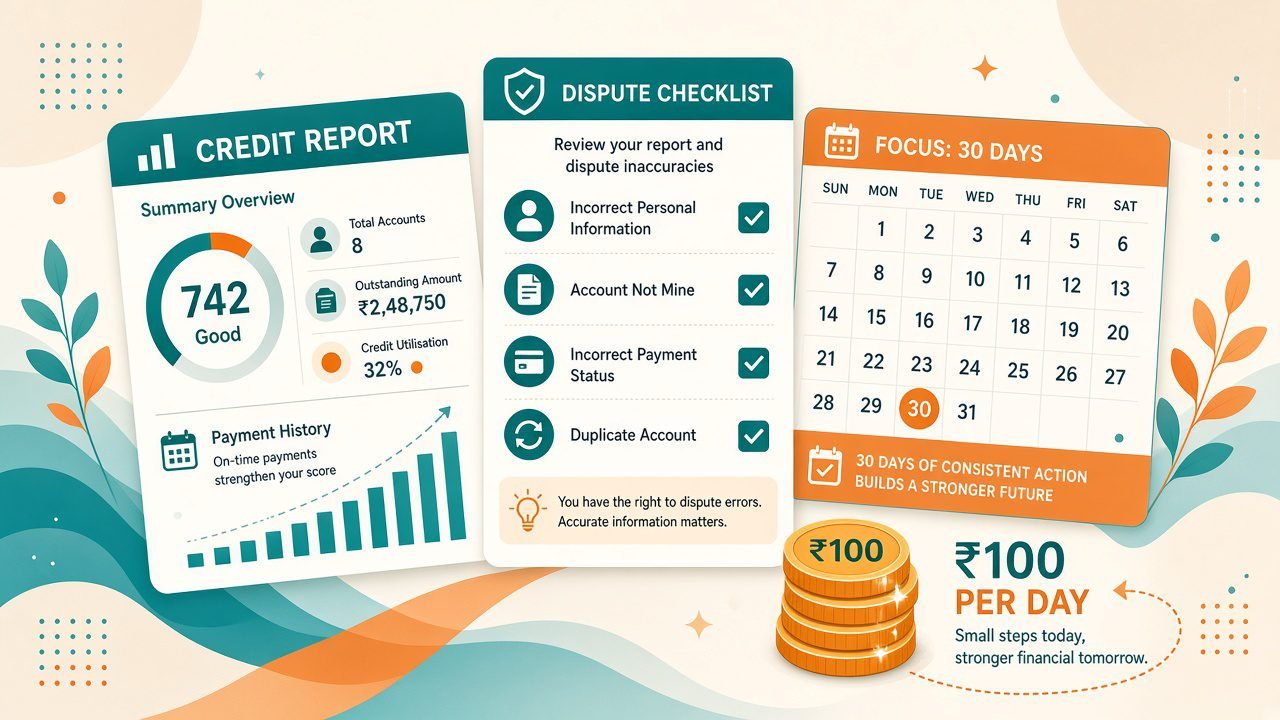
You disputed a wrong loan entry on your credit report. The bank said “we have raised it.” Thirty days later, the same error still stares back at you from CIBIL — and your home-loan file is stuck. That delay is not just annoying. Under RBI’s credit-information updation framework, it can entitle you to ₹100 per calendar day until the complaint is resolved.
Why is this suddenly everywhere again? On 4 September 2026, RBI announced monetary penalties on three Credit Information Companies for failing to credit eligible customers’ compensation on time. The orders (dated 31 August 2026) hit TransUnion CIBIL, CRIF High Mark and Equifax for a combined roughly ₹34.9 lakh. The peg is not a new law — it is the regulator showing teeth on a 2023 circular that many borrowers still do not use.
This guide explains the CIBIL compensation ₹100 per day RBI rule in plain Indian English: who pays, how the 30-day clock splits between bank and bureau, how to file so the payout does not bounce, and when to escalate to the RBI Ombudsman.
Why this is in the news — RBI fines on CIBIL, CRIF & Equifax (Sep 2026)
RBI’s press release on 4 September 2026 listed penalties on three CICs for deficiencies linked to not crediting compensation to complainants under the delayed credit-information updation / rectification framework:
- TransUnion CIBIL — ₹26,82,800
- CRIF High Mark — ₹6,89,600
- Equifax — ₹1,19,400
That is about ₹34.9 lakh combined — the number that powered headlines on the RBI fine TransUnion CIBIL September 2026 story. The underlying customer right, though, comes from RBI circular DoR.FIN.REC.48/20.16.003/2023-24 dated 26 October 2023. The September 2026 fines are enforcement of that framework, not a brand-new compensation invention.
For you as a borrower, the practical signal is simple: CICs and credit institutions (banks, NBFCs, other lenders that furnish data) are on notice. If your genuine dispute sits unresolved past 30 calendar days, compensation is not a favour — it is a regulated outcome, and failure to pay it can itself attract supervisory action.
Your right: ₹100 per calendar day if dispute not resolved in 30 days
The core rule for a credit report error dispute compensation India claim:
- You file a complaint / dispute about incorrect or incomplete credit information with the Credit Institution (CI) and / or the Credit Information Company (CIC).
- If it remains unresolved beyond 30 calendar days from first filing, compensation accrues at ₹100 per calendar day of delay beyond that window (as per the operative RBI framework).
- The money is meant for you, the complainant — not as a vague “we will look into it” gesture.
Worked sense-check: suppose you file on 1 August and the error is fixed only on 20 September. That is 50 calendar days from filing. Beyond the 30-day resolve window, 20 days of delay × ₹100 = ₹2,000 — before you even count the stress of a rejected loan. Longer delays scale linearly. The September fines exist because some eligible payouts were not credited as required.
Important nuance: compensation for delay is separate from whether the underlying data was wrong. You still need a valid dispute about credit information updation / rectification. You cannot invent a delay claim over a score model argument (more on exclusions below).
Who pays — Credit Institution (bank/NBFC) vs Credit Information Company
Borrowers often shout only at “CIBIL.” The framework is smarter — and fairer — about where the delay actually happened.
Credit Institution (CI) means the bank, NBFC or other lender that reported the data. If they sit on a correction request and do not push clean data to the CIC in time, the delay often sits with them.
Credit Information Company (CIC) means TransUnion CIBIL, Experian, Equifax, CRIF High Mark — the bureaus that store and share the report. If the CI has already sent corrected data but the CIC fails to update / close the complaint in its remaining window, the delay can sit with the CIC.
Liability for compensation follows the delay attribution rules in the circular — which is why the RBI penalties in September 2026 specifically called out CICs for not crediting compensation. In real life, many disputes need both sides: you may raise with the lender and mark the dispute on the bureau portal.
CI has 21 days to push corrected data; CIC gets remainder (~9 days)
Inside the 30-calendar-day outer limit, the usual split taught in explainers and aligned with the framework is:
- Credit Institution: about 21 days to verify and push corrected / updated data to the CIC.
- CIC: the remainder (~9 days) to complete updation / rectification and close the loop.
If either side overruns its part, that is where compensation responsibility tends to land. Keep timestamps: complaint ID, email acknowledgements, portal screenshots, and SMS. Without a paper trail, “I told the branch manager verbally” will not help when you claim ₹100/day.
Step-by-step: dispute a wrong CIBIL / Experian / Equifax / CRIF entry
Use this sequence when you are serious about both fixing the report and preserving a compensation claim.
- Pull fresh reports from all four CICs if you can (free annual / regulated free pulls where applicable, plus paid pulls if you are mid-loan). Errors sometimes appear on one bureau and not another.
- Pin the exact line — account number, lender name, date opened, overdue amount, written-off flag, ownership (individual vs joint).
- Raise with the Credit Institution first via their grievance / credit-information dispute channel (email + portal + branch acknowledgement). Attach KYC, loan closure letter, NOC, payment proofs.
- Raise / mirror the dispute on the CIC portal (CIBIL, Experian, Equifax, CRIF) so the bureau clock is also visible.
- Diary the Day-0 date — the first filing that starts the 30-calendar-day count. Do not restart casually with duplicate tickets unless the CI asks for a fresh reference.
- Follow up in writing at Day 10, Day 20, and Day 30. Keep the tone factual.
- On resolution, download the corrected report and confirm the compensation credit (see payout SLA below).
Must share bank account / UPI ID when filing (else payout fails)
This is the boring step that kills real money. Compensation has to be credited to your bank account or UPI ID. If you never shared valid payout details when filing — or shared a closed account — the CI/CIC can “owe” you on paper while nothing hits your balance.
When you file:
- Provide an active savings account number + IFSC, or a UPI ID linked to that account.
- Use an account in your name (the complainant).
- Update details immediately if you change banks mid-dispute.
- Save the acknowledgement that lists the payout credentials you submitted.
If someone asks how to claim CIC delay compensation in one line: file correctly, share payout details, wait out the 30-day resolve window, then demand the ₹100/day credit with your complaint reference.
Compensation must hit your account within 5 working days of resolution
Resolution of the data error and payment of delay compensation are related but not identical. Under the framework, once compensation is due / the matter is resolved for this purpose, the amount should be credited to the complainant’s bank account or UPI within 5 working days.
If the report is fixed on a Monday but no credit appears by the following week’s working-day count, escalate with the complaint ID and a bank statement extract showing nil credit. The September 2026 CIC penalties were specifically about failures around crediting compensation — so citing that supervisory context (politely, with facts) when you write to the CIC grievance cell is fair game.
Do not confuse “case closed on portal” with “money received.” Screenshot both the corrected tradeline and the credit advice / UPI receipt.
What is NOT covered (score-model disputes, pending court cases, etc.)
Not every credit-report unhappiness triggers ₹100/day. The framework excludes, among other things:
- Disputes about credit-score computation or the scoring model itself — arguing “my score should be 780 not 720” without a factual data error is not the same as disputing a wrong overdue flag.
- Matters already pending in other fora — if the same issue is already in court / another statutory forum in a way the circular excludes, compensation under this track may not run in parallel.
- Certain CICRA Section 18 arbitration matters — specialised paths under the Credit Information Companies (Regulation) Act framework can sit outside this delay-compensation recipe.
Also use common sense: if the “error” is actually a genuine unpaid EMI, fixing the report means paying the dues or settling with the lender — not claiming compensation for a true overdue. Compensation protects you against delay in correcting wrong or incomplete information, not against accurate negative data.
Escalate if denied — RBI Integrated Ombudsman (cms.rbi.org.in)
If the CI or CIC denies a valid delay claim, ignores you after Day 30, or fails to credit compensation within the 5-working-day payout SLA:
- Send a final written reminder with chronology (Day-0 filing, follow-ups, resolve date, payout details).
- Use the entity’s own grievance / principal nodal officer channel and wait for their turnaround as applicable.
- Escalate via the RBI Complaint Management System — cms.rbi.org.in — under the Integrated Ombudsman Scheme for eligible regulated entities.
- Attach proof pack: reports before/after, complaint IDs, emails, and calculation of calendar days × ₹100.
Keep expectations realistic: Ombudsman is for deficiency of service within scheme limits, not a lottery. A clean file wins more often than an angry paragraph without dates.
FAQs — multiple lenders on one error, joint liability, how much you can get
1. Can I claim against both the bank and CIBIL for the same error?
You raise the dispute where the data and delay sit. Compensation follows who caused the delay within the 21-day / remainder split. You do not automatically “double dip” the same calendar day twice — the framework attributes delay, it does not invent duplicate rents.
2. The same wrong write-off appears on CIBIL and Experian. Do I get two compensation streams?
You may need separate disputes per CIC if both carry the error, and each clock runs on its own filing. Document each portal’s Day-0. Outcomes can differ if one bureau updates faster.
3. How much can I get in practice?
₹100 × number of calendar days of delay beyond the 30-day resolve window. A 45-day unresolved complaint (15 days beyond 30) points to ₹1,500 before you argue other damages elsewhere. There is no “crore-pati” reading of this circular.
4. Joint loan — who files and who receives the money?
Typically the affected borrower / complainant whose report carries the error should file and provide their payout account. For joint facilities, both holders may need corrections on their respective reports. Follow the CI’s dispute form instructions for joint accounts.
5. Does the RBI fine TransUnion CIBIL September 2026 mean my old 2024 dispute will be auto-paid?
No. Penalties go to RBI’s framework; they are not a class-action cheque to every past complainant. You still need your own eligible claim and credit trail.
6. Is Experian covered even though the Sep 2026 fine list named three CICs?
The ₹100/day framework applies across the regulated CIC ecosystem. The September penalties happened to name CIBIL, CRIF and Equifax for specific inspection findings. Your Experian dispute still follows the same circular logic.
7. Where do I read the official rule?
Start with RBI circular DoR.FIN.REC.48/20.16.003/2023-24 (26 Oct 2023) and the 4 Sep 2026 press release on CIC penalties. Soft reminder: always verify steps and eligibility on official RBI / CIC pages before relying on any blog maths.
Key takeaway
If a genuine credit-information dispute is not resolved within 30 calendar days, you can claim ₹100 per calendar day of further delay — and that compensation should hit your bank / UPI within 5 working days of resolution. The CI usually has ~21 days to push corrections; the CIC gets the remainder. RBI’s September 2026 fines on CIBIL (₹26.82 lakh), CRIF (₹6.90 lakh) and Equifax (₹1.19 lakh) show the regulator is watching non-payment of this compensation. File with proofs, share payout details, diary Day-0, and escalate on cms.rbi.org.in if denied.
Official sources
- RBI press release — penalty on TransUnion CIBIL (4 Sep 2026)
- RBI circular — compensation framework (26 Oct 2023)
- TransUnion CIBIL — Framework for Compensation
Disclaimer: General consumer-education summary based on RBI’s 26 Oct 2023 circular and publicly reported September 2026 CIC penalties. Individual eligibility, exclusions and liability splits depend on facts. Always check official RBI notifications and the relevant CIC / lender grievance pages before filing or escalating.
PhonePe Se AutoPay Kaise Delete Karein | ऑटोपे कैसे डिलीट करें