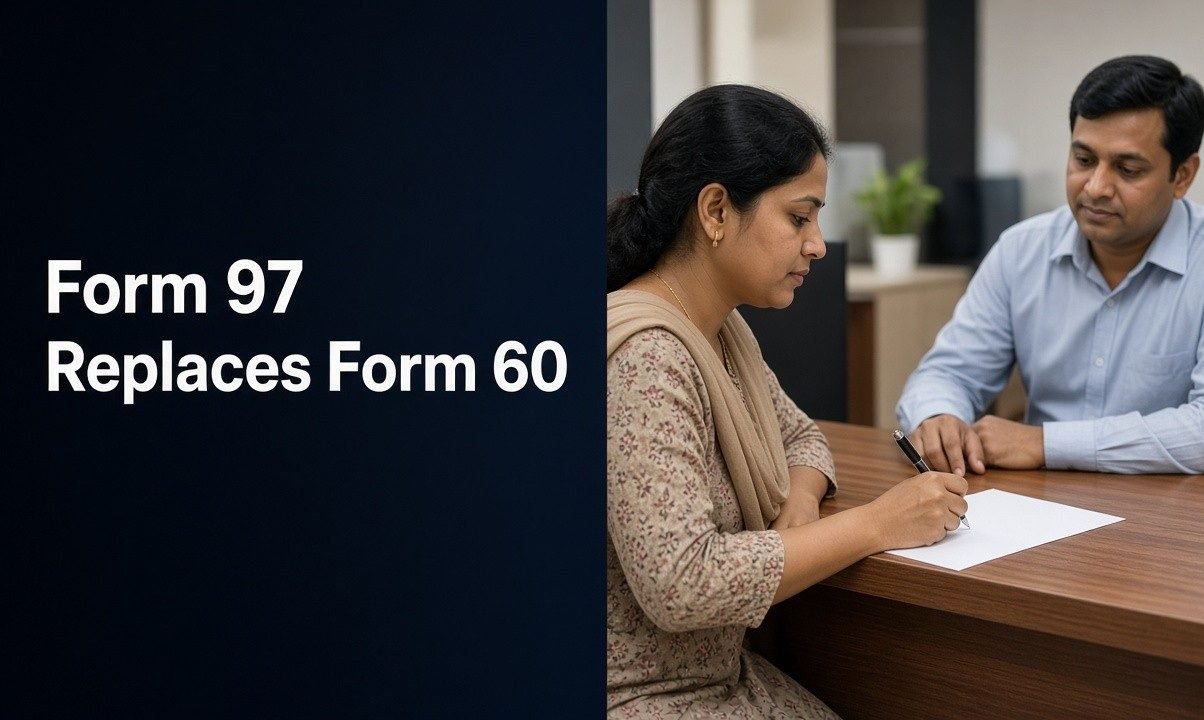
Form 97 Replaces Form 60: How to Declare When You Have No PAN
If a bank, post office or other notified person asks for your PAN and you do not have one, the declaration you fill is no longer Form 60. Under the Income-tax Rules, 2026, that role belongs to Form No. 97. Form No. 98 is the statement the institution later files with the Income Tax Department, taking the place of old Form 61. This guide explains what Form 97 is, who uses it, what the bank must do with it, and where the official text still leaves you to check the Rule 159 table.
Form 60 is now Form 97
The Income Tax Department’s own forms page, titled “Form No. 97 & 98 (Old Form No. 60 & 61) | Non-PAN Declarations & Reporting | Income Tax Rules 2026” and dated 4 April 2026, is the official mapping. The 2025 Act and 2026 Rules replaced the 1961/1962 stack from 1 April 2026. If a branch still hands you a sheet headed “Form 60,” ask for the current Form 97. Using an obsolete number can mean the declaration is not the one the Rules now require.
Form 97 is a declaration by a person (other than a company or firm, or in the cases the form itself contemplates) who does not have a PAN and is entering a transaction that Rule 159 lists. It is not a PAN substitute for all time, and it is not a tax exemption certificate. It is a signed statement so that a specified transaction can go ahead without a PAN quote, on the terms the Rules set.
What Rule 160 requires of the bank
Rule 160 of the Income-tax Rules, 2026 is the part we read in full on the Department’s rule page (upload dated 8 January 2026; title: time and manner in which persons referred to in rule 159 shall furnish a statement containing particulars of Form No. 97).
| Rule 160 piece | What it says |
|---|---|
| 160(1)(a) | A person who has received a Form 97 for a Rule 159 transaction must furnish a statement in Form 98, with particulars of the declaration, to the Director / Joint Director of Income-tax (Intelligence and Criminal Investigation), by online transmission, and obtain an acknowledgement number |
| 160(1)(b) | The institution must retain Form 97 for six years from the end of the financial year in which the transaction was undertaken |
| 160(3) | Declarations received by 30 September must be reported by 31 October; those received by 31 March must be reported by 30 April of the next financial year |
| 160(4) | The Form 98 statement must be verified as specified — by a person mentioned in section 265 if the filer is an assessee, otherwise as the Rule 159 table requires |
Rule 160(2) limits which “persons” have this Form 98 duty by referring to serial numbers in column 4 of the Rule 159 table (including, among others, items 11–14, and items 15–16 where a section 58 audit applies). Banks and specified reporting persons typically fall in that net, but the legal test is the table, not a blog list. We did not reproduce the full Rule 159 table in this article because the Department’s “rule 159” URL currently resolves to an unrelated SEBI-style heading; treat the table itself as something to open on the Income Tax Rules, 2026, not as paraphrased here.
When you are likely to be asked for Form 97
In everyday banking, the request appears when you open an account, make a time deposit, or enter another specified financial transaction and you cannot quote a PAN. Basic savings bank deposit accounts (BSBDA) have long had a narrower PAN practice; confirm with the bank whether your product still has that treatment under the 2026 Rules. Small deposits, locker hire, sale of a vehicle or property, and certain post-office products may also sit in the Rule 159 list — verify the current serial numbers before you travel without a PAN.
Companies and firms generally cannot use Form 97 in place of a PAN. If you have a PAN, you must quote it; Form 97 is not a way to hide an existing PAN. False declarations are a serious tax offence. If your PAN is under allotment, carry the acknowledgement and ask the bank which document it will accept in the meantime.
How to fill and submit it
- Get the current Form 97 from the bank, post office or the Income Tax Department’s forms library — not a photocopy of old Form 60 from a search engine.
- Fill your name, address, date of birth, and details of the transaction (account opening, deposit amount and date, and the institution).
- State clearly that you have no PAN, and complete any income or tax-chargeability declarations the form asks for, if they apply to you.
- Attach the identity, address and date-of-birth proofs the form lists. Aadhaar is commonly used; the form’s own list prevails.
- Sign (or complete e-sign if offered). Keep a stamped copy or acknowledgement. The bank must be able to retain the form for six years, as Rule 160(1)(b) requires.
If your estimated income is taxable, applying for a PAN is usually the cleaner path. Form 97 is for people who genuinely do not have a PAN at the time of a listed transaction, not a standing alternative to enrolment.
Worked example
Meera, 22, has just started a first job and has never applied for a PAN. She wants a savings account to receive her salary. The bank asks for PAN. She has Aadhaar and a job offer letter but no PAN card. She can either apply for a PAN first and wait, or, if the bank accepts Form 97 for that account type, fill Form 97 with her Aadhaar and the account-opening details. The bank must later include her declaration in its Form 98 filing and keep her Form 97 for six years after the financial year. Once her PAN is allotted, she should update it on the account so later deposits and TDS, if any, carry the correct number. This example is illustrative; the bank may still insist on a PAN for a salary account as a matter of its product rules.
Form 97 versus KYC versus Form 121
KYC under RBI’s rules is about identity and address. Form 97 is a tax declaration for a transaction without a PAN. You usually need both. Form 121 (which replaced 15G/15H for many depositors) is a different paper, used to seek no TDS on interest when you have a PAN and meet the conditions — see Form 121 explained. Do not hand the teller the wrong form.
Minors, Aadhaar e-KYC and CKYC are covered in our guides to accounts for minors, Aadhaar OTP e-KYC limits and CKYC numbers.
Salary accounts, BSBDA and “the bank refused”
Some banks will not open a regular salary or savings account on Form 97 alone, even if the Rules allow a declaration for a listed transaction. That can be a product policy, not a rule of the Income-tax Act. In that case, ask whether a BSBDA can be opened with Aadhaar and, in parallel, apply for a PAN. Once the PAN arrives, you can ask the bank to convert or upgrade the product if it offers that path. A refusal should be in writing so you know whether the issue is “no PAN” or “this product always needs PAN.”
Keep a timeline: Form 97 date, PAN application acknowledgement date, PAN allotment date, and the date you updated the account. That timeline helps if 26AS later shows interest under a different identifier.
Common problems
- The branch still prints “Form 60” and has no 2026 template — ask the compliance desk or a controlling office, and keep a written request.
- You already have a PAN and were told to use Form 97 anyway — you should quote the PAN instead.
- The bank refuses a small account without PAN — ask whether a BSBDA is available and what documents it needs.
- You later get a PAN and forget to update the account — interest reporting and 26AS can then mismatch.
- You lose your copy of Form 97 — the bank must have retained it; request a copy from the branch file, quoting the date.
What we could not reprint here
The full table of specified transactions in Rule 159, and the exact official Form 97 field list, should be read from the Income-tax Rules, 2026 and the Department’s form PDF. This article is built on the Department’s Form 97/98 landing page and on Rule 160 as published. It is not a substitute for the form or for personal tax advice.
After you get a PAN
Update every account and deposit that was opened with Form 97. Ask for a written confirmation that the PAN is now the identifier the bank will report. Then check AIS the following year. If a deposit still shows without a PAN or under a mismatch, write to the bank to correct its reporting rather than only editing your ITR. Form 97 does not need to be “cancelled” in a special tax portal step for most people; the live account record should simply carry the PAN going forward. Keep the old Form 97 copy with the PAN allotment letter.
If a clerk still hands you a paper headed “Form 60,” ask whether the bank has migrated to Form 97 under the 2025 Act. Sign the current statutory form, not a retired template, and keep a photo of what you signed.
FAQs
Keep the new numbers straight when a clerk asks for “Form 60.”
Is Form 60 still valid?
The Department’s 2026 forms page treats Form 97 as the successor to Form 60, and Form 98 as the successor to Form 61. Ask for Form 97.
Does the bank file Form 97 with the department?
You give Form 97 to the bank. The bank (if it is a person covered by Rule 160) files Form 98 electronically and keeps Form 97 for six years.
What are the Form 98 due dates?
By 31 October for declarations received up to 30 September, and by 30 April following for declarations received up to 31 March, under Rule 160(3).
Can a company use Form 97?
The form is for persons other than a company or firm, subject to the form’s own coverage. Companies should use a PAN.
Takeaway: Form 97, not Form 60, is the non-PAN declaration under the Income-tax Rules, 2026. The bank reports it through Form 98 and must keep your form for six years. Use the current form, quote a PAN once you have one, and read Rule 159’s table for the exact transactions.
Official references
- Income Tax Department page “Form No. 97 & 98 (Old Form No. 60 & 61)”, upload 4 April 2026.
- Income-tax Rules, 2026, Rule 160 (time and manner of Form 98; retention of Form 97 for six years; due dates in 160(3)), as published on the Department rule page, upload 8 January 2026.
- Rule 159’s transaction table is referred to in Rule 160 but not reproduced here (see the 2026 Rules).
- Last verified: 12 Nov 2026, 9:20 PM IST, against Income-tax Rules, 2026, Rule 160 (Form 98 filing, due dates, six-year retention) as published on the Income Tax Department site, and the Act’s Form 97 / Form 98 substitution for erstwhile Forms 60 / 61. Rule 159’s transaction table was not reproduced: the /w/rule-159 URL on the same site resolved to an unrelated SEBI heading. General guidance, not a filing manual.
Rule 160 · Form 97 & 98 page · RBI. Related: interest certificates for ITR.