How to Close a Bank Account: Checklist, Steps and Closure Charges (SBI ₹500 + GST Rule)
Before you close a bank account, tick off five things: move auto-debits and SIPs, update your salary and UPI links, empty the balance, return or destroy unused cheques, and check whether a closure charge applies. Most people trip on the first and last. A forgotten EMI mandate can bounce and cost a penalty, and closing a savings account between 14 days and one year after opening can cost ₹590 at SBI. Here is how to do it cleanly.
Close a bank account: what it costs
Closure charges are set by each bank, not by RBI. SBI’s published schedule gives a typical picture.
| Account type (SBI) | Closed within 14 days | 14 days to 1 year | After 1 year |
|---|---|---|---|
| Savings account | Free | ₹500 + GST (₹590) | Free |
| Current account, individual, rural | Free | ₹300 + GST (₹354) | Free |
| Current account, individual, other areas | Free | ₹500 + GST (₹590) | Free |
| Current account, non-individual, rural | Free | ₹400 + GST (₹472) | Free |
| Current account, non-individual, other areas | Free | ₹600 + GST (₹708) | Free |
Source: SBI service charges document, “updated as on 30.09.2025”, the latest copy we could find on SBI’s website. Amounts with 18% GST are our calculations. Other banks charge differently, so check your bank’s schedule of charges before you go.
SBI also lists cases where account closure is free at any time: accounts closed while settling a deceased depositor’s claim, and a regular savings account closed by a customer who holds a Basic Savings Bank Deposit (BSBD) account. The savings-account charge does not apply to BSBD, Jan Dhan or small accounts at all.
Before closing: the checklist
- List every link to the account. Check six months of statements for EMIs, SIPs, insurance premiums, credit card auto-pay, subscriptions and utility bills. Our guide to cancelling e-mandates explains how to stop recurring debits.
- Move the incoming money. Tell your employer, pension office, tenants or clients about the new account. Update the bank account linked to your demat, mutual funds, PF and income tax refunds.
- Shift UPI. Remove the account from UPI apps or set another one as primary.
- Close linked deposits. Fixed deposits, recurring deposits and sweep-in deposits linked to the savings account usually need to be closed or moved first.
- Clear dues. Any negative balance, unpaid charges or a loan repaid from this account must be settled.
- Check issued cheques. If someone still holds a cheque from this account, it will bounce after closure. That can lead to a cheque bounce case against you; see our cheque bounce rules.
How to close a bank account, step by step
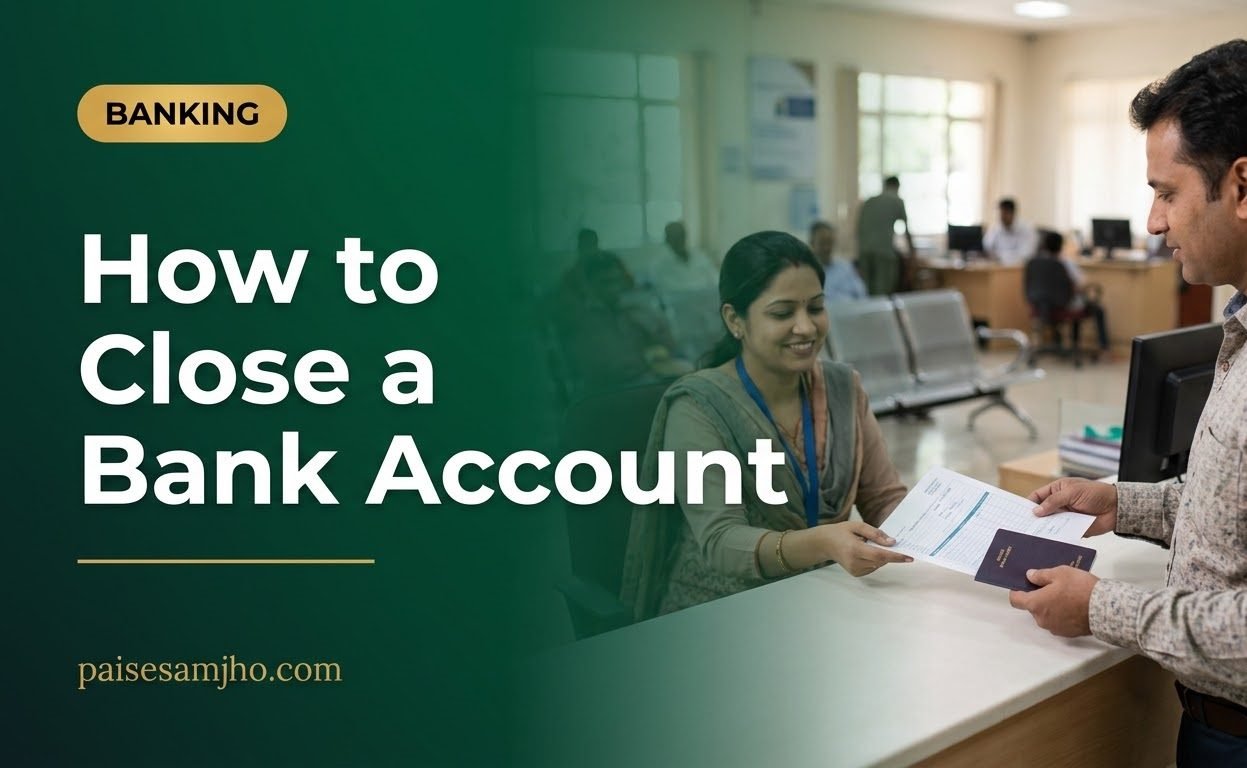
- Visit the home branch (or any branch, if your bank allows) with your passbook, debit card, unused cheque leaves and ID proof.
- Fill in the account closure form. Joint accounts usually need every holder to sign, depending on the operating mode. Our post on joint account modes explains “either or survivor” and other options.
- Say how you want the balance. Transfer to another account is simpler than cash. Large cash withdrawals may need extra paperwork.
- Hand back or destroy the card and cheques. Ask the branch to note that unused cheque leaves were returned.
- Get written confirmation. Ask for a closure acknowledgement or a final statement showing a zero balance and “account closed”.
Some banks let you start closure online or through the app for certain accounts; many still need a branch visit. Check your bank’s website.
Thinking of closing because of charges? Consider a BSBD account
Many people close an account because of minimum-balance penalties. There is a cheaper option. Under RBI’s directions effective 1 April 2026, banks must convert an existing savings account into a BSBD account within seven days of a written request. A BSBD account has no minimum balance and comes with free basic facilities. You can hold only one BSBD account across all banks. Details are in our BSBDA rules guide.
| Option | Cost | Good for |
|---|---|---|
| Close the account | Free after 1 year at SBI; ₹590 between 14 days and 1 year | Accounts you will never use again |
| Convert to BSBD | Free; no minimum balance | Keeping a basic account without penalties |
| Leave it unused | Risky: account may turn inoperative | Not recommended |
Why you shouldn’t just abandon the account
An unused account doesn’t close by itself. After two years without customer-induced transactions, it is classified as inoperative and you may need to complete KYC again to use it, as explained in our re-KYC guide. After 10 years, the balance is transferred to RBI’s Depositor Education and Awareness Fund, although you can still claim it. Meanwhile, auto-debits can keep failing and attracting charges. Taking the time to close a bank account formally is cleaner.
Common mistakes during account closure
- Closing the account that your home loan EMI or insurance premium is linked to, before switching the mandate.
- Forgetting that income tax refunds go to the bank account validated on the e-filing portal.
- Not collecting the final statement, which you may need later as proof of the closing balance.
- Closing within the first year and paying a closure charge when a few more weeks would have made it free.
Keep the closure acknowledgement with your records for a few years. If a bank later claims charges on an account you closed, it is your proof.
Closing the account of a family member who has died
This works differently. You can’t close a bank account of a deceased person with an ordinary closure form. The nominee or legal heirs file a claim with the bank, along with the death certificate and the documents the bank asks for. The bank settles the balance and then closes the account. SBI does not levy a closure charge in such cases. If there is no nominee, the bank may ask for more documents from legal heirs, depending on the amount.
FAQs
Is there a charge when I close a bank account?
It depends on the bank and how old the account is. At SBI, savings accounts are free to close within 14 days or after one year; in between, the charge is ₹500 plus GST.
Can I close an account at any branch?
Many banks prefer the home branch. Ask your bank; some allow closure at any branch or start it online.
What happens to cheques I already issued?
They will be returned unpaid after closure. Pay those people another way before you close the account.
Can I close a joint account alone?
Usually all holders must sign, but it depends on the operating mode and the bank’s rules.
Takeaway: To close a bank account without surprises, shift every mandate and incoming payment first, then visit the branch with your cards and cheques, and get written confirmation. Check the closure charge: at SBI, waiting past the first year makes account closure free.
Official references
- SBI: service charges (updated as on 30.09.2025)
- RBI: Responsible Business Conduct Amendment Directions, 2025 (BSBD account)
Partly verified, 16 Oct 2026, 9:26 PM IST. Closure charges are from SBI’s service charges document updated as on 30.09.2025, the latest we found; BSBD conversion rules are from RBI’s Amendment Directions of 4 Dec 2025. Closure steps, inoperative-account and deceased-claim notes are general practice; charges at other banks were not checked.