Loan Against FD: SBI Rules, Interest Rate, and When to Borrow Instead of Breaking Your Deposit
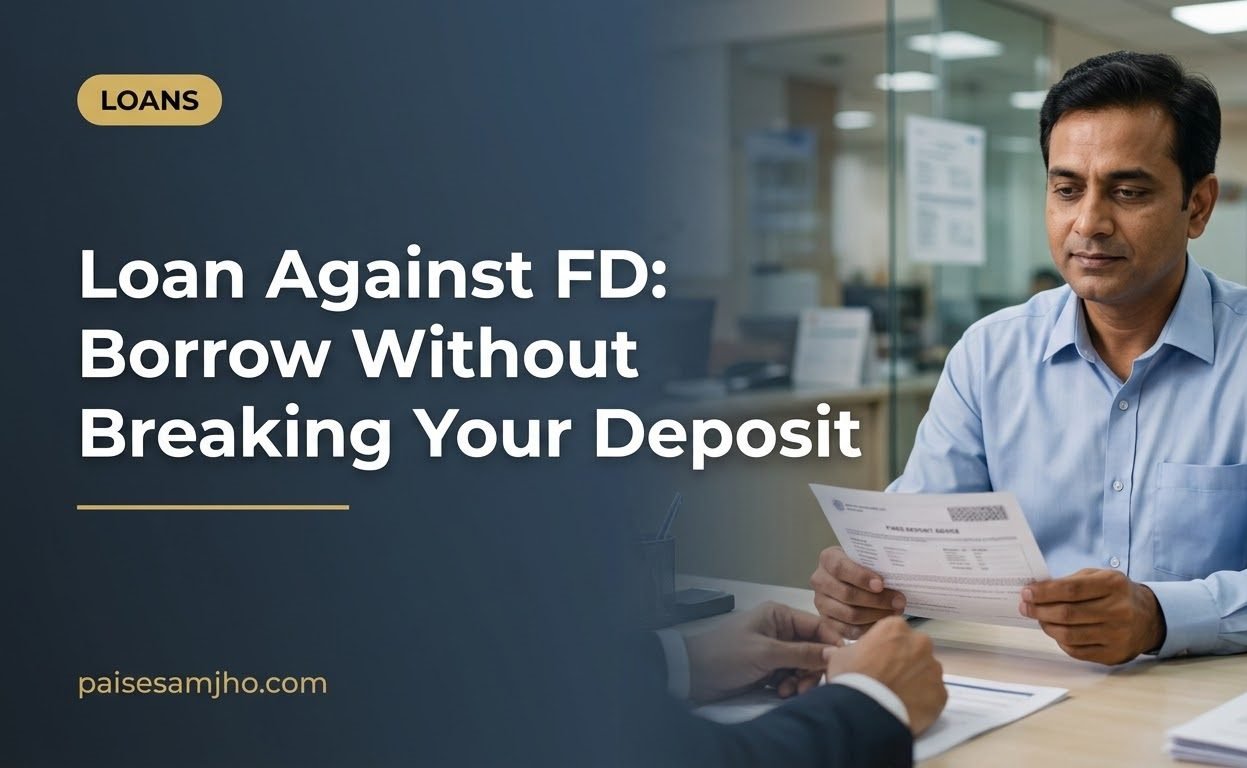
Need ₹1 lakh for three months but your money is locked in a fixed deposit? Breaking the FD is not the only way out. A loan against FD lets you borrow against the deposit while it keeps earning interest. With SBI, the rate is just 1% above your deposit rate, there is no processing fee, and you can repay early without penalty. Here is how a loan against fixed deposit works, using SBI’s published rules, and how to decide between borrowing and breaking.
What is a loan against FD?
You pledge your fixed deposit to the bank, and it lends you a part of the deposit value. The FD stays in your name and keeps earning its contracted rate. If you do not repay, the bank adjusts the loan against the deposit. Because the bank holds your own money as security the loan is easier to get than an unsecured one, and the rate is far lower than a personal loan.
Loan against FD at SBI: the key rules
| Feature | SBI rule |
|---|---|
| Loan amount | Up to 90% of the deposit (10% margin) for deposits up to 5 years; 15% margin for demand loans above 5 years and up to 10 years |
| Interest rate | 1% above the rate on the deposit |
| Interest method | Daily reducing balance |
| Processing fee | Nil |
| Prepayment penalty | Nil |
| Forms | Demand loan or overdraft |
| Demand loan tenure | Up to the residual maturity of the deposit or 120 months; closed at deposit maturity |
| Online overdraft (YONO / internet banking) | ₹5,000 to ₹5 crore |
Source: SBI “Loan against Time Deposit” page (last updated 17 October 2025). Rules can change; confirm with the bank before applying.
Demand loan or overdraft: which suits you?
A demand loan gives you the full amount at once. Interest is charged on the outstanding balance, which reduces as you repay. It suits a single, known expense.
An overdraft sets a limit against your FD. You draw only what you need, when you need it, and pay interest only on the amount used, for the days used. It suits uneven needs, such as a small business’s working capital or a renovation paid in instalments.
SBI’s online overdraft through YONO or internet banking is available only to single account holders, against term deposits or special term deposits opened through YONO or internet banking. It is not available online against MODS, tax-saving deposits, NRE deposits or recurring deposits. Non-callable deposits are eligible only for demand loans. For other cases, visit the branch.
Worked example: borrow vs break
Say you have a ₹2 lakh SBI FD at 6.25% (the 1–2 year card rate for general customers, effective 15 December 2025). You need ₹1 lakh for 91 days.
| Point | Amount |
|---|---|
| Maximum loan (90% of ₹2,00,000) | ₹1,80,000 |
| Loan rate (6.25% + 1%) | 7.25% a year |
| Interest on ₹1,00,000 for 91 days at 7.25% | ₹1,807.53 |
| Interest the FD keeps earning on ₹1,00,000 for 91 days at 6.25% | ₹1,558.22 |
| Net cost of borrowing | ₹249.32 |
Our calculations, using simple interest for illustration. Actual figures depend on compounding, the exact rate on your deposit and when you repay.
In effect, the loan costs you about 1% a year on the borrowed amount, because your FD keeps earning. If instead you broke the FD, you would usually face a premature withdrawal penalty and lose the contracted rate on the broken amount. Our post on FD premature withdrawal rules explains how banks calculate that.
For senior citizens: SBI’s 1–2 year rate for seniors is 6.75%, so a loan against such a deposit would be priced at 7.75% under the 1%-over rule. The net cost works the same way: you pay roughly 1% a year more than the deposit earns on the borrowed amount, for the days you borrow.
When a loan against FD makes sense
- Short-term needs you can repay within months, such as a medical bill, school fees or a gap before a bonus.
- When breaking the FD costs more because of penalties or because the FD locks in a rate higher than current rates.
- Instead of a personal loan or credit card debt. Unsecured loans usually cost far more. Compare using the Key Facts Statement; see our KFS and APR guide.
When it does not
- Long-term needs. If you will not repay for years, you are paying 1% a year on money you could simply use. Breaking part of the FD may be cleaner.
- If you would struggle to repay. At maturity, the bank will close the loan from the deposit, and you lose the savings.
- Tax-saving FDs. These generally cannot be pledged during the five-year lock-in.
Points to check before you apply
- Confirm the margin and rate in writing for your deposit type and tenure.
- Check the interest debit frequency. Interest is charged on the daily reducing balance, but it may be debited monthly or quarterly.
- Know what happens at maturity. A demand loan is liquidated when the deposit matures; if your FD auto-renews, ask how the loan is treated.
- Joint deposits may need all holders to sign.
- Keep the FD receipt or advice and the loan sanction letter together.
Other banks
Most banks offer loans against FDs on similar lines, but the share of the deposit they lend and the spread over the FD rate vary, so compare the margin, rate spread, fees and whether an online overdraft is available. If you keep a ladder of FDs, borrowing against one rung can avoid disturbing the rest; see our FD ladder guide.
Loan against FD vs other secured loans
| Loan type | Security | Typical rate position |
|---|---|---|
| Loan against FD | Your fixed deposit | Small spread over the FD rate |
| Gold loan | Gold jewellery | Varies by lender and loan-to-value |
| Personal loan | None | Usually much higher |
For gold-backed borrowing, read our gold loan guide.
Common questions, answered briefly.
FAQs
How much loan against FD can I get from SBI?
Up to 90% of the deposit for deposits up to five years, as per SBI’s page. A higher margin applies to some longer deposits.
What is the interest rate?
1% above the rate your deposit earns, charged on the daily reducing balance.
Does my FD keep earning interest?
Yes. The deposit continues to earn its contracted rate while it is pledged.
Can I repay early?
Yes. SBI states there is no prepayment penalty.
Takeaway: A loan against FD is often the cheapest way to raise short-term cash: at SBI you can borrow up to 90% at 1% over your deposit rate with no fee or prepayment penalty, while the FD keeps earning. Use it for needs you can repay soon.
Bank sources
Last verified: 14 Oct 2026, 7:50 PM IST against SBI’s Loan against Time Deposit page (last updated 17 Oct 2025) and SBI’s retail term deposit rates (w.e.f. 15 Dec 2025). Other banks’ terms not checked. Worked example is our calculation using simple interest.