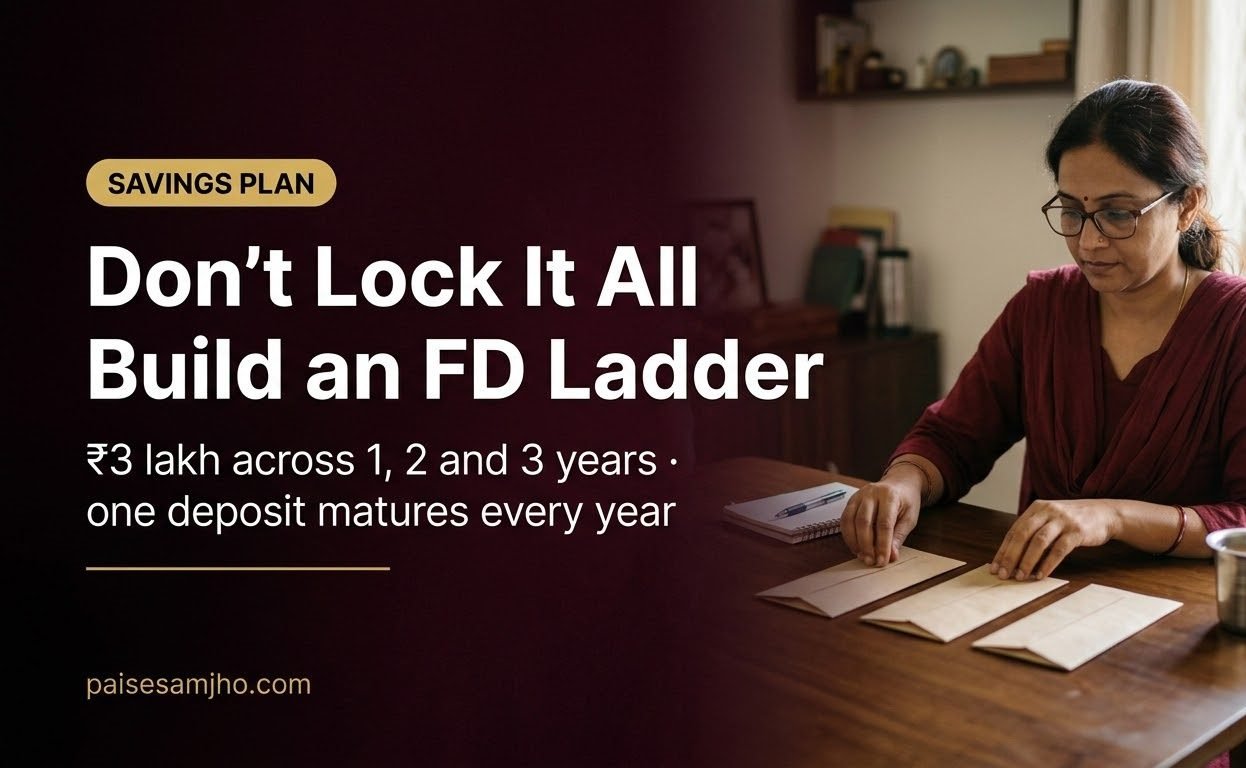
FD Ladder Explained: Split ₹3 Lakh Across 1, 2 and 3 Years, With SBI Rates
Meena, a 41-year-old teacher in Pune, has ₹3 lakh to put in fixed deposits. She is torn. A 3-year FD pays more than a 1-year one, but she might need some of the money for her son’s college admission. And if rates rise, she does not want everything locked in at today’s rate. An FD ladder solves both worries: instead of one big deposit, she splits the money across several tenures so that one deposit matures every year. Here is how an FD ladder works, with real SBI rates and the arithmetic.
What is an FD ladder?
An FD ladder is a set of fixed deposits of different tenures, opened together. Each deposit is a “rung”. When the shortest rung matures, you either use the money or reinvest it for the longest tenure in your ladder. After the first few years, one deposit matures each year, and every deposit earns the longer-tenure rate.
It is not a product a bank sells. You build it yourself using ordinary term deposits.
Meena’s 3-rung plan with SBI rates
SBI’s retail term deposit rates for the general public (below ₹3 crore, in effect from 15 December 2025):
| Tenure | General public | Senior citizen |
|---|---|---|
| 211 days to less than 1 year | 5.90% | 6.40% |
| 1 year to less than 2 years | 6.25% | 6.75% |
| 2 years to less than 3 years | 6.40% | 6.90% |
| 3 years to less than 5 years | 6.30% | 6.80% |
| 5 years up to 10 years | 6.05% | 7.05% (includes SBI We-care premium) |
Source: SBI retail domestic term deposit rates page, read on 11 October 2026.
Meena splits ₹3 lakh into three deposits of ₹1 lakh each:
| Rung | Amount | Tenure | Rate | Interest at maturity | Matures |
|---|---|---|---|---|---|
| 1 | ₹1,00,000 | 1 year | 6.25% | ₹6,398 | Oct 2027 |
| 2 | ₹1,00,000 | 2 years | 6.40% | ₹13,540 | Oct 2028 |
| 3 | ₹1,00,000 | 3 years | 6.30% | ₹20,626 | Oct 2029 |
Interest assumes quarterly compounding, before tax. Our arithmetic.
In October 2027, rung 1 matures with about ₹1,06,398. If Meena does not need it, she reinvests it for 3 years. In October 2028, rung 2 matures and also goes into a 3-year FD. From then on, a deposit matures every October, and each one was booked for 3 years at whatever the rate was at the time.
Why an FD ladder may suit you
1. Money becomes available every year
With one 3-year FD, any emergency means breaking the whole deposit and paying the premature withdrawal penalty (see our FD premature withdrawal rules). With a ladder, the most you wait for some money is a year, and if you must break one rung, the others keep earning their full rate.
2. You do not bet everything on one rate
Nobody can say where FD rates will be next year. The RBI raised the repo rate on 7 October, and some lenders have already lifted deposit rates (see this month’s FD rate hikes). If rates rise, each maturing rung is reinvested at the new, higher rate. If rates fall, the longer rungs are still earning the older, higher rate. The ladder smooths out the timing.
3. It fits real-life goals
Meena can match rungs to dates she knows about: the admission fee in 2027, a family wedding in 2028. Money needed on a known date stays in the rung that matures just before it.
What an FD ladder does not do
- It does not promise the highest rate. If you are sure you will not touch the money for 3 years, a single 3-year FD earns more in total than a ladder in the early years, because the shorter rungs earn less at first.
- It does not beat inflation by itself. September CPI inflation was 5.54%, so a 6.25% FD earns well under one point more than inflation before tax.
- It adds a little work. You need to track maturity dates and choose what to do with each rung. Setting maturity instructions at the time of booking helps.
How to build an FD ladder: step by step
- Keep your emergency fund separate. Three to six months of expenses in a savings account or a sweep-in deposit. The ladder is for money you can park for a while.
- Choose the number of rungs. Three (1, 2 and 3 years) works for most people. Five rungs (1 to 5 years) suits larger sums.
- Split the amount. Equal parts are simplest. You can tilt more money towards the tenure you expect to need first.
- Book separate FDs. Most bank apps let you open several FDs in minutes. Give each a nominee.
- Set maturity instructions. Choose “renew principal and interest” or “credit to savings” for each rung, depending on your plan.
- Diary the dates. Put each maturity date in your phone calendar a week ahead.
Variations to consider
| Variation | How it works | May suit |
|---|---|---|
| Classic 3-rung | 1, 2, 3 years; reinvest each for 3 years | Most savers with a mid-term goal |
| 5-rung | 1 to 5 years; reinvest each for 5 years | Larger sums, longer horizon |
| Monthly income ladder | Several FDs with quarterly or monthly payout | Retirees who want regular cash flow |
| Multi-bank ladder | Rungs spread across banks | People with large deposits, for insurance cover |
A multi-bank ladder has one extra benefit. DICGC insurance covers up to ₹5 lakh per depositor per bank, including interest. Spreading rungs across banks keeps each bank’s balance within the cover. Our DICGC deposit insurance guide explains the limit.
Tax and TDS
Interest on every rung is taxed at your slab rate, year by year as it accrues, whether you receive it or not. Banks deduct TDS when your total interest from that bank crosses the threshold for the year, so splitting deposits within one bank does not avoid TDS. If your total income is below the taxable limit, you can file the relevant self-declaration with the bank to avoid TDS.
For seniors, the same ladder at SBI’s senior citizen rates (6.75%, 6.90%, 6.80%) earns about ₹6,923, ₹14,663 and ₹22,420 on ₹1 lakh rungs of 1, 2 and 3 years, before tax.
Common questions, answered briefly.
FAQs
How many rungs should an FD ladder have?
Three is a practical start. More rungs give more frequent maturities but more deposits to track.
Can I use different banks for different rungs?
Yes. It helps keep each bank within the ₹5 lakh DICGC cover and lets you pick the bank offering the higher rate for each tenure.
Is an FD ladder better than a single long FD?
Not always. If you will certainly not need the money for the full term, a single FD can earn more. A ladder trades a little return for flexibility.
Can I build a ladder with recurring deposits?
Yes, though RDs are built monthly. Our RD vs FD comparison covers the difference.
Takeaway: An FD ladder splits your money into deposits that mature one after another, giving you yearly access and spreading rate risk. With SBI’s 1-, 2- and 3-year rates, a ₹3 lakh ladder earns about ₹40,565 over three rungs before tax.
Sources
Last verified: 12 Oct 2026, 7:05 PM IST. SBI retail term deposit rates (in effect from 15 Dec 2025) as read on SBI’s rates page on 11 Oct 2026; not re-read today. Interest figures are our own arithmetic, assuming quarterly compounding.