RBI Floating Rate Savings Bonds at 8.05%: Who Can Exit Early, Tax and How They Compare
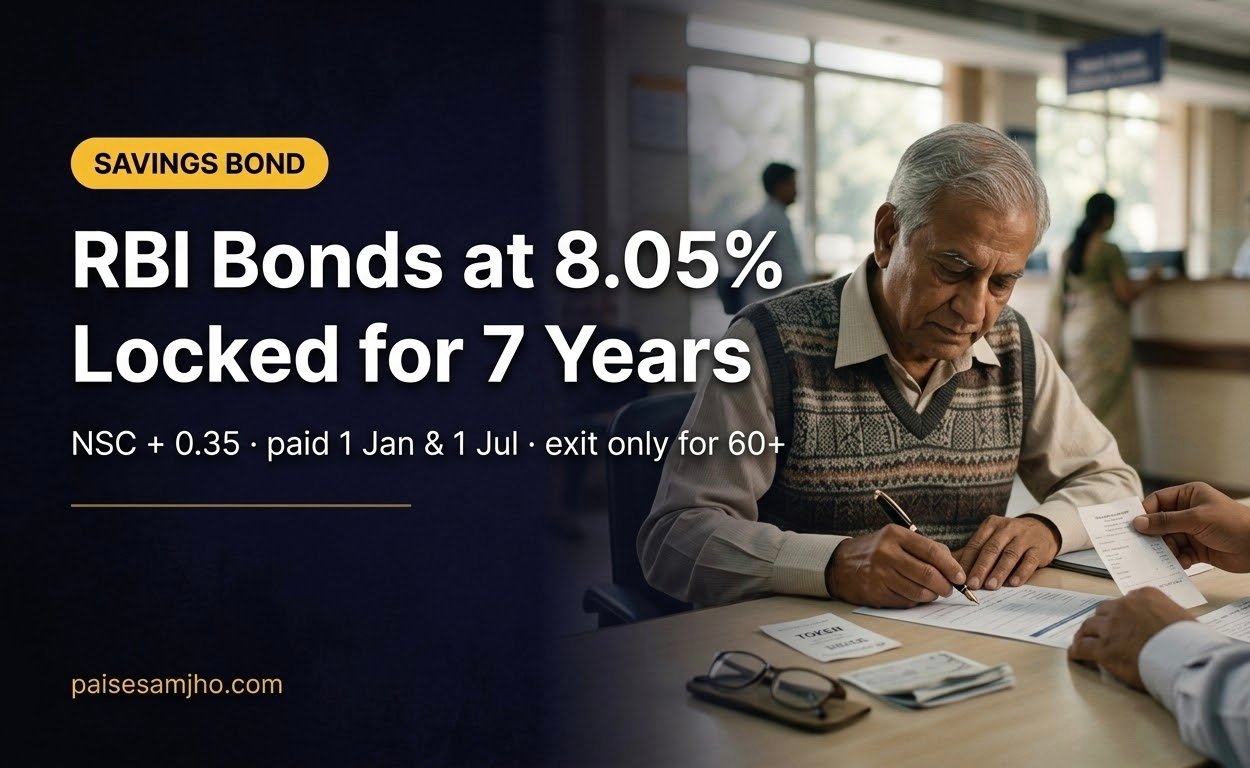
8.05% from the Government of India, or 6.30% from SBI for three to five years? That is the comparison behind the Floating Rate Savings Bonds, 2020 (Taxable), known as FRSB 2020 (T) or “RBI bonds”. For July to December 2026, RBI has set the coupon at 8.05%, the National Savings Certificate rate of 7.70% plus 0.35 percentage point. The catch is a seven-year lock-in with almost no way out unless you are a senior citizen, and interest that is fully taxable.
Floating Rate Savings Bonds: the current rate and how it resets
RBI’s press release of 1 July 2026 says the coupon for 1 July to 31 December 2026, payable on 1 January 2027, “remains at 8.05% (7.70%+0.35%), unchanged from the previous half-year”. The rate is reset every six months at a spread of 0.35 percentage point over the prevailing NSC rate. India Post’s savings page shows NSC at 7.7%, so the formula would still give 8.05% for the next reset if NSC stays put. That is our arithmetic, not an RBI announcement.
On ₹1 lakh, 8.05% means ₹4,025 every six months, or ₹8,050 a year. Interest is paid on 1 January and 1 July. There is no cumulative option: you cannot let the interest compound inside the bond.
Key terms of FRSB from RBI’s documents
| Feature | What RBI says |
|---|---|
| Who can invest | Resident individuals (including joint holdings) and HUFs. NRIs are not eligible. |
| Maximum | No upper limit |
| Tenure | 7 years from the date of subscription |
| Interest | Floating, paid half-yearly on 1 Jan and 1 Jul; no cumulative option |
| Form | Electronic only, in a Bond Ledger Account with the bank |
| Payment mode | Cash up to ₹20,000 only; otherwise cheque, draft or electronic transfer |
| Tax | Interest taxable; tax deducted at source unless you declare an exemption in the application |
| Transfer and trading | Not tradable; not transferable except to a nominee or legal heir; cannot be used as loan collateral |
| Where to buy | Designated branches of SBI, nationalised banks, IDBI Bank, Axis Bank, HDFC Bank and ICICI Bank (Stock Holding Corporation is also listed as a receiving office) |
The minimum investment is widely reported as ₹1,000, in multiples of ₹1,000. That figure is in the Government notification of 26 June 2020, which we did not read directly; RBI’s press release and operational guidelines, which we did read, do not repeat it.
How to apply
RBI’s operational guidelines set out the process at the bank (the “receiving office”):
- Fill in the application (Form B of the Government notification) at a designated branch, or online where your bank offers it. RBI’s guidelines ask banks to provide an online facility.
- Pay by cheque, draft or electronic transfer. Cash is accepted only up to ₹20,000.
- The bank opens a Bond Ledger Account in your name. You get only one such account at a branch; later investments are added to it.
- A Certificate of Holding is to be issued within 7 days of your application, and may also be emailed.
- Add a nominee (Form C). It matters more here than usual, because the bond cannot be transferred to anyone except a nominee or legal heir.
Each investment runs for its own seven years from its subscription date. If you invest ₹1 lakh this month and another ₹1 lakh next year, they mature a year apart.
Premature encashment: only for senior citizens
RBI’s operational guidelines allow early exit only for individual investors in three age bands, after a lock-in:
| Age on the date of encashment | Lock-in | Earliest exit |
|---|---|---|
| 60 to 70 | 6 years | After the 12th half-year |
| 70 to 80 | 5 years | After the 10th half-year |
| 80 and above | 4 years | After the 8th half-year |
Even then, three conditions apply. Payment is made only on the next interest date, 1 January or 1 July. Half of the interest for the last six months is recovered as a penalty: on ₹1 lakh at 8.05%, that is ₹2,012.50. And you must encash the whole amount of an application; partial encashment is not allowed. For joint holdings, at least one holder must meet the age test on the encashment date. Anyone under 60 is locked in for the full seven years.
How it compares, before and after tax
| Option | Rate | Lock-in or term | Note |
|---|---|---|---|
| FRSB 2020 (T) | 8.05%, resets every 6 months | 7 years | Government-backed; taxable |
| Senior Citizens Savings Scheme | 8.2% | 5 years | Mainly for 60+; India Post |
| NSC | 7.7% | 5 years | Compounded yearly, paid at maturity |
| SBI FD, 3 to 5 years | 6.30% | Chosen term | DICGC cover up to ₹5 lakh |
Rates are from India Post’s savings page and SBI’s deposit page as read on 11 October 2026. Because FRSB interest is taxed at your slab, the after-tax yield falls with your bracket. As a rough guide, adding 4% cess and ignoring surcharge and rebates, 8.05% works out to about 7.63% at a 5% slab, 6.38% at 20% and 5.54% at 30%.
Who it may suit, and who should skip
It may suit a retired person who wants regular half-yearly income backed by the Government, does not need the capital for at least the lock-in that applies to their age, and is in a low tax bracket. The floating rate is a plus when rates are rising, as they are after RBI’s hike to 5.50% on 7 October, though FRSB follows NSC, not the repo rate directly.
It may not suit anyone who might need the money before seven years and is under 60; anyone in the 30% bracket who can use tax-free or tax-deferred options; or NRIs, who are not eligible. If you want something shorter and liquid from the Government, our Treasury bills guide covers RBI Retail Direct. For the small-savings rates, see post office interest rates for October 2026, and for bank deposits, our RD vs FD comparison.
Before you invest, here are short answers to common questions.
FAQs
What is the FRSB interest rate now?
8.05% a year for 1 July to 31 December 2026, per RBI’s 1 July press release.
Can I exit early?
Only through premature encashment, which needs you to be 60 or older and past the lock-in for your age band; half of the last six months’ interest is deducted.
Is the interest tax-free?
No. It is taxable, and tax is deducted at source unless you declare an exemption.
Can I sell the bond?
No. Floating Rate Savings Bonds are not tradable.
Takeaway: Floating Rate Savings Bonds pay 8.05% backed by the Government, but treat the money as locked for seven years unless you are a senior citizen.
Documents read: RBI press release 2026-2027/587, 1 Jul 2026 (coupon) · RBI press release, 26 Jun 2020 (scheme features) · RBI operational guidelines, updated 27 Jun 2022, paras 1, 8.9, 9.1, 10 · India Post savings page (SCSS, NSC rates) · SBI retail term deposit rates. Not read: GoI notification F.No.4(10)-B(W&M)/2020. Partly verified, 11 Oct 2026, 3:20 PM IST. Checked: RBI press releases of 1 Jul 2026 and 26 Jun 2020, RBI operational guidelines (updated 27 Jun 2022), India Post savings page, SBI deposit rates. Not read: the GoI notification of 26 Jun 2020, so the ₹1,000 minimum is reported only. After-tax yields are our approximation.