
Bank Locker Rules: What the Bank Pays If Your Locker Is Robbed, and When It Can Open It
Meena Joshi rents a medium-sized locker at her bank’s branch in Jaipur for ₹4,000 a year plus GST. Inside are her wedding jewellery, which she values at about ₹12 lakh, her property papers and a few gold coins. Like many locker holders, she has never read the agreement she signed, and she assumes the bank would cover the full value if something went wrong.
The bank’s liability is far narrower than that. This guide uses Meena’s locker to explain the bank locker rules RBI set out in its revised instructions, in force since 1 January 2022: what the bank owes you, when it can open your locker without you, and what happens to the contents after a death.
How much the bank pays if your locker is robbed
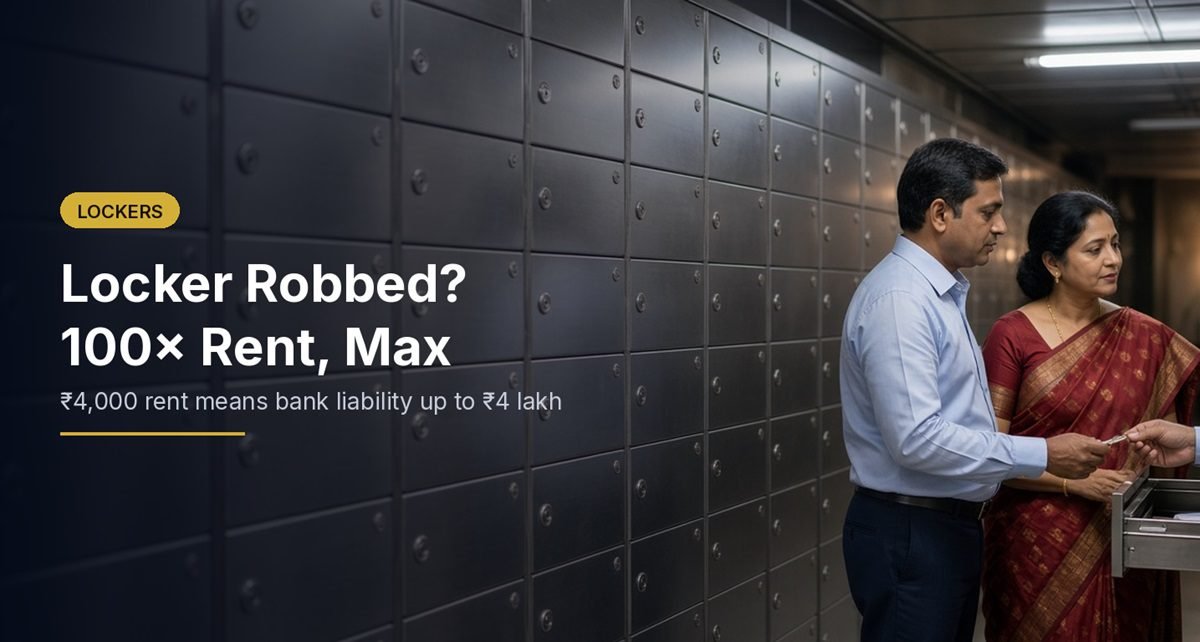
RBI’s locker instructions of 18 August 2021 fix the bank’s liability for losses from fire, theft, burglary, dacoity, robbery, building collapse or fraud by its employees. In those cases, “the banks’ liability shall be for an amount equivalent to one hundred times the prevailing annual rent of the safe deposit locker.”
For Meena, that works out to 100 × ₹4,000 = ₹4 lakh. Her jewellery is worth about three times that. The cap applies whatever was inside, because banks do not keep a record of the contents.
| Event | Bank’s liability under RBI rules | Meena’s position |
|---|---|---|
| Fire, theft, burglary, robbery, dacoity, building collapse | Up to 100 times the annual rent | Up to ₹4 lakh |
| Fraud by a bank employee | Up to 100 times the annual rent | Up to ₹4 lakh |
| Earthquake, flood, lightning, thunderstorm | Not liable, though the bank must protect its premises | Nothing from the bank |
| Loss caused solely by the customer’s negligence | Not liable | Nothing from the bank |
On natural calamities, RBI’s text says “the bank shall not be liable for any damage and/or loss of contents of locker arising from natural calamities or Acts of God like earthquake, floods, lightning and thunderstorm”. Banks must still “exercise appropriate care to their locker systems to protect their premises from such catastrophes”.
Why the bank will not insure what is inside
Banks are barred from selling you contents insurance. The instructions say banks “shall under no circumstances offer, directly or indirectly, any insurance product to its locker hirers for insurance of locker contents”. If a branch staffer offers a locker insurance plan, that runs against RBI’s rule.
If Meena wants cover for the full ₹12 lakh, she has to buy it herself, for example through a home or jewellery insurance policy that covers items kept in a bank locker. Policy terms on this vary, so the wording matters. Our explainer on how insurance works covers the basics, and our guide on how much gold you can keep at home helps if you are deciding what to keep where. If the jewellery is mainly an emergency reserve, our gold loan guide explains how banks lend against it.
The locker agreement and the rent deposit
Every locker comes with a stamped agreement, and you are entitled to a copy. RBI requires that “a copy of the locker agreement in duplicate signed by both the parties shall be furnished to the locker-hirer”. Banks were told to renew agreements with existing customers by 1 January 2023 and must not include “unfair terms or conditions”.
On rent, banks may ask a new customer for a fixed deposit covering “three years’ rent and the charges for breaking open the locker”. They “shall not insist on such Term Deposits from the existing locker holders or those who have satisfactory operative account”. Asking for a larger deposit as a condition of allotment “will be considered as a restrictive practice”. If you surrender a locker, the unused part of any advance rent must be refunded.
When no locker is free, the bank has to acknowledge your application and give you a wait-list number. Meena got hers after eight months on the list.
When can a bank open your locker without you?
There are three situations, each with a set procedure.
| Situation | Trigger | What the bank must do first |
|---|---|---|
| Unpaid rent | Rent not paid “for three years in a row” | Letter, email and SMS; public notice in two newspapers if untraceable |
| Long inactivity | Locker inoperative for seven years and the hirer cannot be located, even if rent is paid | Same notice procedure, then contents go to nominee or legal heir or are disposed of transparently |
| Court or authority order | Attachment or seizure order | Verify the order and inform you by letter and email/SMS |
In each case the locker is opened before an officer and two independent witnesses, the process is video-recorded, and the contents are kept in a sealed envelope with an inventory until claimed. Meena pays her rent through an auto-debit from her savings account, which removes the first risk. Visiting the locker at least once a year removes the second.
What you should get after every visit
The bank must keep a log of everyone who opens the locker, with check-in and check-out times and signatures. It must also send “an email and SMS alert to the registered email ID and mobile number of the customer before the end of the day” confirming the date and time of the visit. If you get an alert for a visit you did not make, report it to the branch the same day; the rules require banks to keep CCTV footage until any such complaint is settled.
If the bank merges, closes or shifts the branch, it must notify you “at least two months in advance along with options for them to change or close the facility”.
What happens to the locker after a death
RBI’s deceased-customer claims directions of September 2025 now govern this. With a nominee, the bank needs only a claim form, the death certificate and the nominee’s ID; a succession certificate is not required “unless there is any discrepancy in nomination”. The nominee gets access “only as a trustee of the legal heir(s)”.
Within 15 calendar days of receiving all documents, the bank must process the claim and fix a date for the inventory. If it misses that deadline, it pays “₹5,000 for each day of delay”. Without a nominee, legal heirs can use a simplified procedure that needs a legal heir certificate or an affidavit, a no-objection from the other heirs, and an independent valuation of the contents. Meena has named her daughter as nominee for the locker; for a joint locker, check whether the mandate is “either or survivor” or joint operation, because that decides who gets access.
What the bank locker rules leave open
| Question | What RBI’s text says | What is still unclear |
|---|---|---|
| Who proves the bank was at fault? | Banks owe a “duty of care” and must have a Board-approved compensation policy | There is no standard test, so disputes often end up with the RBI Ombudsman or a consumer forum |
| Flood damage in a poorly built vault | No liability for natural calamities, but banks must protect premises | Where a calamity ends and the bank’s negligence begins is not defined |
| Proof of what was inside | Banks keep no record of contents | The customer bears the burden of showing value, through bills, photos or valuation reports |
| Rent levels | Banks must display charges on their websites | RBI does not cap locker rent, so the ₹4 lakh figure varies with each bank’s pricing |
Had Meena kept her jewellery bills and photographs with her insurance policy instead of inside the locker, she would have had the paperwork for any claim even if the locker itself were lost.
FAQs
Is the bank responsible if jewellery goes missing from my locker?
Only if the loss comes from fire, theft, burglary, robbery, dacoity, building collapse or employee fraud, and then up to 100 times the annual rent. For other losses, the bank is liable only if you show it was negligent.
Can a bank force me to open an FD to get a locker?
It can ask a new customer for a fixed deposit covering three years’ rent plus break-open charges. It cannot insist on one if you already hold a locker or have a satisfactory operative account with the bank.
Can I add a nominee to my locker?
Yes. Nomination is available for lockers under the Banking Regulation Act. Since November 2025, locker nominations can only be successive, meaning the next nominee gets access only if the earlier one has died.
Disclaimer: This article summarises RBI’s locker instructions in general terms. Your bank’s locker agreement and Board-approved policy set the exact terms for your locker.