RD vs FD: Why a Recurring Deposit Earns Less Than an FD at the Same Rate
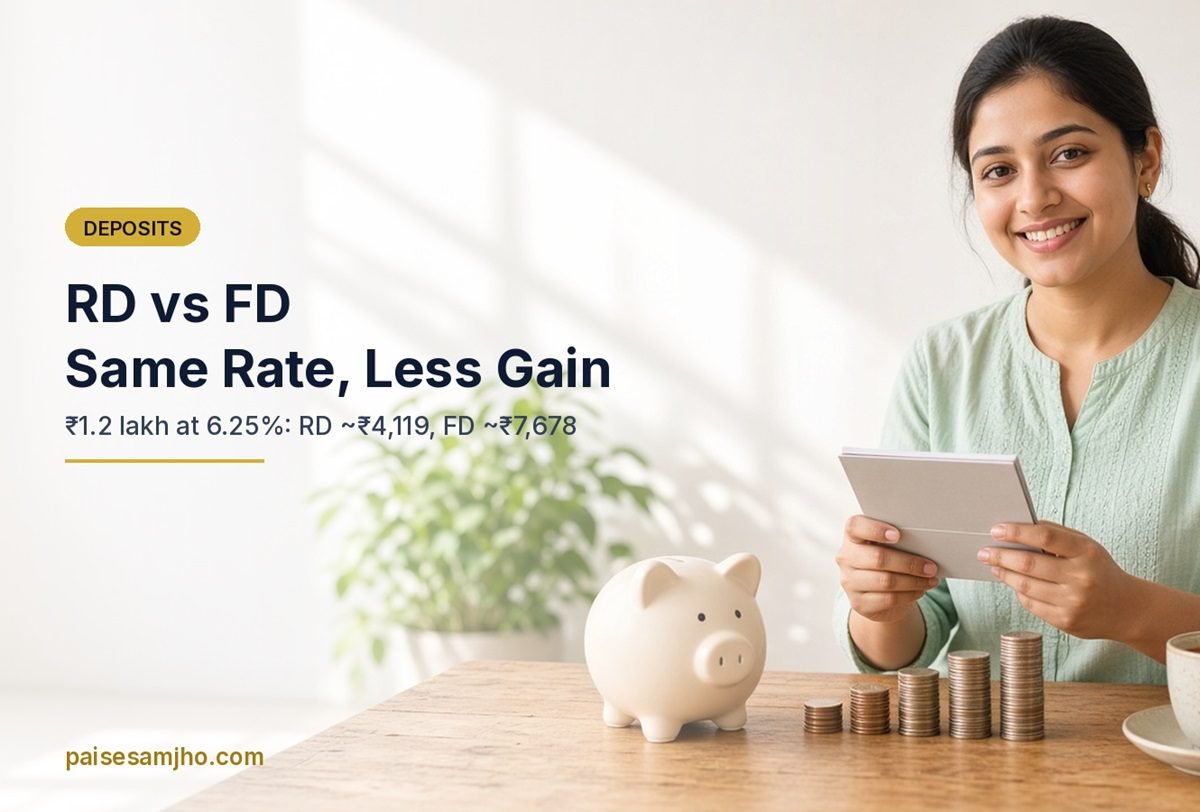
Priya, 29, a teacher in Indore, can save ₹10,000 a month. Her brother Rohan has ₹1.2 lakh sitting in his savings account. Both go to SBI on the same day in October 2026. Priya opens a 12-month recurring deposit, Rohan books a one-year fixed deposit, and both get the same 6.25% rate. A year later, both have put in ₹1.2 lakh, yet Rohan earns almost twice as much interest. That gap is the heart of the RD vs FD choice, and it comes entirely from timing, since the rate is identical.
Why Rohan’s FD earns more at the same rate
Most RD vs FD comparisons online quote only the rate. The rate tells you what each rupee earns per year; the deposit pattern tells you how many rupees are earning, and for how long.
Interest is paid on money for the time it stays with the bank. Rohan’s full ₹1.2 lakh earns for 12 months. Priya’s first ₹10,000 earns for 12 months, her second for 11 months, and her last instalment for just one month. On average her money is in the deposit for about six and a half months.
| One year at SBI’s 6.25% | Priya’s RD | Rohan’s FD |
|---|---|---|
| How money goes in | ₹10,000 every month | ₹1,20,000 on day one |
| Total deposited | ₹1,20,000 | ₹1,20,000 |
| Approximate maturity value | ₹1,24,119 | ₹1,27,678 |
| Interest earned | About ₹4,119 | About ₹7,678 |
The figures assume interest is compounded quarterly, which is how banks usually calculate reinvestment deposits, so your bank’s maturity figure may differ by a few rupees. The comparison only holds when both people have the money. Priya does not have ₹1.2 lakh today. For her, the real alternative is leaving ₹10,000 a month in a savings account, and the RD earns clearly more than that.
What SBI’s rules say about RDs
SBI’s recurring deposit page sets the basic terms. Tenure runs from 12 to 120 months, the minimum instalment is ₹100 a month in multiples of ₹10, and the RD earns the same rate as a term deposit of the same tenure. So the SBI RD interest rate for Priya’s 12-month deposit is the 6.25% listed for one to two years on SBI’s term deposit rate card, effective 15 December 2025.
| SBI tenure | General rate | Senior citizen rate |
|---|---|---|
| 1 year to less than 2 years | 6.25% | 6.75% |
| 2 years to less than 3 years | 6.40% | 6.90% |
| 3 years to less than 5 years | 6.30% | 6.80% |
| 5 years and up to 10 years | 6.05% | 7.05% |
Rates in this table were checked on SBI’s site on 3 October 2026. Because SBI ties the two, the SBI RD interest rate for a 3-year RD is 6.30% and for a 5-year RD 6.05%, and a senior citizen gets the higher column. Bank RDs generally lock the rate on the day you open them, and SBI’s own premature-closure rule refers to “the rate of interest applicable at the time of opening of deposits”.
What happens if Priya misses an instalment?
This is where an RD carries a cost an FD does not. SBI charges ₹1.50 for every ₹100 per month of delay on RDs of five years or less, and ₹2 for longer RDs. If Priya pays one ₹10,000 instalment a month late, the penalty is ₹150. SBI adds that the penalty “shall not exceed the interest paid to the depositor”.
Missing several months in a row is more serious. SBI’s page says: “In case six consecutive instalments are not received, the account shall prematurely be closed, and balance paid to the account holder.” An FD has no instalments to miss, so Rohan carries none of this risk.
Breaking the deposit early
Both products allow premature closure at SBI with the same penalty. For deposits up to ₹5 lakh the penalty is 0.50%, and above ₹5 lakh it is 1%. In SBI’s words, the interest rate “shall be 0.50% or 1% below the rate of interest applicable at the time of opening of deposits, for the period deposit remained with the Bank”, and no interest is paid on deposits that stay less than seven days.
If Priya closes her RD after eight months, she gets interest at the rate for that shorter period minus 0.50%, calculated only on the instalments she paid. SBI also offers a loan or overdraft against the RD, which can be cheaper than breaking it when the need is short-term.
Post office RD vs bank RD over five years
Priya’s father suggests the post office. Its recurring deposit runs for a fixed five years (60 monthly deposits) and currently pays 6.7%, compounded quarterly. The Finance Ministry left that rate unchanged for October to December 2026, as covered in our October 2026 post office rates update.
| Priya’s ₹10,000 a month for 60 months | SBI RD (6.05%) | Post office RD (6.7%) |
|---|---|---|
| Total deposited | ₹6,00,000 | ₹6,00,000 |
| Approximate maturity value | ₹7,01,556 | ₹7,13,658 |
| Recurring deposit interest earned | About ₹1,01,556 | About ₹1,13,658 |
| Early exit | Any time, with 0.50% penalty | Only after 3 years, at savings rate |
The extra ₹12,102 comes with less flexibility. Under the post office scheme rules, premature closure is allowed only after three years, and the whole deposit then earns the post office savings account rate instead of 6.7%. A bank RD can also be opened for 12 months; the post office version cannot.
Is RD interest taxed like FD interest?
Yes. Recurring deposit interest is added to your income and taxed at your slab rate, just like FD interest. Banks deduct TDS on RD interest when your total deposit interest with that bank crosses the threshold. If your total income is below the taxable limit, you can submit a declaration to stop the deduction; our guide to Form 121, the replacement for 15G and 15H, explains the process.
Both deposits are covered by deposit insurance in the same way. DICGC’s guide to deposit insurance says each depositor is insured “upto a maximum of ₹ 5,00,000 (Rupees Five Lakhs) for both principal and interest”, with all savings, FD and RD balances in the same bank and the same capacity added together.
RD vs FD: which one suits whom
An FD tends to suit someone like Rohan who already has a lump sum, such as a bonus, a maturity amount or money from selling something, and does not need it for a year or more. An RD tends to suit someone like Priya who earns a salary and wants a fixed habit of saving each month. If you already have a lump sum and also want to save monthly, you can do both: the FD for the lump sum and an RD for the monthly surplus. Readers deciding between deposits and longer-term options can see our PPF vs FD comparison.
One RD vs FD point often missed is liquidity in an emergency: an FD can be broken in one go, while an RD that is only a few months old holds very little to break. If Priya needs ₹50,000 in month four, her RD has just ₹40,000 in it, so she would need the savings account or a loan against the RD anyway.
Whether banks revise deposit rates after the RBI’s policy decision on 7 October is not known yet.
Pick the RD for a monthly habit and the FD for money you already have.
FAQs
Is the RD interest rate the same as the FD rate?
At SBI, yes. Its RD page says the rate is the one applicable to term deposits of the same tenure. Some banks have separate RD rate cards, so check before opening.
Can I change my RD instalment later?
Usually no. The monthly amount is fixed when you open the account. To save more, open a second RD.
Which gives a better return on ₹1.2 lakh, a 1-year RD or a 1-year FD?
If you have the full ₹1.2 lakh today, the FD. At 6.25%, Rohan’s FD earns about ₹7,678 against about ₹4,119 for an RD where the same amount goes in over 12 months.
What happens to my post office RD rate if the government changes it next quarter?
The rate in force when you open a post office RD generally applies for its full five years, and India Post’s scheme summary says an extended account also keeps the rate at which it was originally opened. A new quarterly rate applies to accounts opened in that quarter.
Disclaimer: Rates and maturity values are for illustration, based on SBI and post office rates checked on 3 October 2026. Confirm the current rate with your bank or post office before investing.