
SMA and NPA Explained: What Happens on Day 31, 61 and 91 After a Missed EMI
Suresh runs a hardware shop in Jaipur and pays a car loan EMI of ₹21,500 on the 10th of every month. In June 2026 a supplier paid him late and the EMI bounced. Nothing seemed to happen that week, but the bank’s system had already started counting. That count decides when his loan moves through the SMA and NPA stages, and the dates are set by RBI rules, so you can work them out before the bank’s letter reaches you.
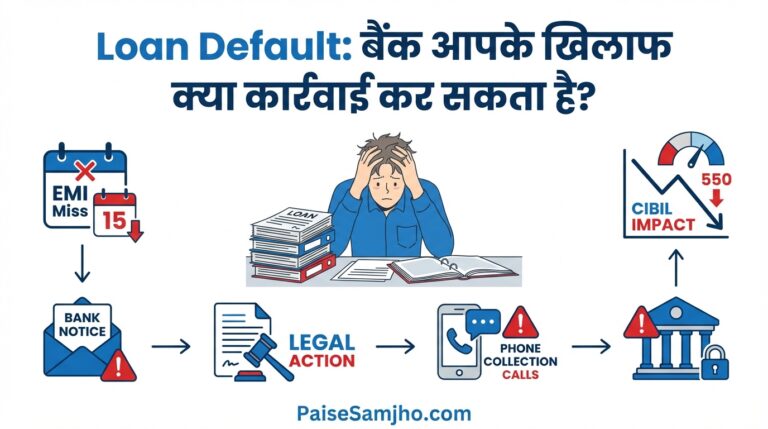
This guide uses Suresh’s loan to show what happens on each day after a missed EMI, how a cash credit limit is treated differently, and how an account comes back to “standard”. For what a lender can do after a default, see our loan default guide.
What SMA means in RBI’s words
SMA stands for Special Mention Account. Commercial banks follow RBI’s 2025 directions on income recognition and asset classification, and the wording below is from RBI’s April 2025 master circular, which carries the same thresholds. It defines SMA as an account “exhibiting signs of incipient stress resulting in the borrower defaulting in timely servicing of her debt obligations, though the account has not yet been classified as NPA”. In plain terms, SMA is the warning stage. NPA, a non-performing asset, is the stage at which the bank stops counting the loan as earning income.
For term loans such as Suresh’s car loan, SMA and NPA stages depend only on how many days the oldest due amount has stayed unpaid. A bank cannot skip a stage or push you into one early.
| Stage | Days overdue (term loans) | Suresh’s date (EMI due 10 June 2026) |
|---|---|---|
| SMA-0 | Up to 30 days | From 10 June |
| SMA-1 | More than 30, up to 60 days | 10 July |
| SMA-2 | More than 60, up to 90 days | 9 August |
| NPA | More than 90 days | 8 September |
How the bank counts the days
RBI settled a long-running confusion in November 2021. Its rule says “the date of SMA/NPA shall reflect the asset classification status of an account at the day-end of that calendar date.” The bank runs this check every night, including the night of the due date itself. If you pay at 4 PM, the account is fine at day-end. If you pay at 11:59 PM through a channel that settles the next morning, it may not be.
RBI gives its own example in the same rule. A loan due on 31 March 2022 that stays unpaid becomes SMA-1 on 30 April, SMA-2 on 30 May and NPA on 29 June 2022. Suresh’s dates in the table follow the same arithmetic from 10 June.
Two things trip people up. The count runs on the oldest unpaid amount. If Suresh pays one EMI on 10 July while two are due, one EMI is still overdue, so in most loan agreements the June clock keeps running. Second, a part payment does not reset anything. Paying ₹15,000 of the ₹21,500 leaves ₹6,500 overdue, and the account stays on the same timeline.
Does an SMA tag show up on CIBIL?
SMA and NPA labels start as the bank’s own classification for its risk reporting, but lenders also report each account to credit bureaus at regular intervals. The payment history in a credit report shows days past due for each month, and can also show an asset classification code for the account. So a missed EMI can show up on your credit report even while the account is only SMA-0. You can check what has been reported with a free CIBIL report.
Credit cards have one extra rule. RBI’s credit card directions say a card account is reported to bureaus as past due only after it is more than three days past due. Under the same directions, a card becomes NPA if the minimum amount due is not paid within 90 days of the payment due date.
Cash credit and overdraft accounts follow a different test
Suresh also has a ₹10 lakh cash credit limit for his shop, but the bank’s drawing power, based on his stock statement, is ₹8 lakh. For CC and OD accounts there is no SMA-0. SMA-1 applies when the outstanding stays continuously above the lower of the sanctioned limit and drawing power for more than 30 days, and SMA-2 when it stays above for more than 60 days. For Suresh, the line that matters is the ₹8 lakh drawing power, the lower of the two.
| Situation in Suresh’s CC account | Likely status |
|---|---|
| Balance ₹7.6 lakh, regular credits from sales | Standard |
| Balance ₹8.4 lakh for 35 days in a row | SMA-1 |
| Balance ₹8.4 lakh for 65 days in a row | SMA-2 |
| Balance above ₹8 lakh for 90 days in a row | Out of order, so NPA |
| Balance ₹6 lakh, but no credit at all for 90 days | Out of order, so NPA |
The last row surprises many shop owners. Under RBI’s definition, a CC account is “out of order” if the balance stays above the limit or drawing power for 90 days, or if there are no credits for 90 days, or if the credits are not enough to cover the interest charged. Keeping the balance within the limit does not protect an account that has gone silent.
Stock statements matter too. If the drawing power is calculated from a stock statement more than three months old, RBI treats drawings in the account as irregular. A late stock statement can therefore push a CC account toward SMA even when sales are normal. Our explainer on CC limits covers how drawing power is calculated.
Why one NPA can affect all your loans with that bank
Asset classification is borrower-wise. When one facility becomes NPA, all facilities of that borrower with the same bank are classified as NPA. If Suresh’s car loan turns NPA on 8 September and the CC account is with the same bank, the CC account is also marked NPA from that date, even if its own balance is within ₹8 lakh.
Loans with other banks are classified separately. They can still be affected indirectly, because those lenders will see the overdue entries on his credit report when he next applies or when they review the account.
What changes after an account becomes NPA
Inside the bank, an NPA is “sub-standard” for up to 12 months and “doubtful” after that. Interest on an NPA is no longer booked as income until the bank actually receives it. For secured loans, NPA status is what allows a lender to start formal recovery, which can include a 60-day demand notice under Section 13(2) of the SARFAESI Act where that law applies.
| Time since Suresh’s loan turned NPA | Category | What it usually means for him |
|---|---|---|
| 0 to 12 months (8 Sep 2026 to Sep 2027) | Sub-standard | Calls, notices, possible recovery steps |
| More than 12 months | Doubtful | The bank sets aside more money against the loan; settlement offers can become more common |
Many borrowers first hear about a loan settlement at this stage. A settlement can end the calls, but it leaves a long-lasting mark on the credit report, so it is worth reading how it differs from a full closure before agreeing to one.
How an NPA becomes standard again
RBI’s rule is strict. An NPA can be upgraded to standard only “where entire overdues pertaining to all the credit facilities availed by a borrower from a given bank have been regularised by repayment through genuine sources”. If Suresh clears the car loan overdue of three EMIs (₹64,500) but his CC account is still out of order, neither account goes back to standard.
The words “genuine sources” also matter. Paying the overdue with a fresh loan from the same bank does not count as genuine repayment. Paying from shop income, savings or a family loan usually does.
What your bank must tell you about SMA and NPA dates
The same RBI rules require banks to put examples of SMA and NPA classification dates in the loan agreement, and to explain these concepts to borrowers through consumer education. If you have never seen such an example, ask your branch for the relevant clause of your loan agreement or key fact statement. It turns the guesswork in this article into exact dates for your own loan.
A practical step for anyone in Suresh’s position is to pay the oldest due first and ask the bank to confirm in writing which EMI the payment was adjusted against. If you can clear everything before the 90th day, the account never reaches NPA.
Missing an EMI starts a clock you can read in advance, and paying before day 90 stops it.
FAQs
Does SMA-0 hurt my credit score?
The overdue days are reported to credit bureaus by the lender, and they can lower your score even before the account reaches SMA-1. One late EMI that is cleared quickly usually weighs far less than a run of them.
My EMI was due on the 5th and I paid on the 6th. Am I in SMA?
Yes, for one day. At the day-end of the 5th the EMI was unpaid, so the account was SMA-0 that night. Once you paid on the 6th it returned to standard.
Can a bank mark my loan NPA before 90 days?
Not on the overdue count. For a term loan, an amount has to stay unpaid for more than 90 days. For a CC or OD account, the “out of order” test above applies, and that also runs for 90 days.
If I pay the full overdue, does the NPA tag go away immediately?
The account can be upgraded once all overdues on all your facilities with that bank are cleared from genuine sources. Your credit report will still show the earlier missed payments, which fade in weight as you build a clean record over the following months.
Disclaimer: This article explains RBI rules for general information. Your loan agreement and your bank’s policy decide the exact treatment of your account.