MCLR to EBLR Switch: 29.6% of Floating Loans Still on MCLR, What Borrowers Can Do
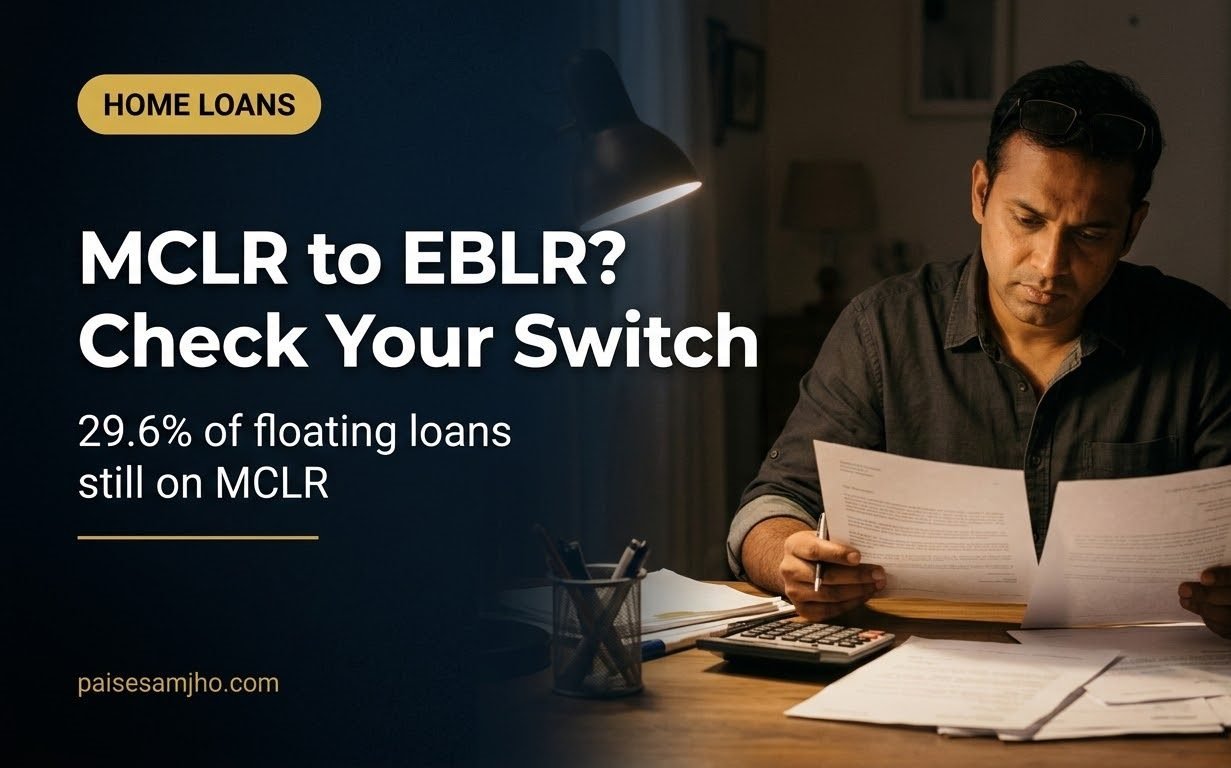
In RBI’s September 2026 data, 29.6% of all floating-rate rupee loans of scheduled commercial banks were still linked to MCLR at the end of June 2026. That is down from 30.2% at the end of March. External-benchmark (EBLR) loans made up 68.2%. The same release, published on 30 September, showed the median one-year MCLR falling to 8.61% in September from 8.70% in August. With RBI’s policy decision due on 7 October, borrowers still on MCLR face a choice they can act on at any time: an MCLR to EBLR switch.
This piece doesn’t predict the policy outcome. It explains how each benchmark passes on a rate change and what the rules allow when you switch.
Why the benchmark decides how fast your EMI moves
RBI’s (Commercial Banks – Interest Rates on Advances) Directions, 2025 (RBI/DOR/2025-26/161, DOR.CRE.REC.80./13.03.000/2025-26, 28 November 2025) set different reset rules for each benchmark.
| Feature | MCLR-linked loan | EBLR-linked loan |
|---|---|---|
| Reset frequency | “The periodicity of reset shall be one year or lower” (para 36), and it matches the MCLR tenor the loan is linked to (para 37) | “The interest rate under external benchmark shall be reset at least once in three months” (para 38) |
| Rate between resets | The MCLR on the disbursement date applies “till the next reset date, irrespective of the changes in the benchmark during the interim” (para 35) | Moves with the benchmark at each reset |
| Who sets the benchmark | The bank’s own cost of funds, reviewed monthly (para 24) | An external rate, such as the repo rate, chosen by the bank; one benchmark per loan category (para 27) |
| New retail loans | Not allowed. Floating-rate personal and retail loans “shall be benchmarked to an External Benchmark Rate” (para 25) | Standard |
A one-year MCLR loan reset in, say, March doesn’t pick up any change until the following March. An EBLR loan picks it up within three months at most. That works in both directions: faster relief when rates fall, and faster increases when they rise.
What RBI’s rules say about an MCLR to EBLR switch
Para 41 of the Directions covers existing MCLR, Base Rate and BPLR loans. Its first proviso is the key one for home-loan borrowers: floating-rate term loans to borrowers who can prepay without charges “shall be eligible for switchover to External Benchmark without any charges / fees, except reasonable administrative / legal costs.”
It also fixes the rate after the switch: “The final rate charged to this category of borrowers, post switchover to external benchmark, shall be same as the rate charged for a new loan of the same category, type, tenor and amount, at the time of origination of the loan.” Other borrowers “shall have the option to move to External Benchmark at mutually acceptable terms”. In every case, “the switch-over shall not be treated as a foreclosure of existing facility.”
Note the conditional “shall be eligible”. The right is yours to use, but the bank won’t switch you on its own.
Worked example: ₹40 lakh outstanding, 15 years left
Assume an older home loan with ₹40 lakh outstanding and 15 years left, at a one-year MCLR of 8.61% plus a 0.50% spread, so 9.11%. Assume your bank quotes 8.10% for a new EBLR loan of the same type and amount, and charges ₹5,000 plus GST (₹5,900) as admin cost. Both the 8.10% and the ₹5,900 are assumptions for illustration. Ask your bank for its actual figures.
| Over the same 180 months | Stay on MCLR (9.11%) | Switch to EBLR (8.10%) |
|---|---|---|
| EMI | ₹40,833 | ₹38,457 |
| Total outgo | ₹73,49,909 | ₹69,22,325 |
| Difference | ₹2,375 a month; ₹4,27,584 over 15 years | |
| Months to recover the ₹5,900 switch cost | 3 | |
If the gap is only 25 bps (8.86% versus 9.11%), the EMI difference falls to ₹595 a month, or ₹1,07,031 over 15 years, and it takes 10 months to recover the cost. The numbers assume rates stay the same for the whole period, which they won’t. The comparison shows the size of the gap, not a forecast. All figures are from scripts/calc.py.
From the banker’s desk: many MCLR borrowers we meet haven’t asked, because no one told them the option existed. If you ask, the first quote may be a higher spread than new customers get. The “same as the rate charged for a new loan” line in para 41 is the one to quote back.
When staying on MCLR can be reasonable
An MCLR to EBLR switch isn’t automatically the right move. If your remaining tenure is short, for example two or three years, the total saving may be small next to the effort and costs. If your current MCLR spread is already close to what new EBLR borrowers pay, the gap may be a few basis points. And MCLR’s slower reset cuts both ways: it delays relief when rates fall, and it also delays an increase when rates rise. Which matters more depends on where rates go next, and that isn’t something this data, or this article, can tell you.
A short checklist before you switch
- Find your benchmark and reset date on the loan statement or sanction letter. It might read “1Y MCLR + 0.50%, reset 15 March”.
- Ask for the new-loan EBLR rate in writing for your loan type, tenor and amount, and the full list of admin and legal costs.
- Check the spread. Para 31 says the spread on an existing borrower “shall not be increased except on account of deterioration in the credit risk profile”.
- Compare on the same tenure. Keep the remaining months the same in both calculations, as above.
- Keep the reset in mind. On EBLR, both a cut and a hike reach your EMI within three months.
Our earlier explainers on how a repo change moves EMIs and home-loan EMI and RBI rate moves cover the mechanics in more detail. If you plan to prepay instead, see home-loan prepayment rules. The policy preview is at RBI policy October 2026.
Two things this data can’t tell you: the RBI release gives system-wide shares, not how many home-loan borrowers in particular are still on MCLR; and what “reasonable administrative / legal costs” means in rupees is left to each bank. RBI sets no figure.
For now, the next step is simple: find your benchmark, then ask your bank one written question about the EBLR rate it would give you.
FAQ
Can my bank refuse an MCLR to EBLR switch on my home loan?
For floating-rate term loans to borrowers who can prepay without charges, para 41 says they “shall be eligible” to switch, with only reasonable admin and legal costs. Other borrowers switch on terms agreed with the bank.
Is a switch treated as closing the loan?
No. The Directions say the switch-over “shall not be treated as a foreclosure”.
Will my EMI change on 7 October if RBI changes the repo rate?
Not on that day. EBLR loans reset at least every three months, and MCLR loans reset on their own schedule, up to a year apart.
What is the median one-year MCLR now?
RBI’s 30 September release put it at 8.61% for September 2026.
Takeaway: if your loan is still on MCLR, ask your bank for the new-loan EBLR rate and the switch cost, then compare the two at your remaining tenure.
Citations
| # | Document | Paragraphs used |
|---|---|---|
| 1 | RBI (Commercial Banks – Interest Rates on Advances) Directions, 2025: RBI/DOR/2025-26/161, 28 Nov 2025 | 24, 25, 27, 31, 35–38, 41 |
| 2 | RBI press release 2026-2027/1224, 30 Sep 2026: Lending and Deposit Rates of SCBs, September 2026 | EBLR 68.2% / MCLR 29.6% (end-June 2026); median 1Y MCLR 8.61% |
Last verified 6 Oct 2026, 11:17 PM IST. Checked: RBI Interest Rates on Advances Directions, 2025 (rbi.org.in) and RBI press release 2026-2027/1224.