Re-KYC and Account Freeze: Why Your Bank Blocked Withdrawals and How to Get Debits Back
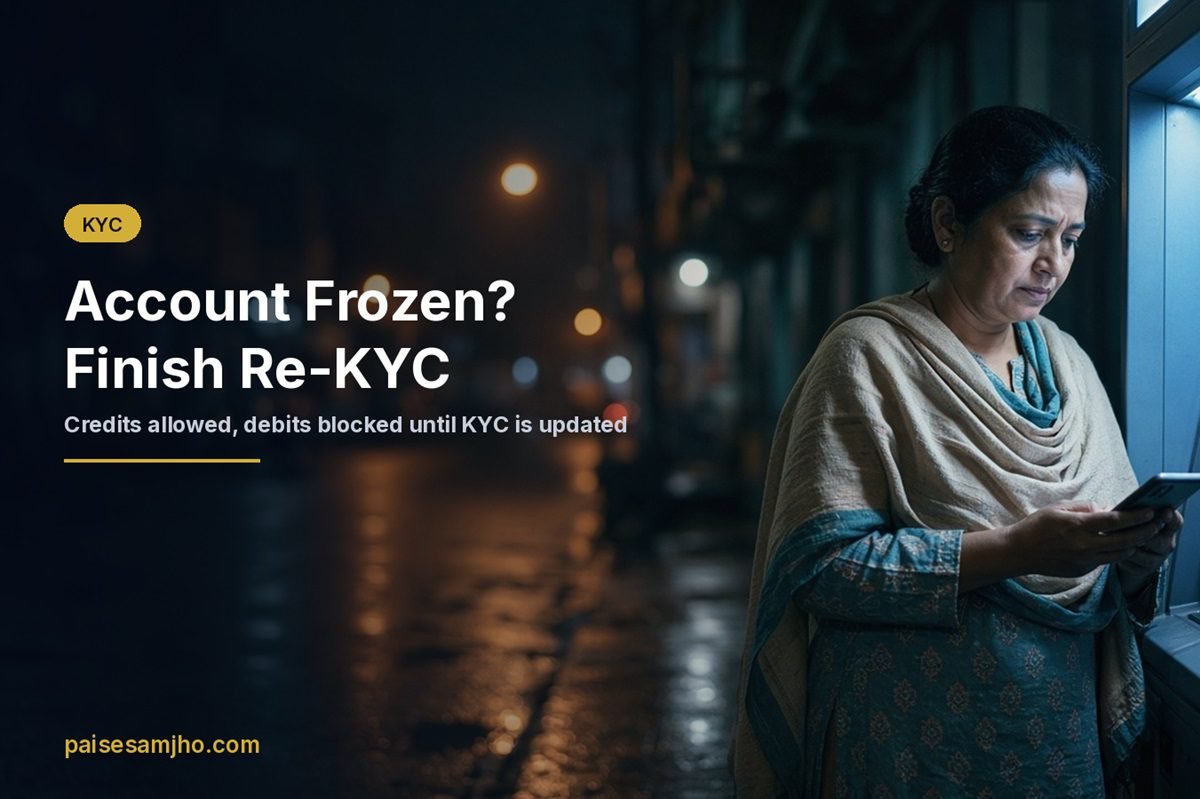
Farida Khan, 54, a school clerk in Lucknow, tried to withdraw ₹20,000 from her savings account in August 2026 and was told at the counter that debits were blocked. Her salary had been credited two days earlier without trouble. The reason was a pending re-KYC: her account, opened in 2015, had fallen due for a KYC update, and the SMS reminders had gone to a phone number she no longer used.
This guide uses Farida’s account to explain how often banks must update KYC, what notice they have to give, how a partial freeze works, and the quickest ways to get debits restored.
What re-KYC is and how often it falls due
Re-KYC is the bank’s periodic update of your identity and address records. RBI’s FAQs on KYC explain that “periodic updation of KYC records (at times referred to as re-KYC) shall be carried out at least once in every two years for high-risk, eight years for medium risk and ten years for low-risk customers”. The clock runs from account opening or the last update.
| Customer risk category | Re-KYC at least every | Farida’s case |
|---|---|---|
| High risk | 2 years | Not her category |
| Medium risk | 8 years | Not her category |
| Low risk | 10 years | Opened March 2015, so due March 2025 |
Banks do not have to tell you your risk category; RBI’s FAQ says “the risk category and reasons thereof are not required to be divulged to the customers”. Most salaried and pension accounts are treated as low risk, but a bank’s policy can require more frequent updates.
The notice a bank must give before acting
RBI tightened this in its KYC amendment of 12 June 2025. Before the due date, a bank “shall give at least three advance intimations, including at least one intimation by letter”. After the due date it “shall give at least three reminders, including at least one reminder by letter” to customers who still have not complied. The letters should include “easy to understand instructions for updating KYC, escalation mechanism for seeking help, if required, and the consequences, if any, of failure to update their KYC in time”. Banks had to put this in place by 1 January 2026.
The same amendment gave low-risk individuals breathing room. Banks “shall allow all transactions and ensure the updation of KYC within one year of its falling due for KYC or upto June 30, 2026, whichever is later”. For Farida, whose KYC fell due in March 2025, the later date was 30 June 2026. After that, her bank could apply the restrictions in its KYC policy.
| Date | What happened in Farida’s account |
|---|---|
| March 2025 | Re-KYC falls due (10 years for low risk) |
| March 2025 to June 2026 | All transactions allowed under RBI’s relief for low-risk individuals |
| Reminders before and after due date | SMS to an old number; one letter to her old address |
| After 30 June 2026 | Bank applies partial freeze: credits allowed, debits blocked |
| August 2026 | Withdrawal refused at the counter |
How a partial freeze works
The idea comes from RBI’s October 2014 circular on KYC non-compliant accounts. It told banks to give “due notice of three months initially” and then “a reminder for further period of three months”. After that, banks “may impose ‘partial freezing’ by allowing all credits and disallowing all debits with the freedom to close the accounts”. If the account is still non-compliant “after six months of imposing initial ‘partial freezing'”, banks “may disallow all debits and credits from/to the accounts, rendering them inoperative”.
Each bank writes the exact sequence into its own KYC policy, so the timing can differ. The pattern is what Farida saw: money can still come in, so her salary was credited, but nothing can go out, including UPI payments, ATM withdrawals, cheques and standing instructions. An EMI auto-debit from a frozen account can fail, which then shows up as a missed payment with the lender; our guide to what happens after a loan default explains why that matters.
A partial freeze for KYC is different from a debit freeze ordered by police or a bank’s fraud team in a money-mule case. Those follow other rules, which we explain in our report on RBI’s draft cap on debit holds.
How to complete re-KYC and lift the freeze
If nothing has changed, the process is short. RBI’s FAQ says banks can take a self-declaration where there is “no change in KYC information”, and also where there is “change only in address details”, through the registered email or mobile number, ATMs, net banking, the mobile app or a letter. A changed address is then verified by the bank “through positive confirmation within two months”.
| Route | Works when | What Farida needs |
|---|---|---|
| Any branch of her bank | Any time; RBI says re-KYC can be done at the home branch “or any other branch of the same RE” | Aadhaar or another officially valid document |
| Self-declaration through net banking, app, ATM or email | No change, or change only in address | Access through her registered mobile or email |
| Business correspondent (bank mitra) | No change, or change only in address | Biometric e-KYC at the BC point |
| Aadhaar OTP e-KYC or video KYC | Where the bank offers it | Her Aadhaar-linked mobile number |
Farida’s registered mobile number was out of date, so the digital routes were closed to her. She went to the nearest branch with her Aadhaar card, updated her mobile number and submitted the self-declaration. RBI says the bank must acknowledge the submission and, once records are updated, “shall also intimate customers about such updation”. Debits are usually restored once the update is recorded; ask the branch for the expected time and get the acknowledgement on paper or by SMS.
If your documents have changed, for example a new surname after marriage, you will need a fresh officially valid document. Keeping Aadhaar details current helps here too; our guide on linking PAN with Aadhaar covers a related check that banks rely on.
Can a bank reject your re-KYC?
It can, but not by software alone. RBI’s FAQ says “the decision to reject the application of KYC/ periodic updation of KYC shall not be automated and such decisions on rejection shall be reviewed by an official of RE authorised for the purpose.” If a branch refuses your documents, ask for the reason in writing and escalate through the bank’s grievance channel.
Accounts that stay non-compliant can eventually be closed. RBI notes that the money-laundering rules allow banks to obtain identity records and, failing that, “the RE shall close the account of the customers after giving due notice”. Closure is the end of a long process, not the first step.
Watch out for re-KYC fraud
Fraudsters use KYC deadlines as bait. RBI’s FAQ warns customers to “exercise utmost caution before clicking links embedded in such SMS/ email as these may be suspicious/ fraudulent”. A genuine reminder will tell you to use the bank’s own app, website or branch. No bank needs your OTP, PIN or a screen-sharing app to update KYC.
Open questions about re-KYC freezes
- RBI’s instructions do not set a deadline for restoring debits after a customer completes re-KYC, so the wait depends on each bank’s process.
- RBI has not published how many accounts were partially frozen after the 30 June 2026 relief period ended.
- Banks’ internal KYC policies, including the gap between a partial and a full freeze, are not published in one standard format, so the timelines can differ from the 2014 pattern described above.
Most KYC freezes start with a reminder sent to an old phone number, so checking the mobile number your bank holds is the first step.
FAQs
My account is frozen for KYC. Will my pension or salary still come in?
Under a partial freeze, credits are allowed and debits are blocked, so incoming money is accepted. If the bank moves to a full freeze after a further period, credits can also be stopped, so update KYC quickly.
Do I have to visit my home branch for re-KYC?
No. RBI’s FAQ says it can be done at any branch of the same bank, and banks also accept self-declarations through digital channels and business correspondents where there is no change in details.
How do I know when my re-KYC is due?
Your bank must send at least three advance intimations, including one letter, before the due date. You can also ask the branch or check the KYC status in net banking, where many banks show it.
Disclaimer: This article explains RBI’s KYC instructions in general terms. Your bank’s KYC policy sets the exact timelines and documents for your account.